Pictures or Words?

Already some people have indicated their gladness because I put a marker across my posts if I’m going to show a few medically mild photographs. We all have different backgrounds but I’ve been thinking a bit lately about this issue. I wonder what people do when watching a news presentation about rioting or some natural disaster or catastrophic event and a nasty scene comes on. Do they immediately turn them off? Is it possible or wise to hide from these terrible realities?

Thinking again, I wonder if more damage is done by what enters the mind via the eyes or through the ears. Reports of the political discussions about the very abnormal sexual behaviour being accommodated, or the legal destruction of life, both at its beginning and its end, entering the mind by reading or hearing, in my thinking, immunises minds against truth. I’ve read of high school kids being expelled for insisting that there are only 2 sexes. I personally think the authorities should be expelled.

Some may explain me away as a psycho-pathological religious nut. But it is they who are forsaking science for emotive who-ha. Please don’t think that I’m totally naive.

I had a young trainee Orthodox priest come to me with his penis halfway severed through because he, as a normal young man, was having difficulties balancing normal human reactions to the monasteries insistence on celibacy. He was trying to cut off his problem.

I’ve had to deal with a pre teenage child brought up as a girl but with strong desires to be male. On examination he had testicles but a grossly deformed penis, and no female organs. I won’t show you the pictures, which I have.

I’ve had to deal with a young man who often had meals with us, who as Orthodox got a Muslim girl pregnant. He was too terrified to tell his father so he used me as a listening ear. I said if you want an abortion you’re talking to the wrong person. He replied that neither he nor the girl wanted that. They had obviously discussed it. We had good talks, but in the end I said he had to talk to his father but that I would go with him. I had discovered that he was the illegitimate son of his father, but had been brought up with the family’s other children by the father’s wife and treated as one with the other kids some older, some younger than him. 

The father booted him out of the house and stated he never wanted to see him again. We cared for him until the ‘mother’ persuaded his father to take him back some weeks later. 

The girl was not prepared to meet me, but the young man and I had input with her. She, too, was unprepared to talk with her family. He could have remained quiet but she had an expanding reason to do something. So while her father was away she spoke to her mother who demanded that she have an abortion. The mother explained that her father would kill her if he ever found out that she was pregnant and particularly to an Orthodox boy. Eventually she was, very tearfully, dragged off to the local American run abortion clinic and the child’s life terminated.

Am I being judgemental in discussing these things? I guess the answer in some ways is ‘yes’. Are there many things with which I disagree? Celibacy should be chosen not forced; a decent look at the child could have seen testicles and no vagina; he explained that he had erections but although everything became hard nothing stood up except for an intense C-shaped thing; intecourse runs the risk of pregnancy – so although not uninformed the pair were stupid. I would say that intercourse is intended to be within marriage but I recognize that is an unpopular concept these days. However, the knowledge of pregnancy prevention is well known and easily obtained; I can’t understand the parents behaviour on either side. Am I judgemental? Maybe, but I sought to help without verbalized criticism to anyone except for the young man, who was like a son to me. Certainly I didn’t reject him.

I loved treating kids. Under the line are some of my ‘kids’. I challenge you to look at them and see them as real people! You will see some dressings but no open wounds.

Continue reading “Pictures or Words?”
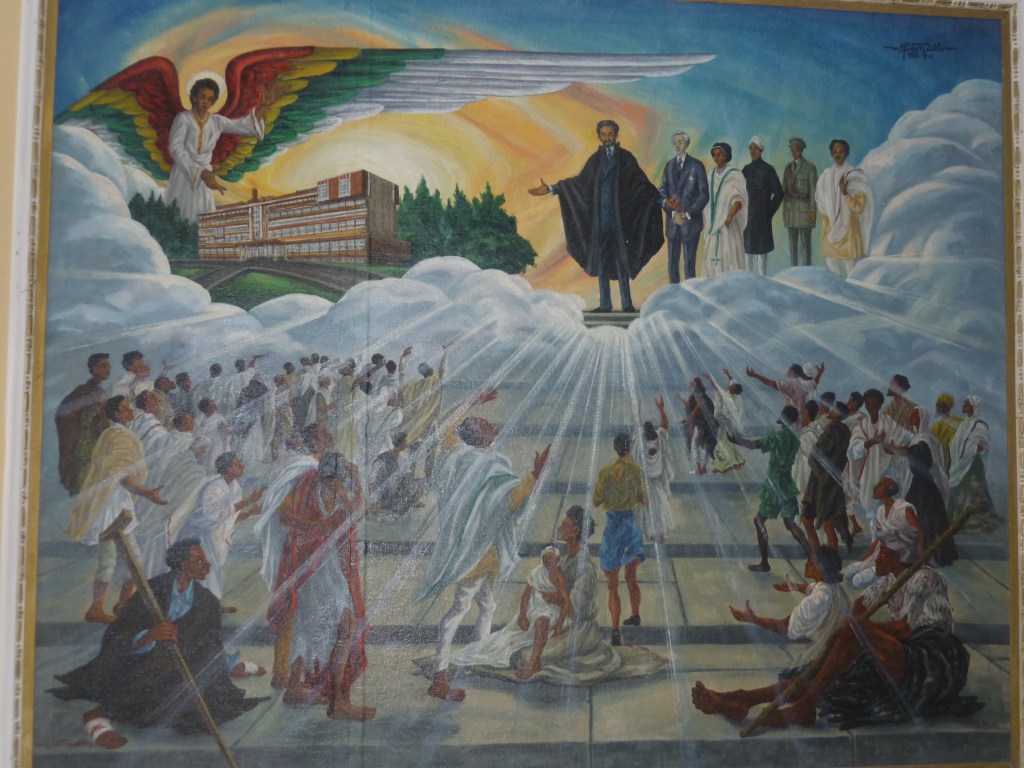
Haile Selassie – a slide discovered.

I’ve mentioned Emperor Haile Selassie in previous posts. I’ve met him, liked him and thought that he did a lot to help his country advance. He created an elected government with partial power. I think basically as an advisory body; he gave up a palace to open the country’s first University; he was very cooperative with foreigners in the country, who were there to help with education and health etc.

He was put under house arrest when the Derg arrested him and took over power. A bit later he had prostatic surgery and was doing well. He was seen on the day before his death by the Professor of Medicine (who had looked after me when I had heart problems) and was declared fit and progressing well. The next day the Professor was ordered to sign a death certificate. I presume he requested a post-mortem, because of his good health the day before, which was denied, and within a couple of days the Professor was dead, and nobody knew where the Royal remains were.

Years later, after the Derg was overthrown, the truth came out. He had been suffocated with a pillow and buried five metres under Mengistu HaileMariam’s desk. Mengistu was the Derg leader. His remains were dug up and buried with much pomp and ceremony in the church where his Majesty had regularly worshipped.

I could say a lot more very interesting stuff about him but I came across a slide in my present cataloging mania. The background to it is interesting, or at least it is to me.

The emperor, in his care for the very poor, had a hospital (Kidus Paulos, St Paul’s) built for the free treatment of the very poor. In the the foyer there was a beautiful mural painted in his honour. With his overthrow his followers felt that the Derg would certainly destroy the mural. So they rapidly but carefully had a false wall built to cover it. The wall wasn’t discovered by the Derg.

After the overthrow of the Derg, when I returned to Ethiopia, I was appointed to Kidus Paulos and was there when the false wall was pulled down. Hence the picture below.

There are some very interesting things about the mural.

  • He was a short man but he is the tallest in the picture. There is a foreigner in the line up of dignitaries and the medical advisor to his government was a Scandinavian.
  • The hospital building looked just like it is painted in the mural.
  • The angel has its wings painted in the Ethiopian flag colours, but interesting in that the order is reversed. Usually the green is on top. In times of war they are reversed so that red is on the top.
  • It was the sunrise of a new era of caring for the poor and the crowd is obviously ecstatic.

Dominic Cartier

Who deserves or wants praise.

Getting old, if nothing else gives you time to think. Someone very generously nominated me for an Australian medal, and justifiable or not, it was granted to me. Twice I’ve been nominated as Australian of the Year, but I didn’t by a million miles deserve it and didn’t get it. Perhaps what I cherish most is a simple piece of paper which my medical students gave me when I was retiring.

So what am I really writing about?

We had the chance to listen in on zoom to a funeral this week. The funeral of an old lady who died at 96 in an old folks home, well cared for but at the end separated from her family because of the Covid precautions, except for daily visits by her husband. She did not get the disease. She had written a book about her experiences, which I had enjoyed, but the funeral service was a great reminder. Her husband outshone her in the eyes of the world in which they lived, or so it seemed to me. But as I listened to the service, heard the eulogies and then watched the slide show, I couldn’t help thinking that she deserved an AM much more than I do. As a child she only had an education up to grade three, but then as a young adult went on to become a triple certificated nurse. Became a nurse in the back blocks of Ethiopia, raised a family of four and still managed to achieve what I mention below. There are now tens of thousands of women emancipated and brought into real liberated life, in the Omo Valley region of Southern Ethiopia because of her work amongst women in the churches which were founded through the work of her husband and others. You could almost envisage a halo hovering above her coffin. She was a great lady.

Or I remember bringing a young down-country teenager who had never played a musical instrument, nor ever even seen a piano, into a room where a lady was playing beautifully. He listened in amazement, and when she left he went and sat down at the piano and played with the notes. Minutes later he was playing the tunes of the local songs he knew from his countryside background. Amazing – to me, who occasionally while singing accidently hits the correct note! What talent. I remember a visiting doctor friend saying that he wondered how many young geniuses were lying with bare bottoms up to the sun just watching a few animals.

Or now we have a young man (at least 25 years younger than me) living with us so that my wife and I can remain living on our little farm. He’s very naughty because he does lots of things that he doesn’t have the pieces of paper which the government want tending to confuse them for ability. He fences, builds roads, adds a patio, builds a small kitchen and replaces cracked walls inserting windows to bring light into a darkened area, puts in electrical points, answers all my questions that I need answered to keep my computer working, and many other things. But no one employs him because all of his Tertiary degrees (4) are seen as impractical. They are linguistic and theological and not seen as practical. His wife left him, so some denominations have taken away his licence to preach; others are so liberal that he cannot sign their bases of belief.

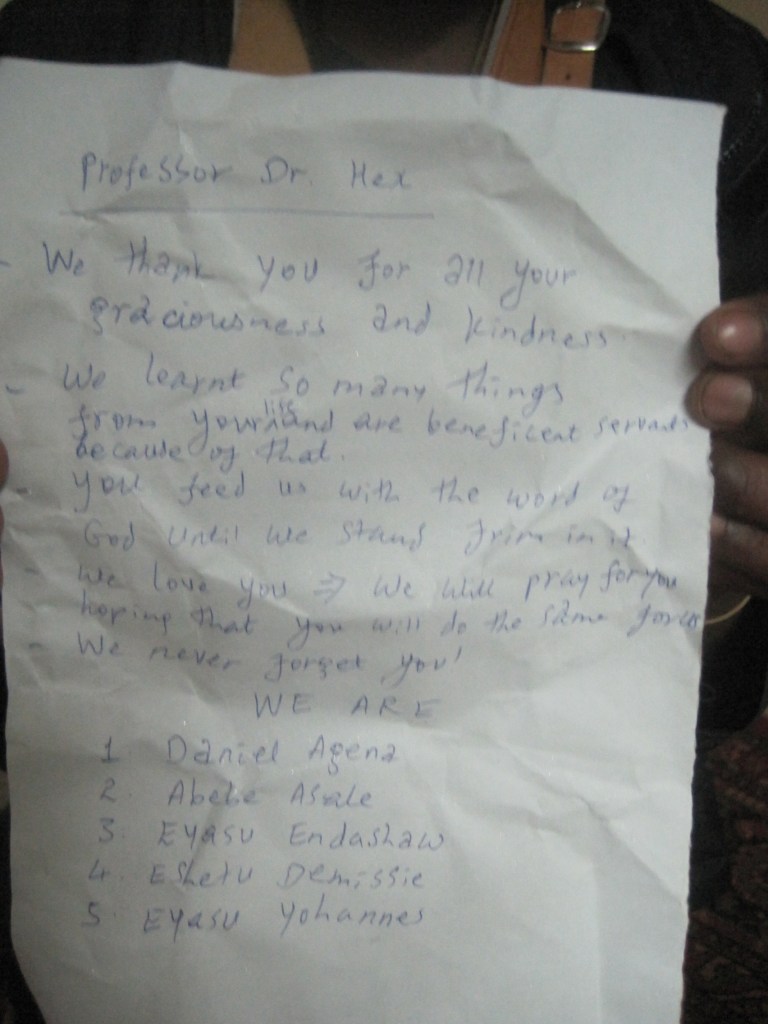
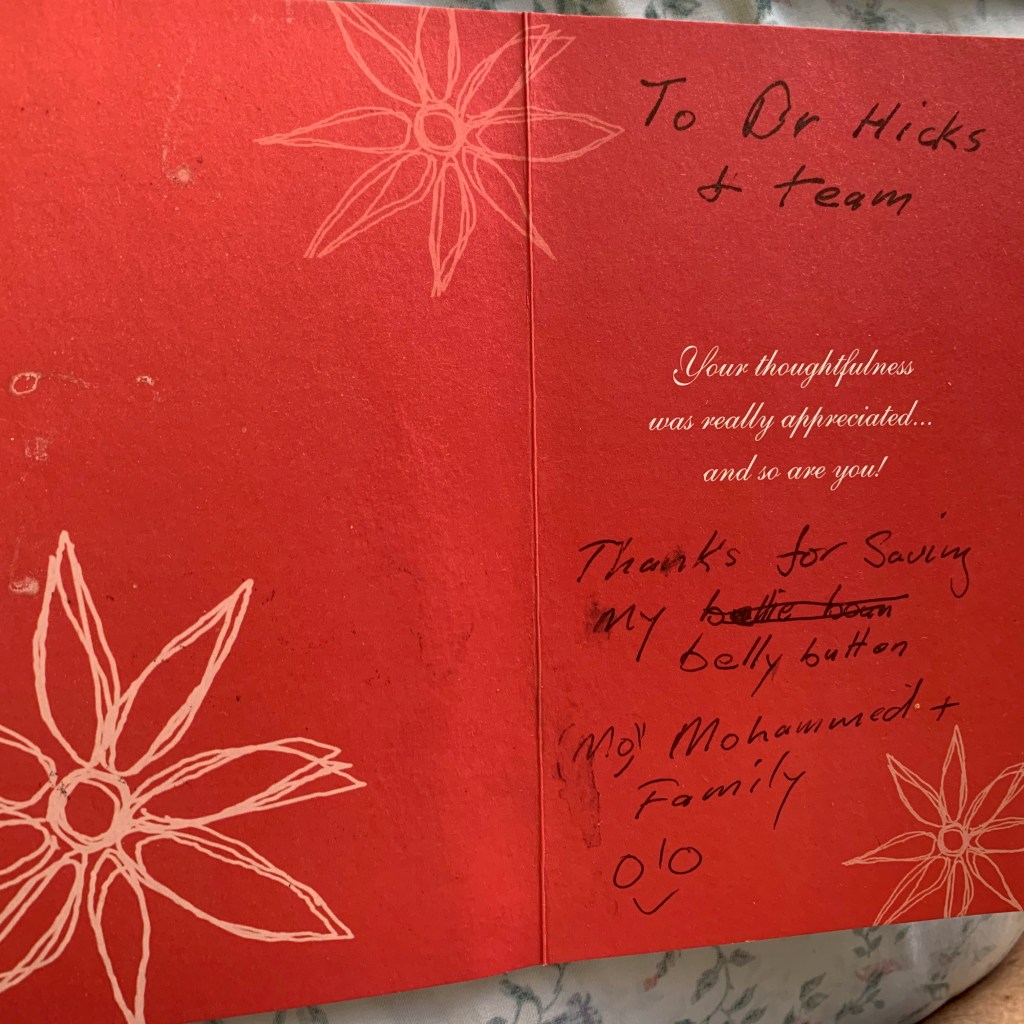
Among my slide sorting I have come across two pieces of paper which give me more joy than the several accolades which I have been given. I share them with you.

The undersigned were all final year medical students, who asked me in addition to teaching them medicine to give them some Bible teaching. You may be able to understand why sometimes I found their English a bit difficult.

They are more important than this…

There were a number of expatriates, mainly from India and the Philippines, but I was the only white person in the department of health and there were only two of us on staff in the University. Arba Mintch University had 39,000 students in 2018. The hierarchy of the University were very gracious to me but the words of a child patient and of 5 students mean more to me. I’m not ungrateful for the several go away functions and the gold medal, but a patient’s or a pupil’s thanks is worth so much more.

Dominic Cartier

I couldn’t sleep

Counting sheep didn’t work. Playing games on the iPad only woke me up. I took 2 sleeping tablets – didn’t work. Asked God to let me nod off, but it only brought some old sayings which I love into my head. So here they are.

It’s better to be a live dog than a dead lion.

Living lions are pretty majestic but dead what are they? Rotting carcasses, taxidermist specimens, mats on the floor or draped over someone’s shoulders to make them think they’re important. My dogs keep the wallabies out of the garden, lift up my hand when I’m trying to type to be patted. My wife says that I mustn’t feed them at the table but they put their heads on my thigh and look up so pleadingly. I guess Solomon may have had a deeper meaning about useless and useful living but I just think of my dogs – so many of them over the years, playmates as kids, guard dogs in Ethiopia, now just friends!

A nagging wife is worse than a dripping tap.

I’m so glad my wife doesn’t let the tap drip often. I guess living years ago Solomon got away with his sexist proverb! I love the story of the American Indian who called his wife ‘Three Horses’. Eventually someone asked him why that name. ‘It’s simple’ he replied ‘nag, nag, nag!’

I had a Rumanian Plastic surgeon with whom I did lots of deformed chest surgery (pidgeon and sunken chests etc.) He had 2 sayings which I will never forget. He had escaped across the iron curtain.

  1. Doctors are like horse manure – spread them out thinly and they fertilize the community, put them in a heap and they breed worms and stink. Remember I’m a retired doctor but the fees some specialists charge these days make me angry.
  2. People think dying is the worst thing that can happen, but failing to do what you know you should is much worse! I tie this in with a statement of Jim Elliot, who died doing what he thought he should and his death achieved great results. He said He is no fool to give that which he cannot keep to gain what he cannot lose’.

Better to remain silent and be thought a fool, than to open your mouth and prove that you are! I think one needs to earn the right to talk about certain things. James, the brother of Jesus, wrote ‘you talk about your faith, I’ll show you mine by the way I live.’ Talking is necessary but can be so hollow!

Almost every night I get an SMS message from one of my sons I love you dad!’ and all my kids are very caring and expressive of their love. I fell to sleep, hearing softly in my mind, as my prayer was eventually answered, ‘And I love you son!’.

Dominic Cartier

Walking Down Memory Lane

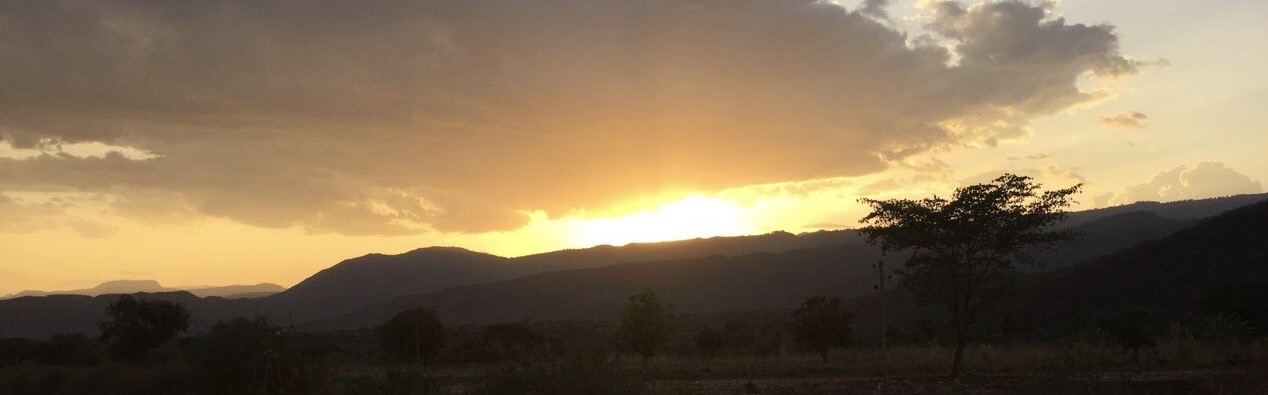
African sunset

I try not to just live on memories. But I sleep a lot; walk slowly with a stick; or if the family goes out together they take me in a wheelchair to speed things up. I still can think clearly (or so I think) and I don’t find it easy to hand over all the control to a son who does almost everything about the place. He’s gracious and I’m trying – maybe in two senses of the word!

But memory lane is mostly pleasant to walk down. I’ve been transferring slides and photographs onto my computer and it has been a bit tedious but full of memories. Here are a few of them.

OV dams from hill copy

I used to own much of the land seen in this photo, but most of it is now sold. Some of the money enables us to live, but much has been invested in lives in Ethiopia. Those lives are very pleasant to remember and the memories give great joy. Some were sick; some were destitute; some needed education, but all were real people, and needed loving. Not always emotional love, but rather helping love. Some are dead already, I guess, but the money and effort was not wasted.

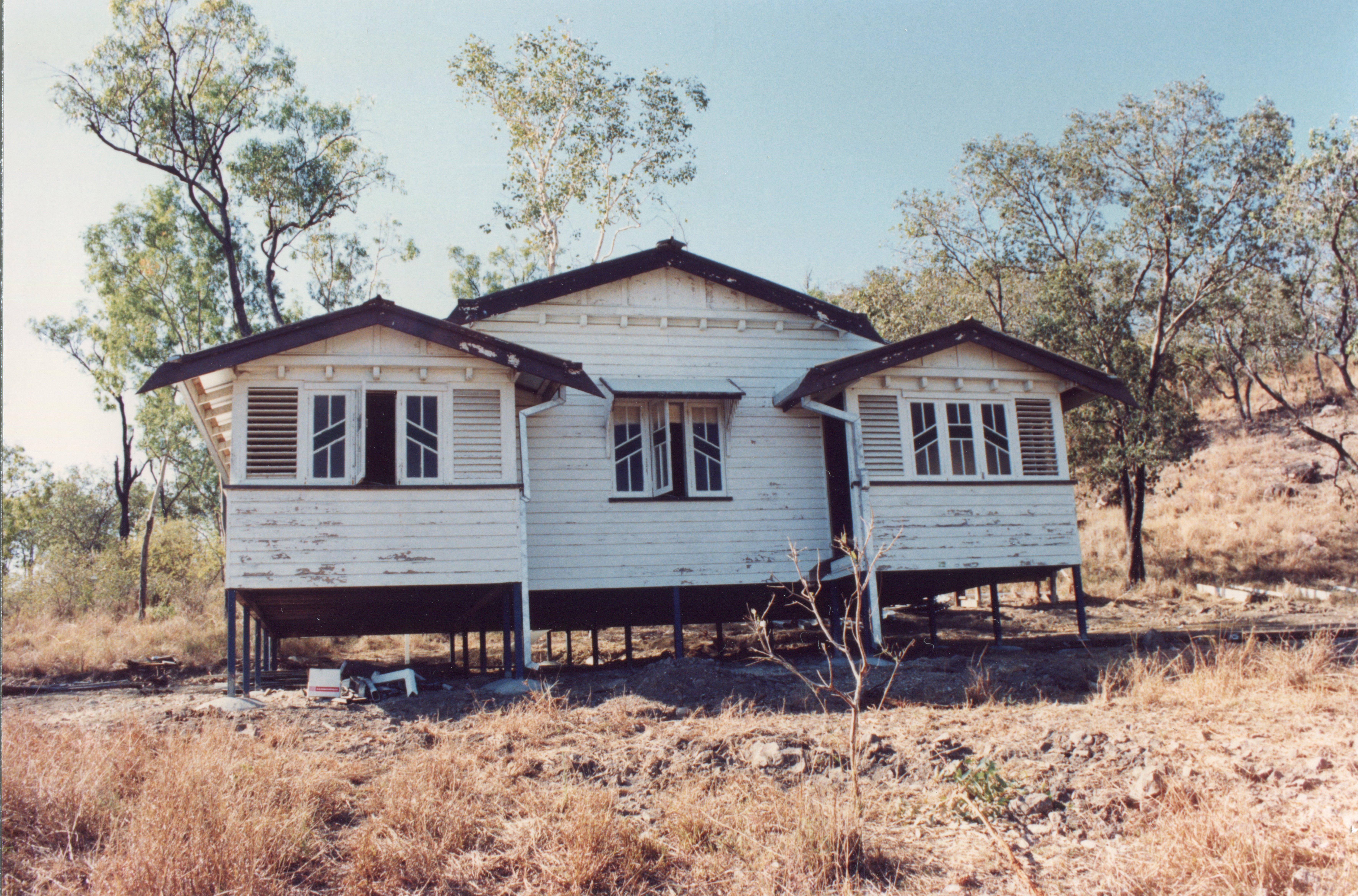
OV house 1 copy
When I was in Australia for several years, about 35 years ago, I bought this old house for $3,000 and we had it transported. It still stands today looking much better and surrounded by trees. 

My computer collection of pictures begins from over sixty five years ago. I didn’t get a camera until I was in my older teens, so although there are a few photos of even great grandparents, mostly the photos start from when I met an amazingly beautiful young teenager. I started to ‘chase’ her from the day I first met her! We will have been married for fifty eight years come December. I’ve got about two thousand more slides and many photos to go through. What a lot of memories still to come!

street huts copy
Sorry about the focus, but these are the street huts people were living in on the street opposite the main government hospital in Addis Ababa.

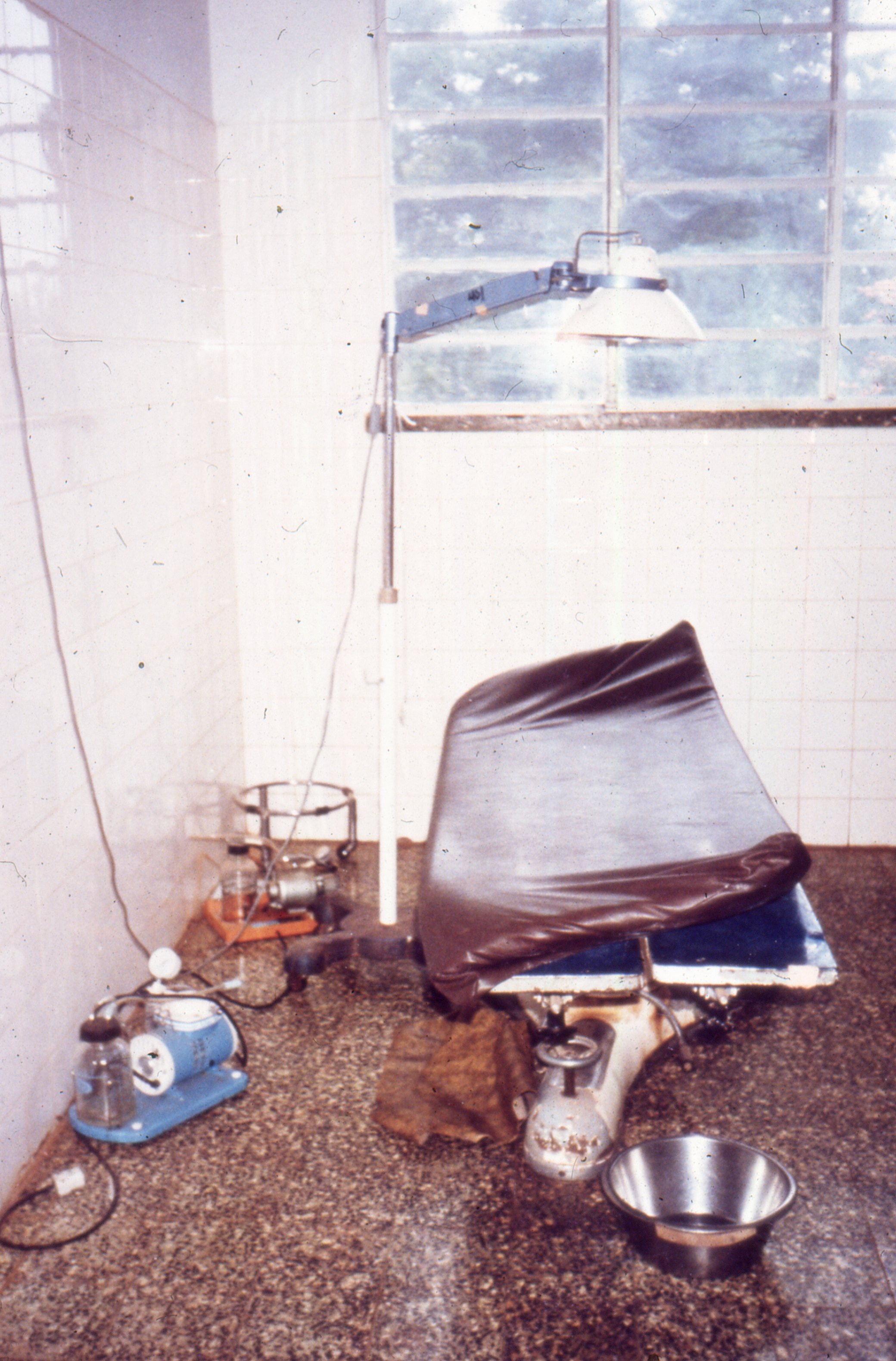
Eth OR 01 copy
And this was one of the operating rooms that first greeted me in 1994

a day's operating copy
This is a list of one day’s emergency surgical admissions. The writing is terrible, but listed below it reads disease-wise ….

appendicitis; intestinal obstruction; intestinal obstruction, volvulus; acute appendicitis; Peritonitis from perforated duodenal ulcer; appendiceal abscess; stab wound to the abdomen; rectal fistula; oesophageal cancer; penetrating abdominal knife wound. Most of these would have needed surgery the same day except the oesophageal cancer which would need work up and time.

Yakob copy
As a baby I found him, deserted,  being swept around on the floor of the paediatric ward.

Now he has a tertiary education and this should mean a satisfying life.

Money is useful if you use it wisely. Memories are more precious!

Dominic Cartier