A day in the bush

I had an appointment to see my doctor yesterday morning. In conversation I mentioned that my wife and I, in spite of our age and my walking difficulties, intended to continue living where we do, some kilometres outside the city limit on a small 40 hectare (100 acre) property. We live upstairs with a grandson and  two of our sons live downstairs in a granny flat. The doctor laughingly declared us ‘mad’ as there is so little to do ‘way out there’.

It made me think of what  happened here yesterday. Was he correct in his statement? As I said earlier, we are five at the moment – my wife and I, 2 sons, one in his mid 50s and one in his early 20s and a grandson a few weeks older than his young uncle. So I’ll try and list what happened in this out-of-the-way, boring place.
IMG_2458
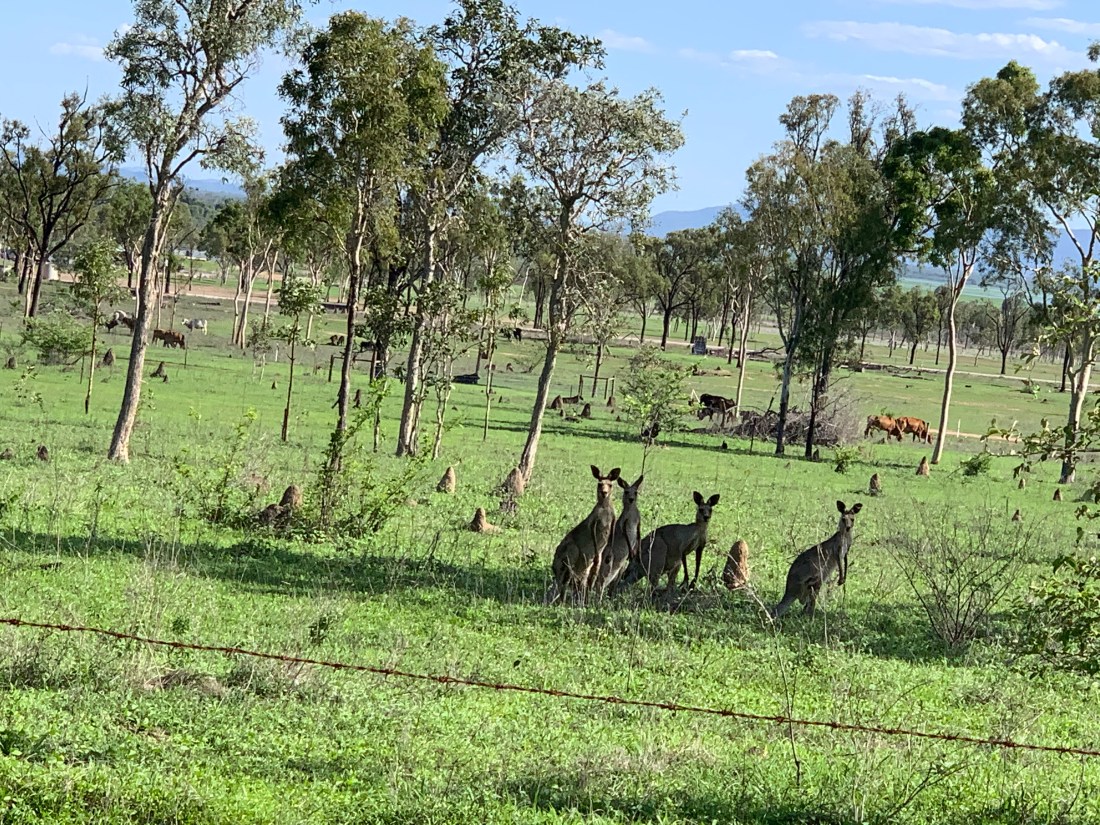
We like what our neighbours look like.

My wife and I, in this cold spell, slept in a bit late. Excusable I think at our ages. Then she got up and worked in the garden for a while, while I did a bit of clearing around the inside. We both went together to my doctor’s appointment as she likes to check that I tell him everything. But she wasn’t let in because of social distancing, only the patient could enter the waiting room. So instead she went window shopping. The doctor had been one of my interns when I was director of surgery here so my visits are always interesting. He decided that I was still alive and I left with a few renewed scripts.

My wife was waiting at the door and led my off to buy something she had seen, for our kitchen. Having made the purchase, we were on our way home when she realised that she had left my prescriptions on the desk when she had paid for the new ‘thingamebob’. So we returned and while she went inside I had a call from our older son asking us to buy some masking tape for his painting job. So we had a trip to the hardware store. We got home just in time for lunch; then

  • I worked on the revision of a small book I wrote a few years ago for the medical students in Arba Mintch. It’s taking a while as now I’m planning a wider distribution, probably as an e-book.
  • my wife replied to email notes and wrote letters.
  • I had a return call from my tax man, which didn’t give me the answer I desired. C’est la vie.
  • I received a quote for a lift to help me up the stairs; I don’t like the idea but getting up and down them is getting harder. Not cheap but maybe necessary.
  • We got an email electricity bill. Our new solar system has cut two thirds off the last bill.
  • We had a lovely email from the mother of the adopted little baby about whom I wrote a post earlier. A baby is born
  • I had a discussion with the sales person about a water pump. I need to get water pumped from the dam to our house – about 500 metres, but fortunately over pretty flat ground, so there is not a great height to lift the water. It’ll need to be sorted out soon if we want to keep some green grass around the house.
IMG_2504

  • Then my wife took our grandson for a driving lesson. He has never wanted to learn but if he is going to live here he’s going to have to become independent, we can’t spend the time taking him everywhere he needs to go.
  • My older son and our grandson spent most of the day painting. Then our son went to do some basic preparatory work to prepare for a fencing project starting with our neighbour on Saturday, on a boundary fence.
  • Our grandson  spent hours after the evening meal writing music. He’s good at it and beginning to get some sales now.
  • Our younger son is an apprentice mechanic so he spent his day at work. When he came home he did some work renewing the thermostat in our farm Patrol vehicle.
  • After the evening meal, a short Bible reading and prayer. While the others scattered to their various activities I sat down to watch the next episode of Judge John Deed. I don’t think much of his sex life, but appreciate his stand for justice.

So Doc, I think there’s enough to do here! Maybe if we moved to town we’d be bored!

IMG_2465
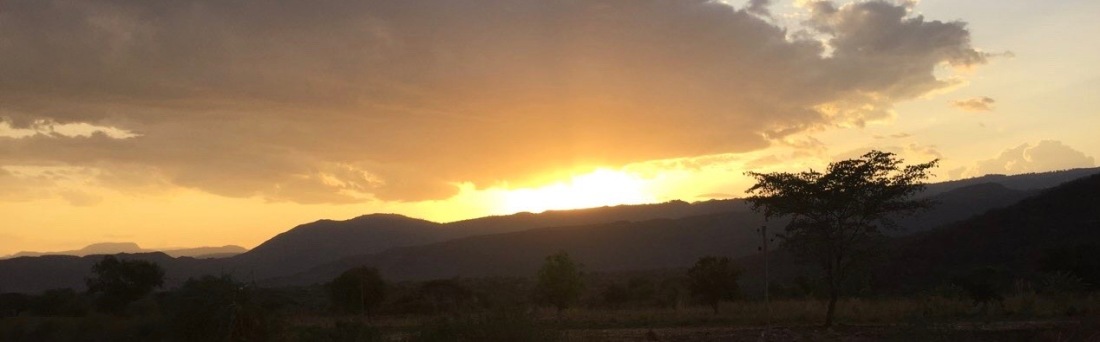
We like the morning and evening ‘paintings’

Dominic Cartier

DEALINGS WITH THE LAW

IMG_3034

Relationships with the law aren’t always easy. To quote the old saying “the law is an ass”. Yes it is, but no it isn’t. I think you know what I mean. Sometimes sticking to the strict letter of the law seems crazy, but I won’t follow that line any further.

I have three episodes at least of disagreements with law authorities in Ethiopia. There is a fourth more complex one that I may tell you about sometime, but not today.

In the first, the ‘traffic’ as they call them stopped me up in Addis. There you drive on the right. Coming to a corner where there were four lanes travelling each way I wanted to turn left. I wanted to cross in front of four lanes. Those coming in the other direction had a stop light. In the past, two lanes had been allowed to turn left, but, unbeknown to me, the rules, the law, had changed – now, one only could turn. So, doing what I thought I knew was right, I turned from the now illegal lane and was whistled over by the ‘traffic’.

As a bit of background, if fined in Addis they take away your licence, give you a fine slip, you immediately go and pay the fine, then come back to the same person, show your receipt and get your licence back. By then the person with your licence may or may not still be there. Or you can pay a bribe, which I am not in the habit of doing.

The guy asked for my licence. Resisting the temptation to tell him that I drove without one (I did have one) I simply said ‘no’. I think it shocked him a bit. ‘Why not?’ I was asked, ‘don’t you have one?’. So I explained that I did but that I knew how fines were handled, that I had a 500 km trip ahead of me and I wanted to be on my way. And, without stopping for him to get a word in, I asked if he had ever done wrong and been forgiven? Again, without stopping, I said that I knew that I had accidentally done wrong, and ended by saying ‘please forgive me!’ He smiled, looked at my licence which I had slowly taken out, and he waved me on. Nice guy!

A patient was brought to our hospital from the prison with a broken thigh bone (femur). We were ordered to treat him. It turned out that, according to him, ‘they’ at the prison had broken his leg. We did not have facilities to put in an intramedullary* nail which would have allowed him to walk in a few weeks, so he was put up in traction. Those bones heal slowly and usually need about three months to heal properly. I think the guy preferred our bed to the prison. Less than a week later the prison guards were there to take him back to prison. After a long and fairly heated discussion they left, without the patient, but with my promise that if they returned with an official letter stating that they would take him to the police hospital in Addis, I would fix him in such a way that he could travel the 200+ km to get there. It didn’t take long for them to get the paper. I knew that, as they drove out from our hospital, if they turned right they were going to Addis, if they turned left they were not. They turned left.

I was only about 30 in the late sixties. Maybe I was young and foolish. Not long before an important person had been involved in an accident near the hospital. Having treated the injured, I had been requested to write a legal report as to what had happened. The report obviously didn’t please the wealthy guy who had caused the accident. So, a policeman arrived in my office and offered me a considerable bribe if I would rewrite the report according to his suggestions. Maybe foolishly, but with great satisfaction (he was not a big man) I picked him up by the scruff of his neck and the seat of his uniform and threw him out the door. I am thankful that I heard no more, as I suspect I was right to refuse but wrong to do what I did!

* intramedullary nails were first used in WWII to allow the Germans to rapidly mobilise prisoners of war who had broken femurs, for example, pilots who had parachuted out of their planes. This concept is used a lot these days.

Dominic Cartier

It’s cold and wet…

African sunset

It’s cold and wet , and I’m not feeling so hot today. Therefore I thought I’d take a look through the last couple of weeks photos from around our house. You may find them interesting.

IMG_2837
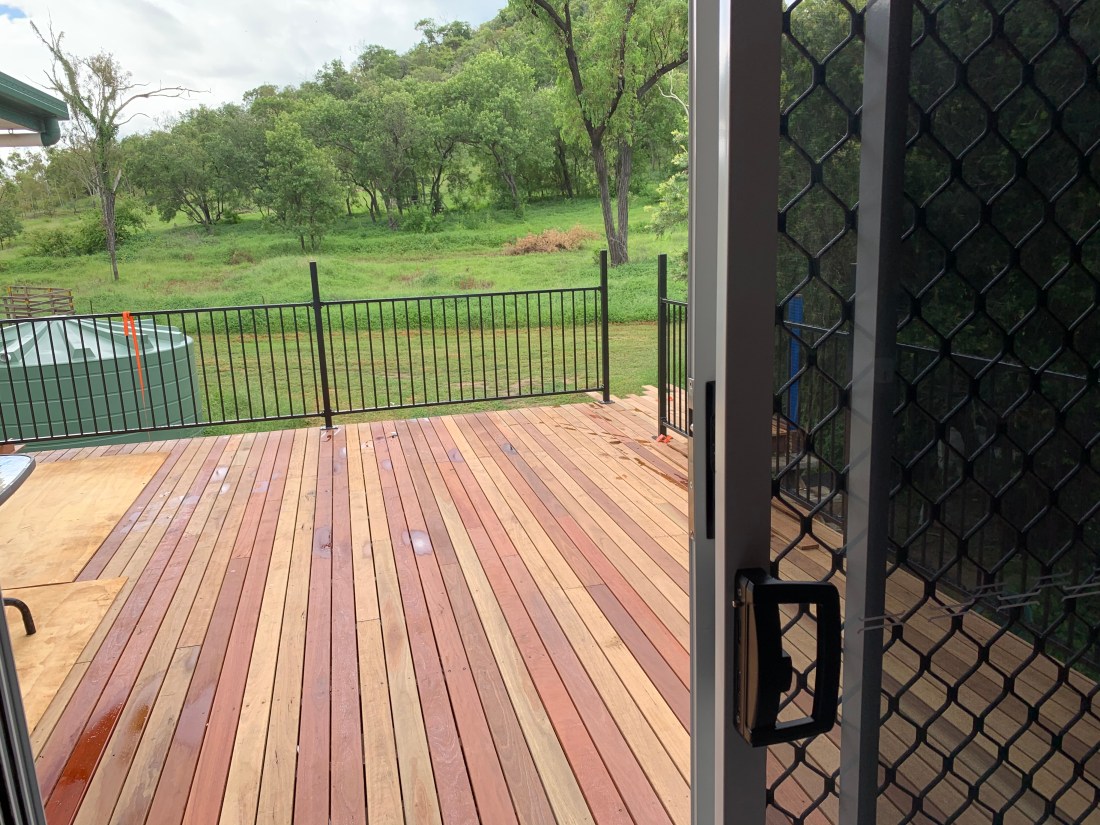
Looking through a new sliding door which our son had put into the dining area, onto a patio which he had just built. A very handy son to have around the place!
IMG_0366
Looking West from the patio.
IMG_0396
We just discovered a patch of white ants in the kitchen floor. Another job for our son and fixed already. 
IMG_0406
He gets to do a lot – here trimming the tops of the Japanese Bamboo which had got to about 8 metres!
IMG_2935
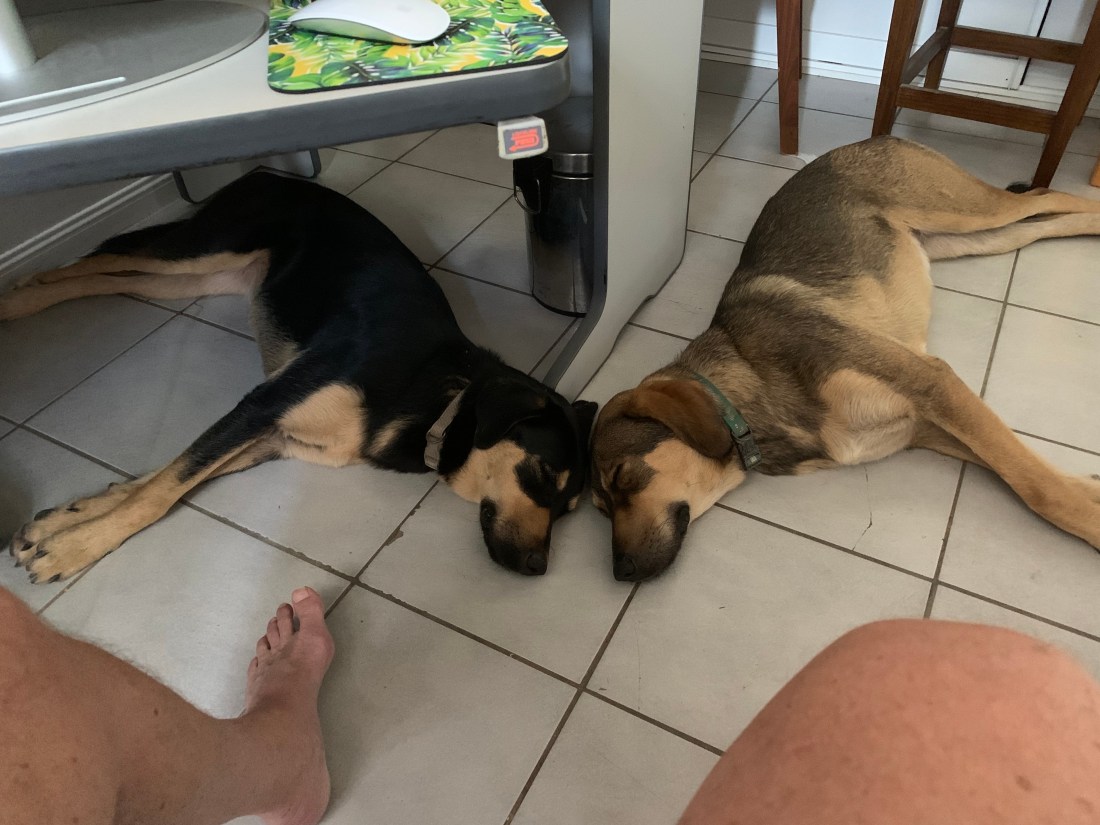
These two pups (about 7 months) are sisters from the same litter. I hadn’t realised that in dogs you can get multiple fathers at the one dropping. They love sleeping at my feet when I’m in my office! The mother was a German Shepherd. One part kelpie, the other 2 parts shepherd.
IMG_3021
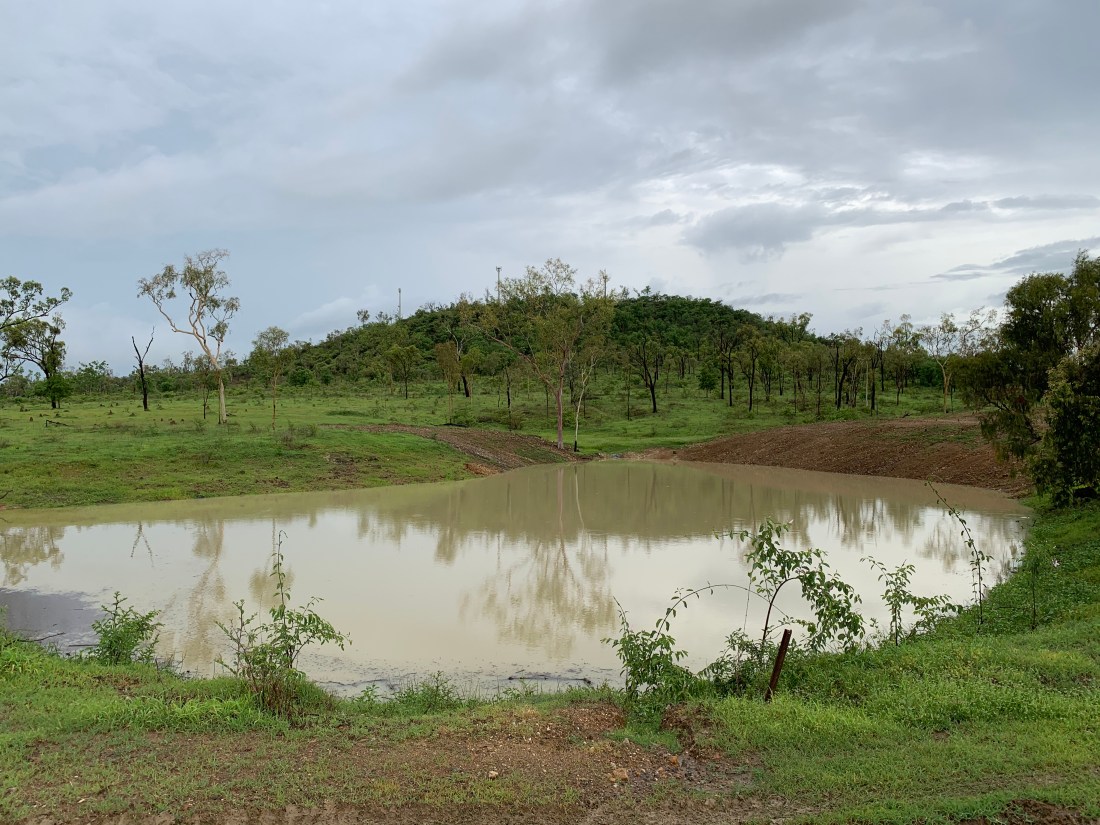
This dam leaked badly. Another job for the son with a friend, spreading polymer. This absorbs water and sinks taking fine mud particles with it. It seems to have worked but with the recent rains we’ll have to wait a while to be sure.
IMG_3034
I am back to front, or maybe top to bottom, as this is a sunrise taken from the patio shown above. We live in a beautiful spot.

Hope you enjoy it

Dominic Cartier


What do you think?

African sunset

I have a friend, an African friend, who did his medical training in Russia. I don’t think that he is a liar. He told me that when he was there, not infrequently, as he walked on the streets, he would feel people checking his lower back to see if he had a vestigial monkey tail. I have not checked for myself, but I know that he has an excellent brain! You probably think that in the twenty first century this behaviour is unbelievable. And yet almost all educators of today are teaching that we have come from monkeys. So why not test the theory?

You probably know the story of the little girl who asked her mother where humans came from and got the ‘God story’. She later asked her father the same question and was given the ‘monkey story’. At the evening meal she accused someone of lying to her. Her mother replied that she had given her the story of her, the mother’s, own family, and that the father had given the story of his family. He was dumbfounded! The child seemed satisfied.

This coronavirus affair has I’m sure made us all question the way it has been handled. That is not to say that we’re complaining at what has been organised, but we would be dumb domesticated animals if it didn’t make us think, and ask questions like..

  • How many have died of other viral illnesses, during the same period? And maybe, how many have died unnecessarily of other non-treated diseases?
  • Why can you have an abortion but not meet your ageing parent in a home?
  • Why are the suicide, domestic violence rates, and incidence of mental illness climbing?
  • Are we living in a runaway world?
  • What will happen to my family if I die?
  • What’ll happen to me if I die?

The list could go on for a lot longer and maybe your questions differ from mine.

When I was a Surgical Registrar in the 1960s I saw the film ‘Lord of the flies’. It was not based on a true story, but graphically pictured how a group of higher class youngsters from England gravitated into selfishness, murder and cannibalism when marooned, for roughly a year, on a deserted island. Just recently I have read an apparently true report of six Tongan boys who to escape the rigours of a strict school, stole a boat and paddled towards New Zealand. They coped by cooperating. They were marooned for more than a year on a deserted island, until they were found by a fisherman. This without doubt is at its root a true story. The recent report about this event leads the author to suggest that whereas the theory of the imaged book highlights the weakness of human character, the truth of the true story is that people are really basically good. And our basic goodness should be highlighted.

Compare how Australians pull together during bushfires versus why do Australians light bushfires and steal from what is left? How do we balance the generosity of the government when they want cooperation, with their usual treatment of some segments of needy society? Why do some blossom in community service at times like we are going through, and others crash into terrible attitudes and situations as mentioned above? Is there truly good and evil in the world? Should our goals be self-centered, financial, comfort seeking or maybe “goodness and truth”? The eternal question – why am I here?

One Sad Memory, One Glad Celebration

African sunset

The SAD One

When I returned to Ethiopia in the 90’s I had the ‘run-around’! I went with all the paperwork settled by both ends to become Associate Professor at the Black Lion (the large University) Hospital. The paperwork was not enough for a newly inducted set of hierarchy. So I was allocated as ‘Head of the Department’ at the soon to be opened Kidus Paulos Hospital (St Paul’s). Before it opened I was twice demoted to become another surgeon on the second surgical department in that hospital. In addition I was employed by the University on a contract – to be paid a salary, which was not exorbitant but livable. The contract was made in Ethiopian birr when the US dollar bought 2 Ethiopian birr. Within weeks without warning US$1 equalled 6 birr. At the moment it is nearly US$=30 birr. So my wage was effectively reduced by two thirds. I was still paid at the two birr level! Then the Kidus Paulos was slow in opening.

After pleading negotiations I was permitted to work at the Menelik II Hospital until Kidus Paulos opened. But I was paid from the Yekatit Asara Hulet hospital. Which brings us to “The Sad Memory” mentioned above.

Yekatit is a month of the Ethiopian Calendar. Asara hulet is the number twelve. (February 19th in our calendar – our calendars don’t match.) So why is that a sad memory?  It is quite a story….

During their occupancy of Ethiopia 1936-41,  the Italians had apparently built a huge poison chemical factory near Mogadishu in Italian Somalia. They had 37,000 gas masks kept for their own use. The fear, from an Ethiopian point of view, was that they themselves were a major target for attack by chemical warfare. In a failed attempt to assassinate  the Italian Viceroy of East Africa, Marshal Rodolfo Graziani; he was injured but several Italians were killed. The Italian response was over the next 3 days to slaughter over 30,000 Ethiopians, including about 20,000 in Addis Ababa (at that time 20% of the population of Addis!) Talking to local people they say that, as part of this slaughter, 1,000 people were lined up near the Sidist Kilo corner in Addis and the Italians shot every tenth one. The Yekatit Hospital is built at Sidist Kilo and there is a monument there until this day. Italians still walk and work in Ethiopia. The Emperor, on his return from exile in Britain after the Italians were driven out, said that they should be forgiven. Not many Italians, however, are seen out and about on February the 19th!

The GLAD One

If you look in your computer to see if an African Nation has ever conquered an invading European force unaided you are given “The Battle of Adwa”.  I can find no other. The Italian invasion discussed above was the second of their major attempts to conquer Ethiopia.  In 1896 the Italians planned to enlarge their empire in Africa. They already had Eritrea as a base. In the end after much fighting the countries faced each other at Adawa. Without trying to go into great detail the following facts seem to be basically true.

  • The Ethiopians had a much larger force being on home soil. Roughly 80,000 to 20,000
  • The Italians had much the better war machinery.
  • There was previously after some squirmishes an agreement between Ethiopia and Italy with different wording in the Italian and Ethiopian copies. Menelik II acted on his copy which meant having discussions with Europe without going through Italian sources. Italy by their copy of the agreement obviously saw Ethiopia as a subject nation and invaded.
  • On March 1st 1896 the Italians were routed. The story is complex but the victory complete and is celebrated with vigour every year.


Dominic Cartier