

The border between Benin and Niger is the Niger River. It is about 400m wide and there is a separate Immigration post on each side of the river. Luggage examinations were held in the open with the locals watching all that went on.
Let me tell you how and why I got there.
I was supposed to fly into Niamey, the capital of Niger, from Parakou in Benin. The plane never arrived and as my trip was strategic I had to travel by local taxis. I was allowed to sit in the front seat and enjoyed the trip – except that there was a hole in the side of the petrol tank of the taxi. The presence of the hole was not revealed in my contract of carriage, which was in fact only an urgently arranged verbal agreement. The driver was able to put in about 10 litres and then drove on until the fuel was about to run out, when another aliquot was added. So, having left about midday, we staggered along arriving at the border at dusk. The taxis had legal limits in which to take fares – one group was allowed to drive to the border, a second across the bridge; a third group was allowed to drive in Niger.
On the Beninois side Immigration ‘spot’ not everyone one was inspected – only one was, and I, maybe because of my distinctively different colour, was chosen. (sometimes bing a foreigner is a help, sometimes it’s not). My case, having been laid on the ground, was opened and I had to take out everything and place it on the ground. Every item was ‘oohed and ahhed’ by the watching crowd. There was no duty to be paid, so I repacked the case, got into a taxi, and arrived in Niger.
I think that you can guess what happened. The previous examination was replicated. Still there was no duty to be paid and I headed towards the next taxi area where there was only one taxi present. Approaching the driver, I asked how much to go to Niamey. Previously I had been told the cost was 1250CFA. He quoted 2500CFA, so I told him that I knew better. He told me that I was correct, but, pointing to a ramshackle place a few hundred metres away, told me that he was the last taxi going that night, and that I could choose that ‘hotel’ or pay the 2500. I chose the latter, was given a front seat again. We arrived about midnight. The place where I was to stay had given me up as a lost cause but found me a corner in which to bed down.

Dominic Cartier
 Th
Th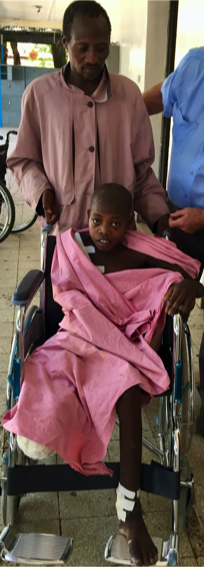 He survived this but soon developed tetanus. This is hard to treat anywhere but much more in an open ward with no intensive care specialists available – but we did. Besides the initial guillotine type amputation surgery he needed other refashioning and skin graft surgery. Early mobilisation is always attempted but how do you get one mobile if he has no armpit for a crutch and no leg on the same side? The hospital had a few wheel chairs for emergency use but none to be dedicated for a single patient. My wife and I fortunately had enough money to buy him a wheel chair which he loved. I retired when nearly 80 before the saga ended but we hadn’t solved the problem by any means. There is no social security in the country. Everything has to be paid for – so that even if it were possible to make an artificial above knee prosthesis learning to work without an arm to hold a crutch would be extremely difficult. He and his father could whizz around the cement paths of the hospital in the chair but when they went back into the mountains there would be mud and slush galore and probable no cement paths at all. I grew quickly to love both of them but I can’t even begin to imagine what life is like for them now.
 Heated Stew