Can a non-scholar be a Christian?

I was, and greatly enjoyed being, a surgeon! Shortly after obtaining my higher degree in surgery I joined a Christian Mission to go to Ethiopia as a missionary surgeon in one of their hospitals. I was expected to and very willingly underwent an assessment of my beliefs as a Christian. Obviously and logically the mission had standards and desired a certain degree of theological unity among its members. Having satisfied them that I was okay and could be accepted as a member I went to Ethiopia, where I worked up to 80 hours a week as the only surgeon covering a population of more than a million, but I also had a vital relationship with the ‘spiritual’ side of mission life. Later on after the communist takeover was overturned I was in government hospitals on their Academic staff.

In one area that I worked in the early 2000’s the population was very largely Muslim. But there was a University with a student body of about 40,000. This student body was made up from candidates accepted from all over the country. A significant percentage of these students were ‘Protestant’ Christians. The Protestant Kale Hiwot church was small in the University town but was the central organizational base for the churches which were scattered over that region of the country which made up one of 13 regions in the whole country. The church eldership was basically made up of mature Christians who had some but not a great theological nor secular education. They were great people but the younger University students were much greater in number. An average attendance at the church which the University students attended would have been nearly a thousand. That was great but the young people kept referring to and using Paul’s phrase ‘we are not under law but under grace’ (Romans 6 v 14) to underpin the thought that, as they were no longer under law, they could act as they wanted and God would turn a blind eye. This sounds, and was, wrong. The kids were basically good kids but some of their actions were not acceptable by the elders! Well the problem was magnified because the majority of the University students, whether they were Protestant or Orthodox or Islamic, in the freedom of their situation and of modern thinking seemed to live on the same basis. The student population came from all over the country and lived in University housing without parental advice or control!

There were 500 recorded terminations among students by an American subsidised clinic in the last 6 months that I was there. There were a number of other places willing to perform abortions whose activity I have not included. Drugs were a problem. I remember an instance where I had to operate late at night on a senior member of our University staff who, when drinking and ‘drugging’ with a younger member of his own unit, was severely stabbed in his abdomen which caused a critical situation. Neither of them were members of the Protestant church to which I referred earlier but both claimed to be Orthodox Christians. So the problem of lack of morals was society wide!

The morals of our Western countries aren’t any better! It is not a theological issue in most people’s eyes. There is a broad sense of personal rights to freedom and consequently a loss of moral standards.

So how does that take me back to the Pauline teaching that ‘we are not under law but under grace’? In the context of his whole book of Romans, where he writes this phrase, Paul has said in the early part that all mankind is guilty under the law as sinners alienated to God. BUT the Grace of God in Jesus and the Easter Event gives us the opportunity to be forgiven! And that in a sense is the core of the Christian message, now God has given us the opportunity to be forgiven by His Grace and not be judged by our law breaking. There is, however, more to the law than the law relating to Justice.

In the Jewish religion the law had different aspects – sacrificial, dietary, health and moral for example. When we think about it, we also think of the law in different ways. Jesus said that He had not come to destroy the law. Most certainly he didn’t come to destroy the moral law. We have a good summary of God’s moral requirements in the ten commandments! (Exodus ch 20). Christianity is not legalism in that we have to obey certain rules to earn our way in God’s acceptance, but it is certainly a call to a high understanding of what God has laid down as moral. I find that so releasing. Most see the commandments as negative and they do have a prohibitive aspect but equally they are there to be a guide and encouragement to a wonderfully rich and peaceful life.

Are we being led by the nose?

The picture shows a severe case of bilateral TB. There are people who affirm that it is best treated by going to a holy place and drinking holy water. I don’t agree.

We all know that languages change with time. When we first went to Ethiopia the common greeting in Amharic was ‘tenastelign’. That was a brief, shortened way of saying “Igzehabier tena ystelign’ which translated means ‘May God give you health on my behalf.’ If you wanted to say, ‘How are you?’, you had to choose one of three ways. You used one for females, one for males and another for important people. After some years away I went back after the Communist takeover had been overthrown. I went to a university teaching post. After a short time I found the students addressing me in what used to be the common feminine greeting but had now become the friendly greeting between people with whom you felt comfortable. They were really honouring me as someone they trusted. I had not lost respect. Older people still stood up when I walked into a room and said ‘nuur’ or something like ‘May you live forever!’

The language had changed.

In English when the Bible was first translated into English the word ‘conversation’ referred to the way one lived. Today it means a talk together. A change occurring over time with usage. ‘Gay’ used to mean ‘jolly’ or ‘happy’ the meaning has been changed to mean what used to be thought of as a sexual perversion. ‘Marriage’ used to mean a state between a man and a woman wherein there was a commitment to sexual and emotional faithfulness, in a lifelong commitment. It was a basic functional unit of society. Today it seems to be either, for some, what it has always been, but for others an excuse for a party and a declaration that they are proud to be different and want to declare their situation as normal.

The first example (about conversation) which I gave, seems to me to be like dropping the ‘ye’ and ‘thee’ of older English for just ‘you’. The next two seem to be purposeful alterations to fool the masses into seeing things differently and with the purpose of making, what was previously seen as immoral, acceptable.

The above is a prelude to the use of the word ‘vaccine’.….

The meaning of ‘vaccine’ has been purposefully redefined by the government to include altered rna (ribonucleic acid) material being injected into people to alter the body’s ability to immunologically respond to some outside attack. Previously a vaccine was always produced specifically to attack a specific infecting agent by using an attenuated bacterium or part of the troublesome ‘germ’. I am not an expert and have no desire to be such, I am retired. But what concerns me is that the ‘vaccines’ being used against COVID 19, under the new definition, have not been, by usually accepted medical and legal standards, adequately tested. They are causing at least occasional, and some claim more frequent, deaths and serious complications. I have several personal contacts who have become seriously ill. And without a doubt there are a number of cases of significant heart problems (myocarditis and/or pericarditis) in young people.

Many experts, even though a minority, in the field have warned of late serious effects, maybe even in future generations. There is a sizeable body of reported deaths and significant immediate complications, enough I believe to stop the use of a new medication. Honest discussion is, I feel strongly, being suppressed by authorities and the mainline media. The statistics which we are fed seem slanted to a desired result. Can you remember – lies, damn lies and statistics?

I am not an anti-vaccine person by the old definition but am dubious about substances produced under this new definition until they have been adequately and thoroughly tested.

Chopping down the tall poppy.

It is often said of Australians that we try and diminish people who stand metaphorically head and shoulders above the crowd. We cut off the tall poppy.

We recently had to get some trees lopped to allow the sunshine onto our solar system!

Today I want to build up one considered a short weed. Physically he is not big, except in his heart! I met him about 28 or 29 years ago, when he was a teenager. He was a double orphan but in the government hospital where I was working as an astermame (like a carer) for another teenager with whom he had grown up. His friend was also a double orphan. He slept under his ‘brother’s’ bed, emptying bedpans and feeding him because the other boy had very nasty infections in both elbows.

The hospital staff were angry at me because I had increased the occupancy rate of the hospital from 5 when I arrived to about 120. It was a 120 bed hospital. They invited me to go home because they only got the same government wage for doing a lot more work. In addition to verbalizing their discontent they were very uncooperative. I had to wheel the trolley to collect patients for their operations, load them on myself and push them to the operating room and lift them onto the table. I organized a highly intelligent young man (employed as a cleaner) to watch over the anaesthetics after I had put the person to sleep. Two nurses worked in the operating room and were on the whole cooperative. But after recovery I would have to repeat the process in reverse.

As soon as he heard the wheels of the patient’s trolley moving, the young boy of whom I am writing, would run to help me push the trolley. Eventually we adopted him and that in itself is quite a story. There were many hoops to hop through to get him to Australia. At High School he had his zygomatic arch in the side of his face broken because a lot of the other coloured girls thought him very handsome and some of the other coloured boys beat him up! He couldn’t open his lower jaw. Just as well his father was a surgeon!

He was never a good student but he stuck with it and eventually obtained a diploma in aged care. In the interval before getting his diploma he was never without a job. He is a terrible speller; his grammar is at best basic but he copes very well at a conversational level and does his job well.

I think in many senses he is a tall poppy.

Dominic Cartier

My 101st Heated Stew attempt.

Our small church has two congregations. At 9AM we have a service for mainly older white people, you might label us a ‘dying’ church. But we do have an outreach into India, South Africa and Ethiopia where people from an overseas church which was disrupted have scattered to other places. The outreach is by the internet. Then we have a much younger Indian congregation which meets at about 10.30 for a service and then an all age Sunday School. Once a month we have commenced a combined service with communion. Today was the first such combined service.

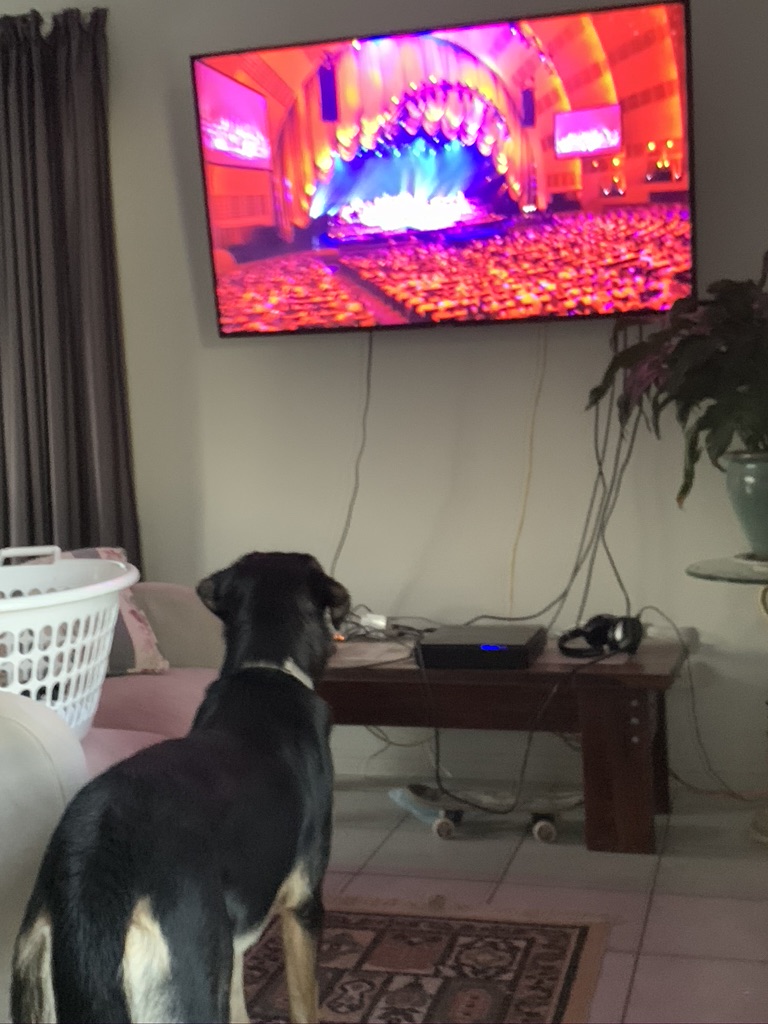
You might wonder what a dog staring at a Television set has to do with church services. I’ve written about my dogs before. Sadly they are both dead, euthanized, because they got into my sheep and started killing them. Here is Liesel staring very intently up at a very colourful, very active packed scene. What is she thinking? How is she reacting? I talk to animals, I may be even more stupid as I sometimes talk to myself. They recognize expressions, they respond to moods but I don’t know what they are thinking. I guess when I talk to myself I can tell myself what I’m thinking!

So what has that got to do with church this morning? The Indian adults, although from a different background have been in Australia for long enough to understand our ways of thinking. But I wondered what the kids thought. Their church services are in their own tongue, Malayalam, and this morning was the first time some children have been in an adult English speaking service. The kids’ English is good, but there are real differences in styles of worship.

In the morning tea afterwards I called one of the little kids to talk to me. He was a bit shy and his older brother came to guard him. He’s in grade 1. So I asked him if he could add up. ‘Yes’, he said. I asked him to add up 1+1, then 2+2, then 6+3 and he got them all correct. I saw him counting on his fingers. I knew that kids in grade one don’t deal in thousands so I asked him to add up 6 thousand and 3 thousand. He looked at me with his head on an angle to the side, thought for a moment and said nine thousand. So I asked him if he knew subtraction. The bigger brother said that his little brother hadn’t learnt that yet. So I told him, the older brother, to let his brother try to answer. So I asked 2-1, then 4-2, then 9-6 and he got them all correct. I then asked what if he took 4,000 from 10,000. And sharp as a tack he told me 6,000. For you and me very easy, but I thought for a grade one boy, that was excellent.

I wonder what people think and how much they understand when a church service is going on. The Indian children sat perfectly well behaved – not a noise out of place. But how much did they or any of us hear of the prayers, the songs, the preaching, the communion? I guess it will be told in the way we live our lives this week.

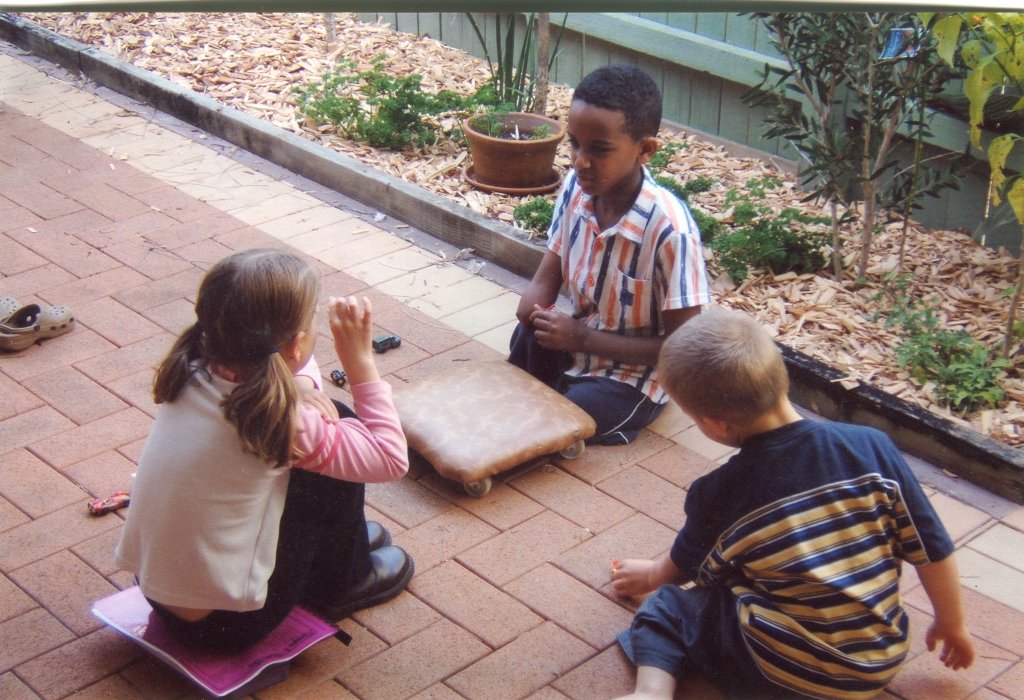
Please note the small skateboard under the table, in the dog picture above. It hasn’t been used for many years. The small boy seen below playing below with two of my grandchildren was run over by a train and lost both legs and an arm. We were allowed to bring him to Australia for medical help but not permitted to adopt him. He used the skateboard and the little ‘do-dad’ in front of him in the picture below to get around. He is now a University student in the USA. We still correspond but I’d love to see him face to face before I die!

He used to love sitting in front of the TV, conducting Andre Rieu as he watched a DVD.

The day I first met him he was about to be discharged to be a beggar on the streets of Ethiopia. I brought him home that evening and it was the beginning of a long friendship. He knew no English, but we had Amharic as a common language. I asked him if he had to get up to pee at night. He said ‘no’. I asked because I knew it would either mean a wet bed or me getting up to carry him to the loo. Then I asked him if he ever woke up screaming at night after the accident. I was surprised and delighted when he replied ‘There is a God in Heaven and I have left it in His hands.’ He was somewhere between 8-10. It was drizzling rain and, on a dirty road, I kept having to use the windscreen wiper and following behind other vehicles when the rain stopped I had to use the water spray jets to clean the window. I tested him when he asked where the water came from. He had never been in a car. I told him that there were two little boys under the hood and I would give them a little electric shock and they would pee for me. I kept a straight face. He looked worried for a moment and then burst out laughing. ‘Now, tell me the truth!’ I knew we would get on well, and we still do.

People can think! It’s what they do with what they’ve learned that counts!

Dominic Cartier.

Looking at a picture..

You can wander through your photos and think different things…..

  • Why did I take that?
  • I can’t remember what that was!
  • Weren’t we stupid to do that.
  • I wonder where they are now? etc
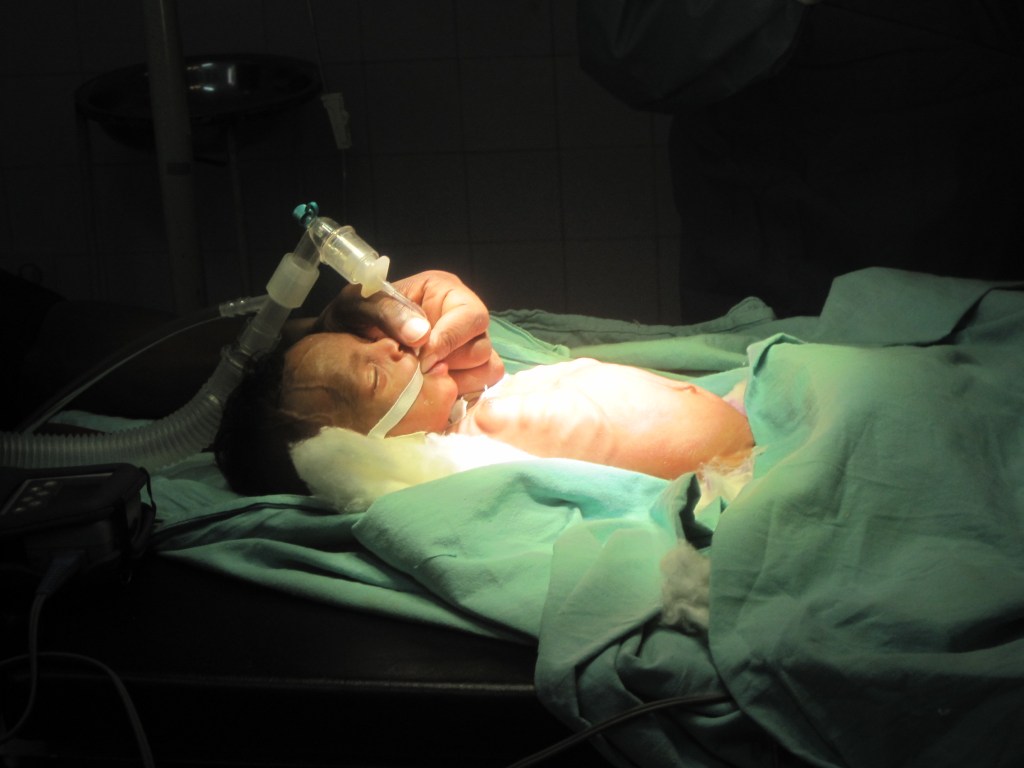
There are no other nasty pictures to follow and this is just a little six week old baby boy.

This photo takes me back over a lifetime of medical practice.

The past…As a first year intern in Adelaide, in the days when specialists were not as plentiful, I was sidelined into being a temporary anaesthetic registrar for six months to cover a shortage. It would be not even an option in this day of many more available people. But it gave me the opportunity to have a hands on experience which has served me well throughout my years of practice as a surgeon. Almost all of my time in Ethiopia I had to give/supervise all of my anaesthetics when I was the surgeon. So for chests and abdomens, orthopaedic and urological procedures the responsibility for the anaesthetic lay with me. Sometimes I even had to unscrub and deal with a problem before getting back to the operation. And tiny babies are a special problem; this boy was vomiting and needed to have his abdomen opened. I was, once the child (everyone knew that he was a boy, in spite of the troubles which politicians seem to have these days!) was properly anaesthetised going to leave the management at the head end to a cleaner. The length of the trachea in which the tube had to stay was only a couple of centimetres long – if it moved up he couldn’t be breathed for; if it went in too far, one of his lungs and maybe even one and a half of his lung capacity would be blocked off! I can remember my years of specialist surgical training; I can remember leaving my parents and siblings for a life in a land with, to me, a variety of unknown languages and a totally different culture.

The present….Here was the first born son a young family whom they had watched for a couple of weeks as he vomited everything they fed him and they were afraid that he would die. They were unsure if they could trust this young foreign white man, in their eyes an infidel. But they came and all their hopes were hanging on this moment.

The future…He survived and they were very, very happy. But here I have to let my mind float away into the ether. What sort of education did he get; is he married; did he become a good boy and make wise choices; is he a blessing or a curse to those around him. But that is the future of every patient you treat – some you get to follow and know, others are just passing in the night. Do you wonder why I like looking at the photos on my computer?

Dominic Cartier