I spent the last years of my working life in the University at Arba Minch. The city has a population of more than 200,000. The University has more than 40,000 enrolled students. I went there as the medical students were about to enter their clinical years. They were not ready to receive students in the hospital but we had to do so!
In my time we had to take the Hippocratic Oath, which I’m sure would be impossible to take these days with abortion, euthanasia, sex change operations. At Arba Minch they had a commitment called ‘Passing the Light.’ There were a number of ex-patriots mainly Indian subcontinent or from the Philippines. There were only two Caucasians. I was the only one involved in training doctors. Thus for a while as they came to clinical years thy found my accent difficult.
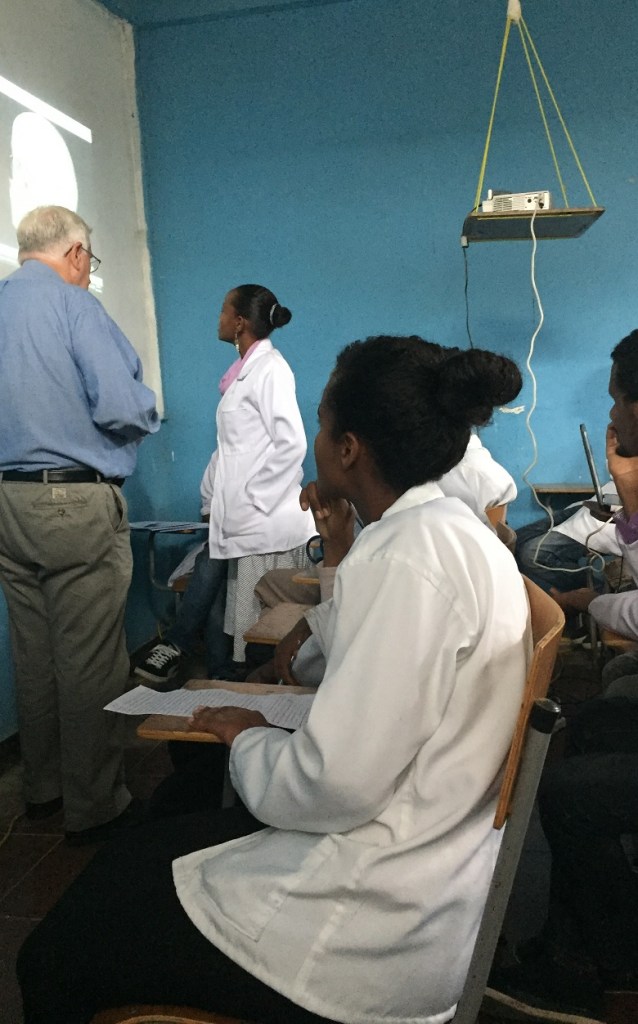
Every morning we discussed the emergency admissions from the the previous day, deaths and the operations performed. Because of the way we divided the students for teaching there were 60-75 people packed into a small room. As you can see above there was no room between the front row of participants and the people leading. You can see the data projector hanging from the roof on a little platform attached by rope.
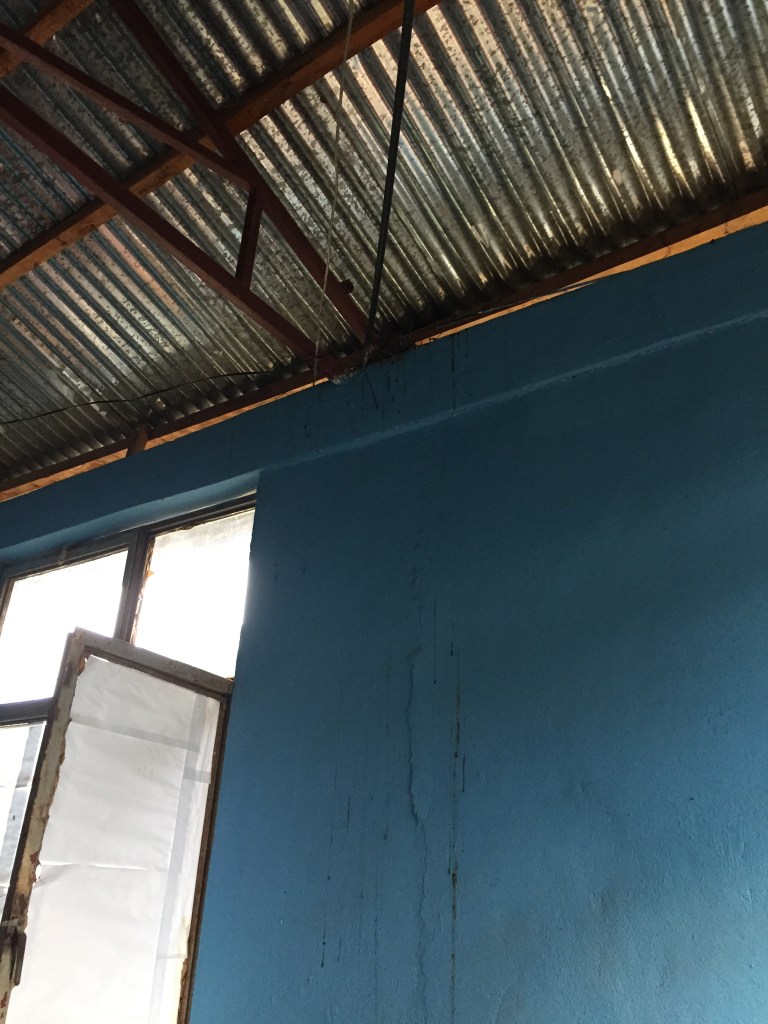
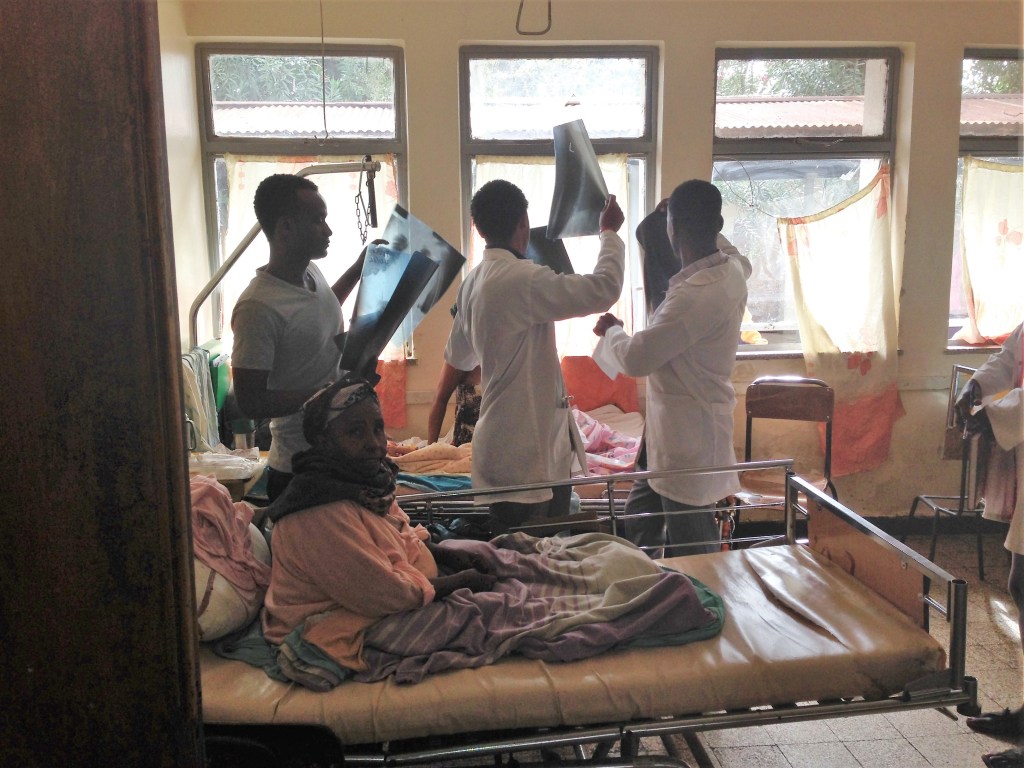
This is looking up at the ceiling. The mark on the wall is bird poop, and the tin roof without a ceiling made it very difficult during the rainy season.Robin and I shipped across a ship container of stuff to make the system workable even though not perfect. You are looking at a large part of my superannuation!There were other lectures to be given also. These were presented in the University grounds in much better facilities which had been prepared for the preclinical years.If you let your eyes wander you can see the level of furnishings in the wards. There was one X-ray box for the whole hospital, so the light coming through the windows did the job. There was no radiologist to report on the X-rays.But a University enrollment of 40,000 makes for a big graduation ceremony. Not all faculties graduated on the same day.Terrorism either as anti-government protests or as a means of getting the attention of those in charge occurred, although thankfully not all that commonly.But the purpose of training medical students is treat patients and we had an endless supply of them!
I have been told that there is a tribe in South America which has 40 words to differentiate shades of what we might, in a single word, describe simply as ‘green’. And in a country without sign posts they use these shade words to direct people on forest paths. For example travel on the path for …. (distance) until you see a tree of …. (shade of green) then turn left. in about …. (distance) you will see a bush of …. (shade of green) there turn right. etc – you get the idea. No doubt this has worked well for centuries and still does, but what a mess a traveller would be in if someone purposefully substituted the word for a different shade of green.
I wonder how many shades of green are in this area of Ethiopian countryside?
I looked up ‘shades of green’ on google search and the list is long and interesting. Usually just saying green is enough but sometimes we need to be more specific. And this applies to many other words. And we can get into or cause trouble by unintentionally or intentionally using a shade of meaning which the speaker or author didn’t intend. There are about a million words in the English language but I am told that the average word usage of the common person is only in the thousands – 10 to 20,000. I looked up the word ‘guilty’ in google search. This is part of what I read…
culpable of or responsible for a specified wrongdoing.”he was found guilty of manslaughter” Similar: culpable, to blame, blameworthy, blameable, at fault, in the wrong, responsible, answerable, accountable, liable, censurable, reproachable, condemnable, reprehensible, erring, errant, delinquent, offendings, felonious, iniquitous, criminal, convicted, peccant
Opposite:innocent.
justly chargeable with a particular fault or error.”she was guilty of a serious error of judgement”
conscious of, affected by, or revealing a feeling of guilt.”he felt guilty about the way he had treated her “Similar: ashamed, guilt-ridden, conscience-stricken, remorseful, sorry, regretful, contrite, repentant, penitent, rueful, abashed, shamefaced, sheepish, hangdog, mortified, discomfited, distressed, uncomfortable, in sackcloth and ashes, compunctious. Opposite:unrepentant
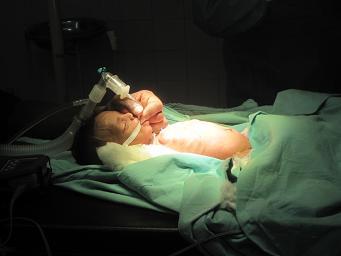
Let us say that the little baby pictured above died. That is not true, he did very well after his emergency surgery. He recovered quickly and was sent home well, but with a lot of growing up to do. But picture this scenario: –
He came in with an obstructed gut. He was operated upon and the condition corrected. On being woken up from his anaesthetic he vomited, inhaled his vomitus, but after that treated well according to the book but over the next 24 hours dies. A distraught parent accuses me of killing the baby and says that they hope I feel well and truly ‘guilty’. Should I feel guilty? I had made the correct diagnosis and done the right operation. My name was still on the end of the bed as the responsible surgeon. I had seen him and ordered several things post operatively. I was not the anaesthetist. Measures should have been taken by the anaesthetist to reduce the risk of him vomiting to a minimum, which he did not take. But I was by then in a side room writing up the case record. The mistake having been made I raced back into the operating room and did all I could to correct the situation.
But that accusation is that I have killed him and should feel guilty. I don’t think that it is fair to say that I have killed him, even if in a court the lawyers would have tried hard to push that all the responsibility of the anaesthetist fell back on me as the team leader so….? Now coming to the guilty word I have to confess that maybe I should feel guilty. I’ve seen that anaesthetist make similar mistakes before and because it was after midnight and I was tired I chose to do what was legal but maybe not wise i.e. do the rest of my legal paperwork and hopefully get home to bed. I had previously spent time on several occasions explaining the right way and watched him through several operations. I had since then stayed in the room on several occasions making sure that he did the waking up procedure correctly. But he was still relatively inexperienced. Because of the hour should we have waited until the morning, accepting that he may have died overnight and would certainly have been medically worse by the next day. If everyone had rested he might have lived and grown up to be a healthy man.
Would that label me guilty? I understand why the parents did, and I have to struggle hard to say that I bear no guilt. But I reject that I should feel guilty of murdering him or even of having done the wrong thing. Surely there must be a synonym in there for my feelings at this moment. Blameable? – but surely it is not my responsibility to do someone else’s work correctly. Ashamed? – because in the world there is such inequity between what we have in my home country cf my adopted land. Remorseful? – that I didn’t stay in the operating room until the child was wide awake. But then I knew that the post-op care workers often slept on their duty time – so should I have watched him overnight? Am I to bear the whole weight of the medical inadequacies on my shoulders.
Often when I use a word I have to depend on my reader/hearer to discern the context into which I am using it. It is not easy for the user or the recipient of a word to be sure of the correct meaning and I guess we have to settle for being honest, generous and understanding in our assessments.
It may be almost illegal these days to say that about a husband-wife relationship! Particularly if you are the male speaking! There I go, being provocative again. But I’m not talking about a person but about a load of work.
Some years ago I self published a book – a sort of autobiography come medical journey of mine. It sold out and is 10 years out of date at any rate. Then a few years ago I wrote a book, probably better called a booklet, for my students as they began their clinical surgical courses. It was relevant to their situation with lack of facilities and language difficulties. Their ability to read thick tomes was limited, so I tried to put the very relevant stuff in a compressed form. As I meet a new era of Western students sold on investigations, before physical examinations, I’m convinced that it may be of use to them also.
I’m pretty dumb, computer wise, but my eldest son, who lives on our farm and runs it and who runs me is a wizard. He wants to reproduce them and also shortly after them another pictorial cum anecdotal short book of our lives. So at the moment the thumb of pressure to get it done on time is hard on me! Publication date for the first two is set for November 27. Between now and then we have a granddaughter’s wedding to attend about 1,500Km away, and a sheep shed to get built, so the pressure is on, the thumb is pressing down.
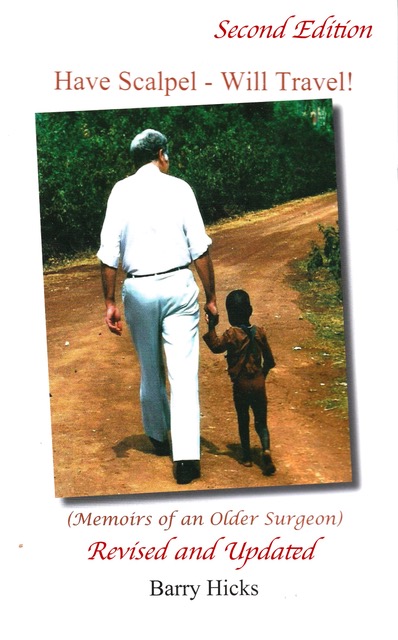
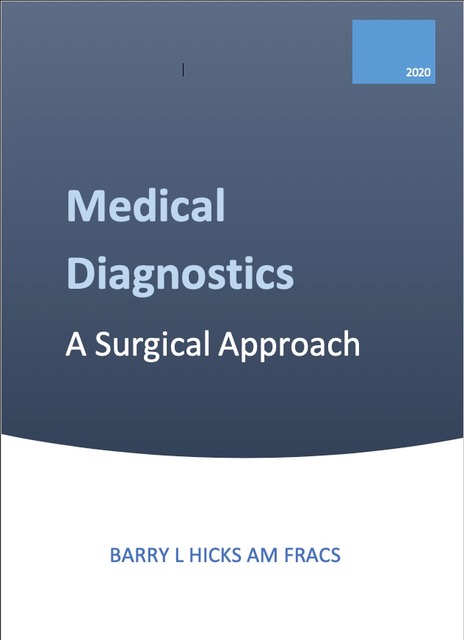
My first book was called ‘Have Scalpel – Will Travel’, and the new edition will have the same name but with ‘Revised and Updated’ added. The other will be ‘Medical Diagnosis – a Surgical Approach.’ I’m slowly labouring through the third one – as yet unnamed.
The introduction to the first book was and will remain as follows: –
They cut off the tip of his ear. Yes he was a thief and this was the custom. He was naked and caught stealing clothes left out by the river to dry. He could see no-one but they saw him! He was tightly bound with his hands behind his back and taken to court. Eventually he was brought to the hospital. One arm was already gangrenous. It had to be amputated. The other – the nerve supply had been cut off by the pressure of the binding and the arm was paralysed, probably forever.
How did he feed himself? How? He had his food put on the cupboard by the bed – but there was no one to feed him. He had to feed himself. So he got up like a dog on his knees and elbows. He ate like a dog. My heart was touched and so each day I stayed back at lunch time and fed him myself. What became of him? I don’t know. But to God he is a person – to the others he was just a thief.
One night I sat in the common room of Addis Ababa HQ of SIM – the mission with which I was associated. I had just come up from Soddo on business and had left behind this one who deeply disturbed me. People were singing that beautiful old hymn ‘Peace, perfect peace when all around….’ Yet I was not totally at peace. Sitting in that common room I was not totally at peace. Was I doing all that could and should be done in these circumstances? Certainly the future my young thief saw ahead had no pension, no physiotherapy, and no social support.
Maybe because we want too much, but the average Australian now has difficulty in buying a home. The cost is high, and many rent all their lives.
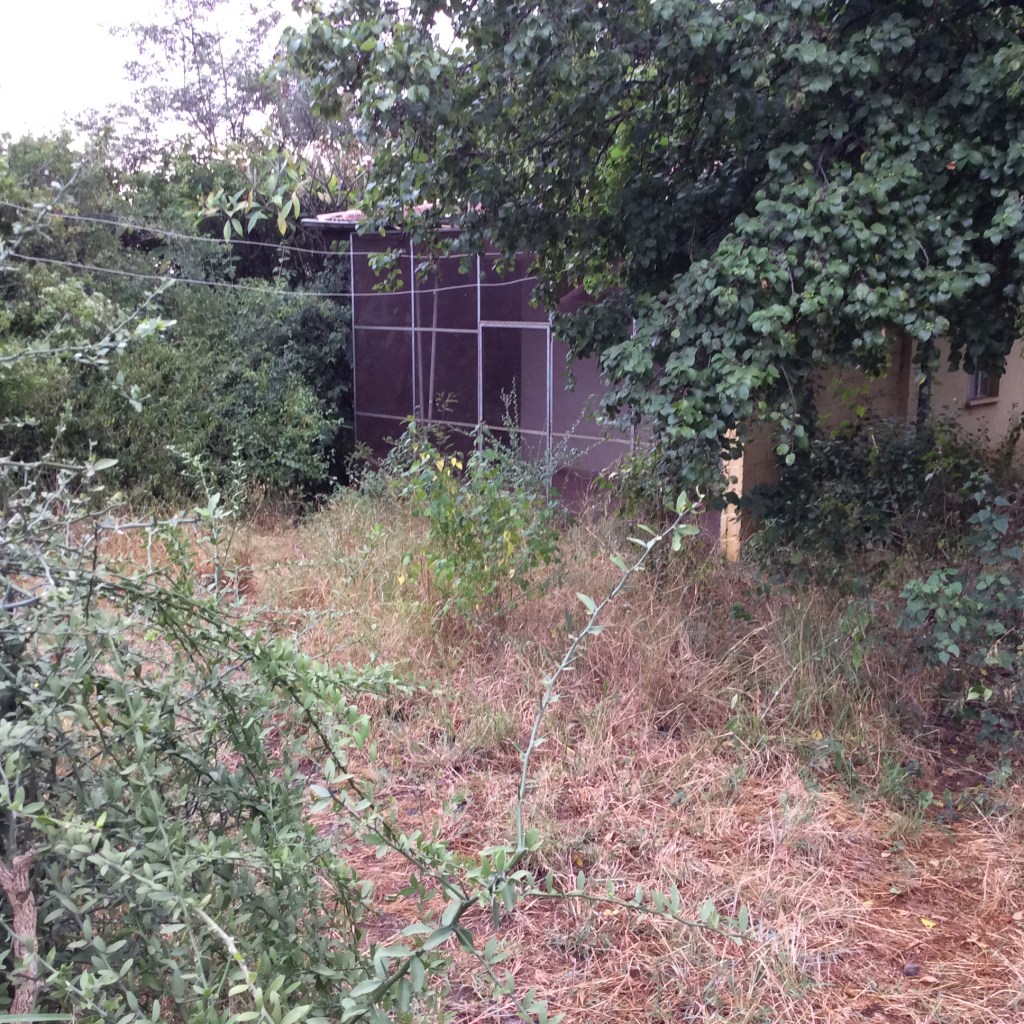
A relative of ours went out to the hospital where we worked at no cost to the hospital or government except that they were to provide housing. He stayed for about 3 years working during the day in the hospital area as a general, very handy, handyman. He taught a lot of evenings and weekends in a local church run vocational school. So rental was free but I wonder how much it would have gone for on the market as a rental property? I’ll show you a few pictures to put in a brochure. The young local graduated doctors refused to live in it. Could you blame them?
The entranceGoing insideThe lounge roomThe toiletThe kitchen
There were pretty good views nearby.
A panoramic view from the hotel where official hospital visitors stayed.The left hand lake as seen in the photo above now viewed standing outside his back door! You could increase the rental for the view! Lake Abaya is 60X20 km at its longest and widest points.
As I said above he stayed for several years and in his spare time and at personal cost did an enormous amount of work on it as part of his gift to the work. When it was finished and he was thinking of leaving, he was invited to leave soon. They wanted the renewed house for visiting lecturers.
(In praise of him he also started a tax free fund for a building for the locally run vocational school. It is now up and looking good!). His reward is in the satisfaction of a job well done. His thanks will ultimately come from above the clouds.
Already some people have indicated their gladness because I put a marker across my posts if I’m going to show a few medically mild photographs. We all have different backgrounds but I’ve been thinking a bit lately about this issue. I wonder what people do when watching a news presentation about rioting or some natural disaster or catastrophic event and a nasty scene comes on. Do they immediately turn them off? Is it possible or wise to hide from these terrible realities?
Thinking again, I wonder if more damage is done by what enters the mind via the eyes or through the ears. Reports of the political discussions about the very abnormal sexual behaviour being accommodated, or the legal destruction of life, both at its beginning and its end, entering the mind by reading or hearing, in my thinking, immunises minds against truth. I’ve read of high school kids being expelled for insisting that there are only 2 sexes. I personally think the authorities should be expelled.
Some may explain me away as a psycho-pathological religious nut. But it is they who are forsaking science for emotive who-ha. Please don’t think that I’m totally naive.
I had a young trainee Orthodox priest come to me with his penis halfway severed through because he, as a normal young man, was having difficulties balancing normal human reactions to the monasteries insistence on celibacy. He was trying to cut off his problem.
I’ve had to deal with a pre teenage child brought up as a girl but with strong desires to be male. On examination he had testicles but a grossly deformed penis, and no female organs. I won’t show you the pictures, which I have.
I’ve had to deal with a young man who often had meals with us, who as Orthodox got a Muslim girl pregnant. He was too terrified to tell his father so he used me as a listening ear. I said if you want an abortion you’re talking to the wrong person. He replied that neither he nor the girl wanted that. They had obviously discussed it. We had good talks, but in the end I said he had to talk to his father but that I would go with him. I had discovered that he was the illegitimate son of his father, but had been brought up with the family’s other children by the father’s wife and treated as one with the other kids some older, some younger than him.
The father booted him out of the house and stated he never wanted to see him again. We cared for him until the ‘mother’ persuaded his father to take him back some weeks later.
The girl was not prepared to meet me, but the young man and I had input with her. She, too, was unprepared to talk with her family. He could have remained quiet but she had an expanding reason to do something. So while her father was away she spoke to her mother who demanded that she have an abortion. The mother explained that her father would kill her if he ever found out that she was pregnant and particularly to an Orthodox boy. Eventually she was, very tearfully, dragged off to the local American run abortion clinic and the child’s life terminated.
Am I being judgemental in discussing these things? I guess the answer in some ways is ‘yes’. Are there many things with which I disagree? Celibacy should be chosen not forced; a decent look at the child could have seen testicles and no vagina; he explained that he had erections but although everything became hard nothing stood up except for an intense C-shaped thing; intecourse runs the risk of pregnancy – so although not uninformed the pair were stupid. I would say that intercourse is intended to be within marriage but I recognize that is an unpopular concept these days. However, the knowledge of pregnancy prevention is well known and easily obtained; I can’t understand the parents behaviour on either side. Am I judgemental? Maybe, but I sought to help without verbalized criticism to anyone except for the young man, who was like a son to me. Certainly I didn’t reject him.
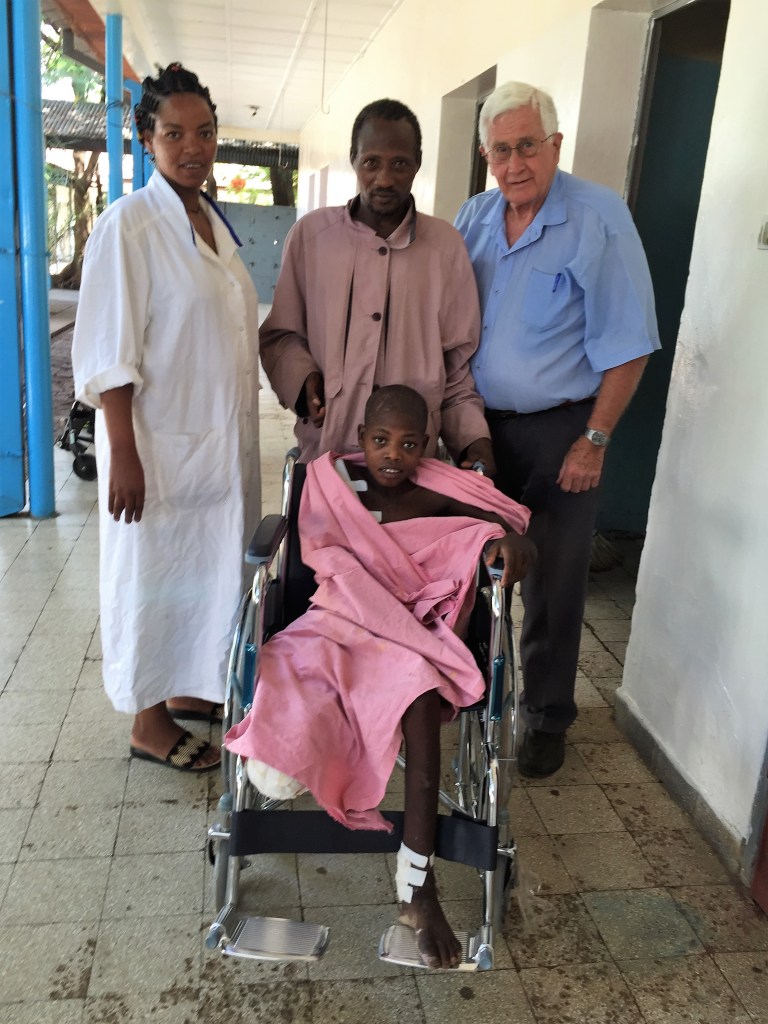
I loved treating kids. Under the line are some of my ‘kids’. I challenge you to look at them and see them as real people! You will see some dressings but no open wounds.












 Heated Stew