A nightmare of a day!

African sunset

I am, at the strong encouragement of one of my sons, who says that there are some stories in my life worth recording, reviewing and extending a brief autobiography I wrote years ago. Going through a bit of it yesterday I came across this brief event of one day in my journey. This occured while I was briefly attached to a large teaching hospital in Addis Ababa.
I was on call one night on the eve of a large Muslim holiday. The next morning I left to go to the hospital surprised that I hadn’t had a single call over night. As usual we did a round of the whole surgical wards and early in the round I came across a poor lady lying in bed with most of her small bowel and a bit of her large bowel mixed in with a lot of dirt and gravel lying on the bed next to her. She had a large hole in her right side where all the tissues down to and including portion of the right iliac crest (part of her pelvis) had been torn off in a car accident.
Later I discovered the story. She had been hit by a car driven, by a nun, about four hundred kilometres south of Addis Ababa. The driver had taken her to the local hospital who stated, correctly, that they had no surgeon and the nearest hospital with a surgeon was one hundred and fifty kilometres up the road towards Addis. So the nun took her to that hospital, where she was told that they did have an appointed surgeon but he was away and they had no idea when he would return. They came to Addis, where the first three hospitals said that they had no empty beds. She was eventually admitted into St. Pauls – but nothing had been done for her. No IV fluids, no antibiotics, no dressings – in fact nothing at all except that she had been put in a bed.
I have learnt to be pretty patient but this stretched me to the limit. Why had nothing been done? The hospital was without water so the operating theatres were out of action and definitive treatment could not therefore be undertaken. I think it was planned to leave everything to the undertaker! So I organized for a drip and antibiotics and a clean moist dressing over the exposed entrails and planned to look into the water situation later. I had already noted a tap being used down the street by the general public.
Soon we came across another young man who had been stabbed in the back. He was as white as an Ethiopian can be. As he was of a higher social class he at least had a drip up but the blood bank was closed for the holiday. My wife had arrived in the country by this time and I arranged for her and a missionary nurse Jean Sokvitne to donate blood. With some difficulty we were able to collect it and cross match using Eldon cards.
I organized a group of workers and I worked with them. Between us, we carried water from the afore-mentioned tap and collected maybe a hundred litres in a large container outside the operating rooms. Grudgingly the staff agreed to operate. The young man when stabbed had had his renal artery and vein divided and fortunately the knife, avoiding the duodenum, opened into the peritoneum but not causing any bowel injury. He thus had a peritoneal cavity filled with blood but uncontaminated by intestinal content. We gave him two units of foreign blood and I showed the doctors how to filter the blood from inside his abdomen through gauze and we auto-transfused the patient. He survived and did very well.
Next we worked on the lady. It was difficult but we cleaned her intestines, cleaned the edges of her wound and after returning the bowel to its proper place closed the wound with considerable difficulty. She also recovered, although much more slowly than the young man. In addition to her physical disease she had underlying mental problems which added to her initial poor management and which made things difficult during her recovery.
The day after the holiday we had, as usual on working days, a morning meeting at which all admissions over the past couple of days were discussed. I was, surprisingly to me, severely chastised. Two motions were passed:
  1. Never again would doctors be involved in carrying water to the hospital or in arranging for it to be carried as this was a government responsibility.
  2. No auto transfusion would be used unless a modern cell saver were used (of course there were none in Ethiopia!) as the country was not a ‘banana republic’.

Dominic Cartier
I can get frustrated!

African sunset

Standards of nursing care, vary from place to place. I have sympathy for people in developing countries. Trained personnel are few; wages are low; materials are in short supply; sometimes patients personal habits are fairly low by the standards of those who have everything at their fingertips. Looking up Mr Google, the poverty line in Australia is said to be just under AUD67,000 annually. The wage of a newly graduated surgeon in Ethiopia is about AUD 500 per month. A house worker gets about AUD 50 per month.

I remember several events very clearly from my first few months in Ethiopia. I wanted to look down a patient’s throat, so I put my hand under his chin to lift it for me to inspect the inside of his mouth. He spat a glob of juicy purulent spit into my hand. Rather shocked I went out and washed my hand before coming back and trying again with the same result. It was the custom with no handkerchiefs, if you were sick a relative or friend took your sputum and wiped it somewhere, often on the wall. No wonder our walls looked like they did. But I learnt a cultural and very practical lesson.

When a second doctor joined me we made a combined effort to get the floors cleaned up. There was a layer, several, maybe five, mms thick of hard dirt ground into the floor. We got no response, until one day, walking through the ward, I accidentally put my foot in a ‘paw-paw’, their name for a bedpan. You will understand why now I never eat the fruit ‘pawpaw’. I enjoy Papaya, however.

But it made me mad. So I got the other doctor onside and, down on our knees with scrubbing brushes, we dealt with the floors of our 35 bed general hospital. I think it embarrassed the other staff as it was much cleaner after that. They talk about leading by example!

I remember a day when a new young worker was in the ward while I was doing my morning round. I was told that he had been employed as an assistant to the nurse. He seemed an affable chap. The next day he wasn’t there so I asked what had happened. There had been a patient with an IV Drip running and a tube into his stomach draining the contents as his intestines weren’t working. Without the drain he had kept vomiting. The new guy had been told that he was just to watch and learn for the first week or so. The nurse went for lunch and, on returning, was told that this patient had died. Apparently during the morning the new worker had seen someone put up another bag of IV fluid. Not content to wait , when this patient’s IV ran out, he took the gastric drainage bag and ran it into his IV line – with fatal results. What a tragedy.

I had two experiences at another hospital, which made me realise that I came from a different world. The first was when we had a Hong Kong anaesthetist for 2 weeks with me. We had got to know each other working in Australia and he came during his holidays to help me. He was an excellent anaesthesiologist. A man came in having been beaten and speared after committing a heinous act. We operated and I felt that we had everything under control, in fact, I expected a quick, complete recovery. Late in the evening I had a visit from my friend saying that he had just been to see the chap and everything was stable. The next morning he was dead. We couldn’t think of any reason why until I heard a worker say that he didn’t deserve to live, and I remembered hearing staff murmuring when he was admitted that he wasn’t worth the effort of operating on him. Judge nurse, I think had the final say.

Later I had a lady who with an obstructed labour had lost the baby, her uterus, her bladder, and needed a colostomy for bowel control. She survived after I did a colostomy and a very simple thing to drain her urine. When it appeared as if she would recover I created a new bladder out of intestine. On about the tenth day postoperative everything was going well and I took a two day trip to Addis. When I came back I went to see her and she wasn’t in the ward. They were honest enough to say that they thought that no woman in Ethiopia should live with that set up like that. So they had taken the opportunity of my absence to take everything out and send her home to die. Maybe they knew better than me, but it was hard to take.

We had many more good, rather than bad, results!

What do you think?

African sunset

I have a friend, an African friend, who did his medical training in Russia. I don’t think that he is a liar. He told me that when he was there, not infrequently, as he walked on the streets, he would feel people checking his lower back to see if he had a vestigial monkey tail. I have not checked for myself, but I know that he has an excellent brain! You probably think that in the twenty first century this behaviour is unbelievable. And yet almost all educators of today are teaching that we have come from monkeys. So why not test the theory?

You probably know the story of the little girl who asked her mother where humans came from and got the ‘God story’. She later asked her father the same question and was given the ‘monkey story’. At the evening meal she accused someone of lying to her. Her mother replied that she had given her the story of her, the mother’s, own family, and that the father had given the story of his family. He was dumbfounded! The child seemed satisfied.

This coronavirus affair has I’m sure made us all question the way it has been handled. That is not to say that we’re complaining at what has been organised, but we would be dumb domesticated animals if it didn’t make us think, and ask questions like..

  • How many have died of other viral illnesses, during the same period? And maybe, how many have died unnecessarily of other non-treated diseases?
  • Why can you have an abortion but not meet your ageing parent in a home?
  • Why are the suicide, domestic violence rates, and incidence of mental illness climbing?
  • Are we living in a runaway world?
  • What will happen to my family if I die?
  • What’ll happen to me if I die?

The list could go on for a lot longer and maybe your questions differ from mine.

When I was a Surgical Registrar in the 1960s I saw the film ‘Lord of the flies’. It was not based on a true story, but graphically pictured how a group of higher class youngsters from England gravitated into selfishness, murder and cannibalism when marooned, for roughly a year, on a deserted island. Just recently I have read an apparently true report of six Tongan boys who to escape the rigours of a strict school, stole a boat and paddled towards New Zealand. They coped by cooperating. They were marooned for more than a year on a deserted island, until they were found by a fisherman. This without doubt is at its root a true story. The recent report about this event leads the author to suggest that whereas the theory of the imaged book highlights the weakness of human character, the truth of the true story is that people are really basically good. And our basic goodness should be highlighted.

Compare how Australians pull together during bushfires versus why do Australians light bushfires and steal from what is left? How do we balance the generosity of the government when they want cooperation, with their usual treatment of some segments of needy society? Why do some blossom in community service at times like we are going through, and others crash into terrible attitudes and situations as mentioned above? Is there truly good and evil in the world? Should our goals be self-centered, financial, comfort seeking or maybe “goodness and truth”? The eternal question – why am I here?

One Sad Memory, One Glad Celebration

African sunset

The SAD One

When I returned to Ethiopia in the 90’s I had the ‘run-around’! I went with all the paperwork settled by both ends to become Associate Professor at the Black Lion (the large University) Hospital. The paperwork was not enough for a newly inducted set of hierarchy. So I was allocated as ‘Head of the Department’ at the soon to be opened Kidus Paulos Hospital (St Paul’s). Before it opened I was twice demoted to become another surgeon on the second surgical department in that hospital. In addition I was employed by the University on a contract – to be paid a salary, which was not exorbitant but livable. The contract was made in Ethiopian birr when the US dollar bought 2 Ethiopian birr. Within weeks without warning US$1 equalled 6 birr. At the moment it is nearly US$=30 birr. So my wage was effectively reduced by two thirds. I was still paid at the two birr level! Then the Kidus Paulos was slow in opening.

After pleading negotiations I was permitted to work at the Menelik II Hospital until Kidus Paulos opened. But I was paid from the Yekatit Asara Hulet hospital. Which brings us to “The Sad Memory” mentioned above.

Yekatit is a month of the Ethiopian Calendar. Asara hulet is the number twelve. (February 19th in our calendar – our calendars don’t match.) So why is that a sad memory?  It is quite a story….

During their occupancy of Ethiopia 1936-41,  the Italians had apparently built a huge poison chemical factory near Mogadishu in Italian Somalia. They had 37,000 gas masks kept for their own use. The fear, from an Ethiopian point of view, was that they themselves were a major target for attack by chemical warfare. In a failed attempt to assassinate  the Italian Viceroy of East Africa, Marshal Rodolfo Graziani; he was injured but several Italians were killed. The Italian response was over the next 3 days to slaughter over 30,000 Ethiopians, including about 20,000 in Addis Ababa (at that time 20% of the population of Addis!) Talking to local people they say that, as part of this slaughter, 1,000 people were lined up near the Sidist Kilo corner in Addis and the Italians shot every tenth one. The Yekatit Hospital is built at Sidist Kilo and there is a monument there until this day. Italians still walk and work in Ethiopia. The Emperor, on his return from exile in Britain after the Italians were driven out, said that they should be forgiven. Not many Italians, however, are seen out and about on February the 19th!

The GLAD One

If you look in your computer to see if an African Nation has ever conquered an invading European force unaided you are given “The Battle of Adwa”.  I can find no other. The Italian invasion discussed above was the second of their major attempts to conquer Ethiopia.  In 1896 the Italians planned to enlarge their empire in Africa. They already had Eritrea as a base. In the end after much fighting the countries faced each other at Adawa. Without trying to go into great detail the following facts seem to be basically true.

  • The Ethiopians had a much larger force being on home soil. Roughly 80,000 to 20,000
  • The Italians had much the better war machinery.
  • There was previously after some squirmishes an agreement between Ethiopia and Italy with different wording in the Italian and Ethiopian copies. Menelik II acted on his copy which meant having discussions with Europe without going through Italian sources. Italy by their copy of the agreement obviously saw Ethiopia as a subject nation and invaded.
  • On March 1st 1896 the Italians were routed. The story is complex but the victory complete and is celebrated with vigour every year.


Dominic Cartier

A little about the Amharic language

Amharic is the language of the Amharas, one of the major tribes of Ethiopia. Emperor Haile Selassie (The power of the Trinity) was an Amhara and sought to make it and English the main languages of Ethiopia. French was, for a while, a popular alternative and a number of words in modern Amharic also come from the Italian invasion. There are apparently 83 languages in Ethiopia giving rise to about 200 dialects. Ge’ez is the old language of the Orthodox Church and introduces the ‘ in the middle of a word to indicate a glottal stop.

To show how different these tribal languages are I will give four greetings with a rough English translation. I will use our script to give an idea of how they sound

  • Amharic greeting is classically Tenastilygn – a shortened form of the sentence Igzeehabeeyer Tena Yisterlygn  – May God give you health for me.
  • In Oromifa – Neggaa, Fiya, Errga – Hello, how are you, it’s nice to smell you. In this situation I think the ‘smell’ is conceptually ‘to have your presence with us’.
  • In Wolaitata – Sero Lo’oo Lo’oo Fiedaitey – Hello, How are you., nice to see you.
  • In Hadeyan – Tuuma, Tuuma. Hello, hello!

Haile Selassie attempted to make Amharic the common Ethiopian language and it was taught in primary and secondary school with English being added later in primary school. English was the official language of tertiary education. After Haile Selassie was murdered the era of Mengistu HaileMariam (The kingdom of the power of Mary) sought to elevate other tribal languages with English as the second language, leaving Amharic for the Amhara tribe. It is thought by many that, whereas Haile Selassie was seeking to unite the country, Mengistu was seeking to divide the tribes to make the country easier to rule.

3 languages
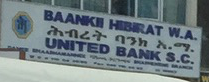
Above the sign is in Oromifa which uses the Roman script and a lot of doubling of letters eg baanke. In the middle Amharic, And below English. Addis Ababa is officially a Federal State but used to be Oromo territory so that comes first and Amharic is in smaller letters.

Certainly when I went back after the overthrow of Mengistu I experienced some trouble from this. I was living in the Wolaita area and patients coming from the Hadeyan area only 40 km down the road could frequently not be understood by the staff. The present government seems to now have a three language policy.

DCP_1734 copy
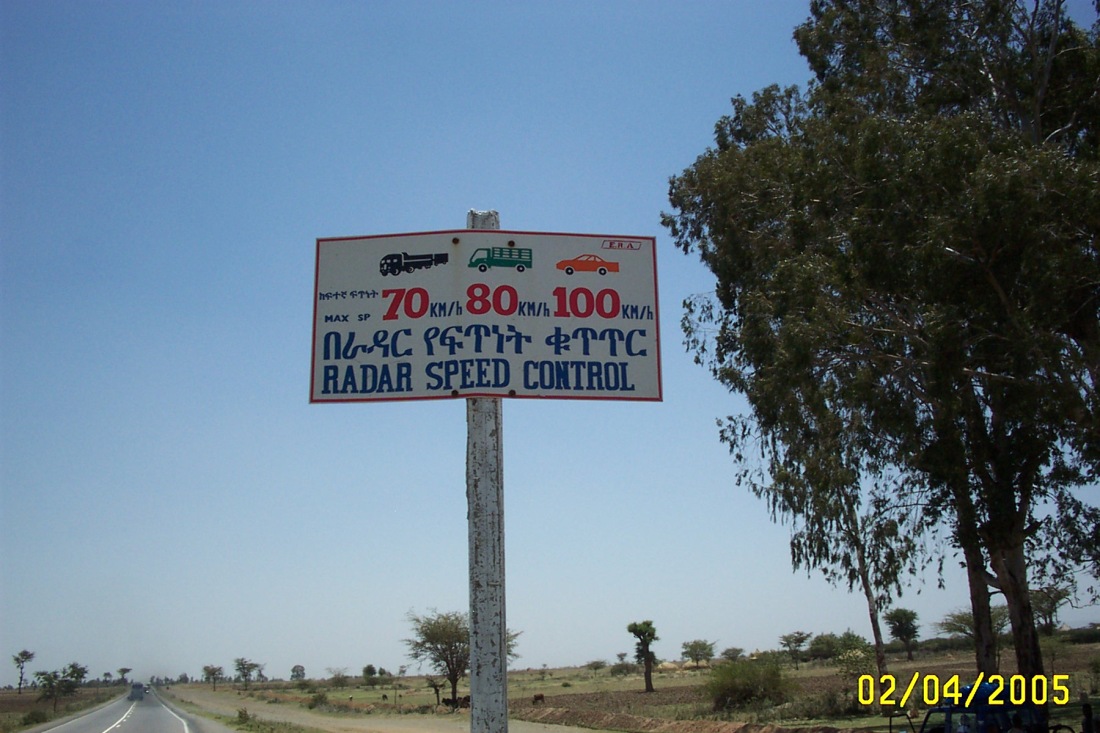
The 3 languages used here are symbols, Amharic and English. In voting, because so many are illiterate each party has a symbol to show the voters whom they should choose. I never saw a radar gun on that road!

In Amharic there are two ‘t’s – both normal for them but with very different meanings. Also with ‘k’s and ‘ch’s  differences which we describe as soft or explosive. You can get into real trouble. I was in the bank with a couple of friends and our business was drawn out. I said to my friends  ‘Chiger alle?’ thinking I was saying ‘is there a problem?’ but actually saying ‘do you have pubic hair?’ Embarrassing for them and for me, when it was explained. But their letters are written differently and so easily read but not easily heard by us, who think anything like a ‘t’ sound is in fact a ‘t’. In Amharic ‘sebake’ and ‘sebake’, depending on how you sound the ‘k’  means a ‘preacher’ or ‘a bearer of false tales’.

In English we have many letters and letter groups with same or different meaning. We spell Monday with an ‘o’ and say it with a ‘u’. We have the ‘ou’ and say it differently in the following – cough, mouse, tough, through – and pronounce it differently in each word. We have the one letter eg ‘t’ and pronounce it differently in different words. The ‘t’ in tough and the ‘t’ in take are made with the tongue in very different places. Or more significantly the ‘c’ in cat and centipede. Say them and see how your tongue is in a different position for each. We have f’s and ph’s which sound the same. In some of the languages you don’t differentiate p’s and f’s, so people, when they speak in English  go to fray or pray at church; they wear certain clothes either because it is the new fashion or new pashion, without recognising the difference. In Amharic if you know the syllabet you can read it with the correct sound even if you maybe cannot understand it!

IMG-3041
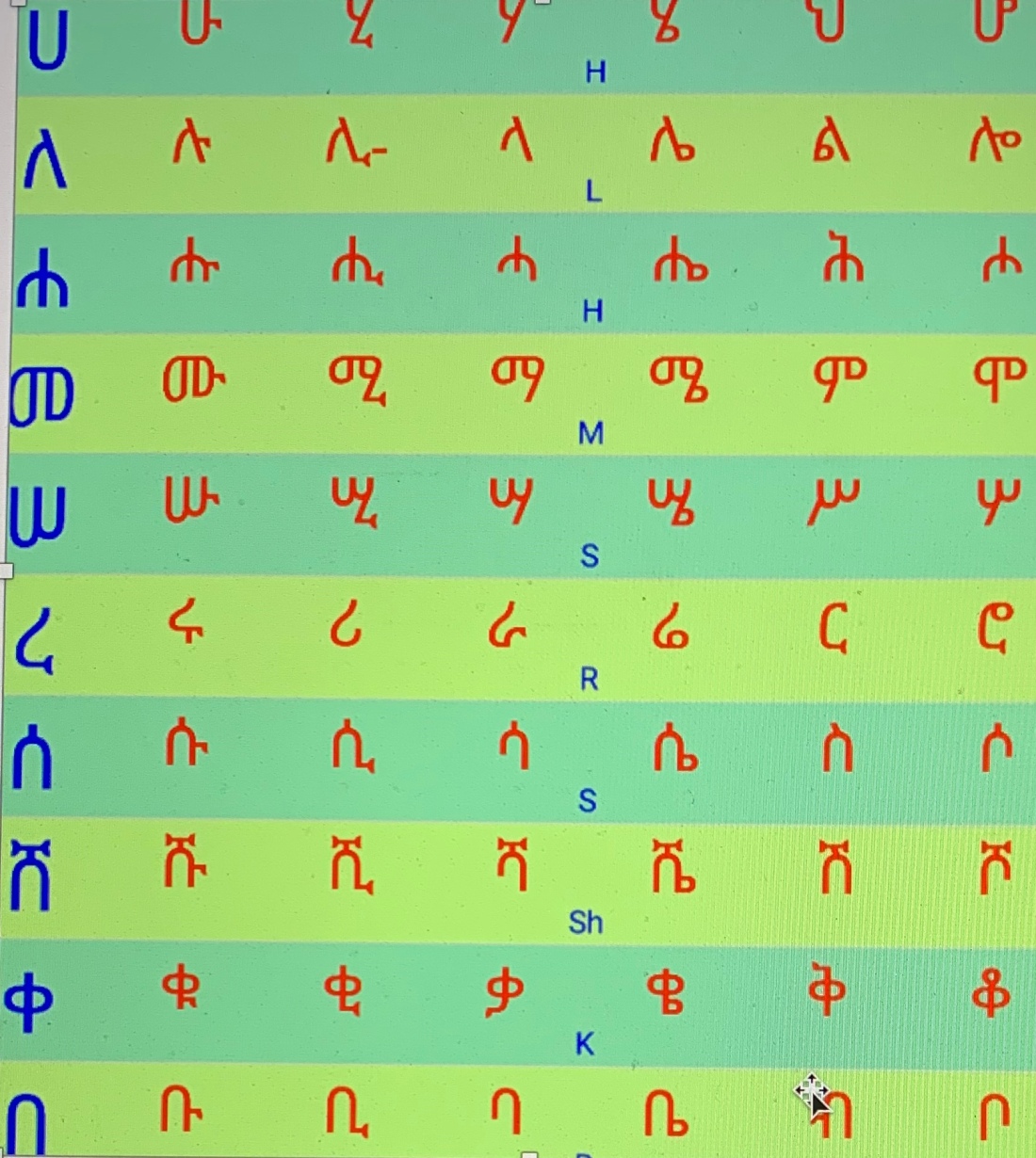
The fidel is not really an alphabet but a syllabet. The second line is basically the ‘l’ sound but the seven syllables as go across from left to right are le,lu, lee, laa, ley, li, lo. There are 238 basic syllables and another 79 special ones, punctuation marks and numbers.

I once told a patient that, as I had spent hours fixing the problems which his venereal disease had caused, ‘that if you have sex with anyone apart from my wife after this, I will kill you!’ I used the sound for my instead of the one for your. Fortunately he spoke in Oromifa and after my Amharic speaking fellow workers got up from the floor, having ceased rolling around in laughter, they translated what I had meant to say!

Learning another language is always a challenge and we all make mistakes!

Dominic Cartier