Winning the battle; Losing the war!

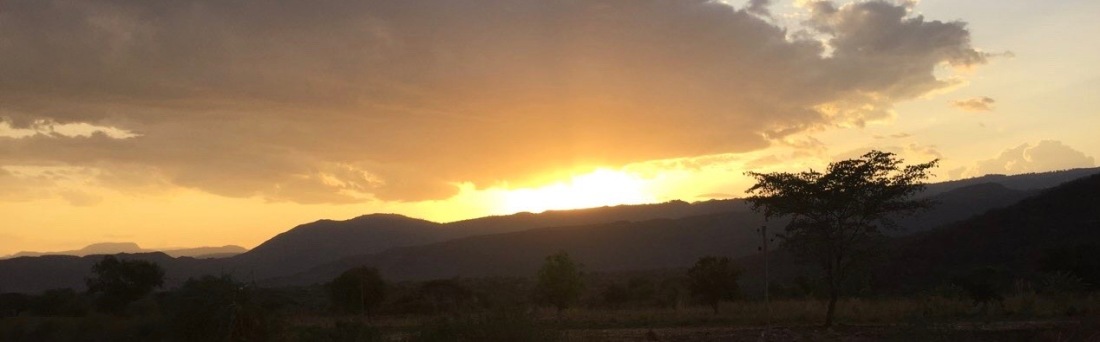
African sunset

I spoke earlier about tangles with authorities. DEALINGS WITH THE LAW My biggest tangle saw me with a renewal request for my visa denied. I was working in a government hospital after ‘peace’ had been restored after the communist take over.

For some years there had been a great shortage of equipment, drugs and materials. The country was just coming out of years of war, and this was understandable. Fortunately  I was able to keep working reasonably satisfactorily because of aid sent out from Australia. I had been working in 3 hospitals where I had a private practice, and public sessions – two were private and the other a public hospital. They very generously collected good second hand equipment, and from donations we were able to occasionally buy new but usually second hand items. We paid for it to come in ship containers. No duty was charged on its entry into Ethiopia, but then everything was a gift.

new drapes
In this photo, as an example, we had provided the following: the operating table, the portable light, the oxygen concentrator, the suction machine,the drapes and gowns,as well as the diathermy machine, the leads of which you can see covered in plastic. WE had the drapes and gowns made locally.

Suddenly, whilst a container was on the high seas, an import tax was announced amounting to some 35% of the new value of these gifted usually second hand items.

It was too late to not get it, it was already on the way.

After several days at the ‘goomrook’ (customs) I was handed a bill. To get the money I had to sell my second hand Toyota Land-cruiser. The government had paid nothing for all that we had shipped in for about four years. The bill was paid by me.

Then the fun began. The powers that were in place refused to release the container. So after three months of phone calls, pleading letters I sought an appointment with the official whom I knew had both the power to stop release or to grant permission. He wasn’t the head of health (she was a pleasant lady from a smaller tribe) but the highest in line from the ruling tribe.

After over two hours of my persisting to hear the ‘no, no, no’ which he kept uttering, and I think that he realising that there was another way to say ‘no’,  said ‘ok, I will, come back tomorrow’. If I had agreed I knew that the chance of getting another appointment was minuscule. So I indicated my thanks for the ‘yes’, but as the paperwork was in front of him I wasn’t leaving until I left with the signed form. After about another 30 minutes of discussion, he said ‘ I will, but I don’t see what you see in those people!’ Naming the tribe amongst whom I was working. I should have shut up,, I guess, but couldn’t help saying ‘when you get to know them, Sir, they’re almost human.’ I got my paper and a little later the stuff. I’m convinced that he wanted the stuff for his own area.

I had won the battle, but I lost the war. Soon I had to seek a renewal of my work permit and visa. They were denied.

Some six years later, with another person in power, I got a visa again and spent another ten years working in the country.

Dominic Cartier

DEALINGS WITH THE LAW

IMG_3034

Relationships with the law aren’t always easy. To quote the old saying “the law is an ass”. Yes it is, but no it isn’t. I think you know what I mean. Sometimes sticking to the strict letter of the law seems crazy, but I won’t follow that line any further.

I have three episodes at least of disagreements with law authorities in Ethiopia. There is a fourth more complex one that I may tell you about sometime, but not today.

In the first, the ‘traffic’ as they call them stopped me up in Addis. There you drive on the right. Coming to a corner where there were four lanes travelling each way I wanted to turn left. I wanted to cross in front of four lanes. Those coming in the other direction had a stop light. In the past, two lanes had been allowed to turn left, but, unbeknown to me, the rules, the law, had changed – now, one only could turn. So, doing what I thought I knew was right, I turned from the now illegal lane and was whistled over by the ‘traffic’.

As a bit of background, if fined in Addis they take away your licence, give you a fine slip, you immediately go and pay the fine, then come back to the same person, show your receipt and get your licence back. By then the person with your licence may or may not still be there. Or you can pay a bribe, which I am not in the habit of doing.

The guy asked for my licence. Resisting the temptation to tell him that I drove without one (I did have one) I simply said ‘no’. I think it shocked him a bit. ‘Why not?’ I was asked, ‘don’t you have one?’. So I explained that I did but that I knew how fines were handled, that I had a 500 km trip ahead of me and I wanted to be on my way. And, without stopping for him to get a word in, I asked if he had ever done wrong and been forgiven? Again, without stopping, I said that I knew that I had accidentally done wrong, and ended by saying ‘please forgive me!’ He smiled, looked at my licence which I had slowly taken out, and he waved me on. Nice guy!

A patient was brought to our hospital from the prison with a broken thigh bone (femur). We were ordered to treat him. It turned out that, according to him, ‘they’ at the prison had broken his leg. We did not have facilities to put in an intramedullary* nail which would have allowed him to walk in a few weeks, so he was put up in traction. Those bones heal slowly and usually need about three months to heal properly. I think the guy preferred our bed to the prison. Less than a week later the prison guards were there to take him back to prison. After a long and fairly heated discussion they left, without the patient, but with my promise that if they returned with an official letter stating that they would take him to the police hospital in Addis, I would fix him in such a way that he could travel the 200+ km to get there. It didn’t take long for them to get the paper. I knew that, as they drove out from our hospital, if they turned right they were going to Addis, if they turned left they were not. They turned left.

I was only about 30 in the late sixties. Maybe I was young and foolish. Not long before an important person had been involved in an accident near the hospital. Having treated the injured, I had been requested to write a legal report as to what had happened. The report obviously didn’t please the wealthy guy who had caused the accident. So, a policeman arrived in my office and offered me a considerable bribe if I would rewrite the report according to his suggestions. Maybe foolishly, but with great satisfaction (he was not a big man) I picked him up by the scruff of his neck and the seat of his uniform and threw him out the door. I am thankful that I heard no more, as I suspect I was right to refuse but wrong to do what I did!

* intramedullary nails were first used in WWII to allow the Germans to rapidly mobilise prisoners of war who had broken femurs, for example, pilots who had parachuted out of their planes. This concept is used a lot these days.

Dominic Cartier

One Sad Memory, One Glad Celebration

African sunset

The SAD One

When I returned to Ethiopia in the 90’s I had the ‘run-around’! I went with all the paperwork settled by both ends to become Associate Professor at the Black Lion (the large University) Hospital. The paperwork was not enough for a newly inducted set of hierarchy. So I was allocated as ‘Head of the Department’ at the soon to be opened Kidus Paulos Hospital (St Paul’s). Before it opened I was twice demoted to become another surgeon on the second surgical department in that hospital. In addition I was employed by the University on a contract – to be paid a salary, which was not exorbitant but livable. The contract was made in Ethiopian birr when the US dollar bought 2 Ethiopian birr. Within weeks without warning US$1 equalled 6 birr. At the moment it is nearly US$=30 birr. So my wage was effectively reduced by two thirds. I was still paid at the two birr level! Then the Kidus Paulos was slow in opening.

After pleading negotiations I was permitted to work at the Menelik II Hospital until Kidus Paulos opened. But I was paid from the Yekatit Asara Hulet hospital. Which brings us to “The Sad Memory” mentioned above.

Yekatit is a month of the Ethiopian Calendar. Asara hulet is the number twelve. (February 19th in our calendar – our calendars don’t match.) So why is that a sad memory?  It is quite a story….

During their occupancy of Ethiopia 1936-41,  the Italians had apparently built a huge poison chemical factory near Mogadishu in Italian Somalia. They had 37,000 gas masks kept for their own use. The fear, from an Ethiopian point of view, was that they themselves were a major target for attack by chemical warfare. In a failed attempt to assassinate  the Italian Viceroy of East Africa, Marshal Rodolfo Graziani; he was injured but several Italians were killed. The Italian response was over the next 3 days to slaughter over 30,000 Ethiopians, including about 20,000 in Addis Ababa (at that time 20% of the population of Addis!) Talking to local people they say that, as part of this slaughter, 1,000 people were lined up near the Sidist Kilo corner in Addis and the Italians shot every tenth one. The Yekatit Hospital is built at Sidist Kilo and there is a monument there until this day. Italians still walk and work in Ethiopia. The Emperor, on his return from exile in Britain after the Italians were driven out, said that they should be forgiven. Not many Italians, however, are seen out and about on February the 19th!

The GLAD One

If you look in your computer to see if an African Nation has ever conquered an invading European force unaided you are given “The Battle of Adwa”.  I can find no other. The Italian invasion discussed above was the second of their major attempts to conquer Ethiopia.  In 1896 the Italians planned to enlarge their empire in Africa. They already had Eritrea as a base. In the end after much fighting the countries faced each other at Adawa. Without trying to go into great detail the following facts seem to be basically true.

  • The Ethiopians had a much larger force being on home soil. Roughly 80,000 to 20,000
  • The Italians had much the better war machinery.
  • There was previously after some squirmishes an agreement between Ethiopia and Italy with different wording in the Italian and Ethiopian copies. Menelik II acted on his copy which meant having discussions with Europe without going through Italian sources. Italy by their copy of the agreement obviously saw Ethiopia as a subject nation and invaded.
  • On March 1st 1896 the Italians were routed. The story is complex but the victory complete and is celebrated with vigour every year.


Dominic Cartier

A little about the Amharic language

Amharic is the language of the Amharas, one of the major tribes of Ethiopia. Emperor Haile Selassie (The power of the Trinity) was an Amhara and sought to make it and English the main languages of Ethiopia. French was, for a while, a popular alternative and a number of words in modern Amharic also come from the Italian invasion. There are apparently 83 languages in Ethiopia giving rise to about 200 dialects. Ge’ez is the old language of the Orthodox Church and introduces the ‘ in the middle of a word to indicate a glottal stop.

To show how different these tribal languages are I will give four greetings with a rough English translation. I will use our script to give an idea of how they sound

  • Amharic greeting is classically Tenastilygn – a shortened form of the sentence Igzeehabeeyer Tena Yisterlygn  – May God give you health for me.
  • In Oromifa – Neggaa, Fiya, Errga – Hello, how are you, it’s nice to smell you. In this situation I think the ‘smell’ is conceptually ‘to have your presence with us’.
  • In Wolaitata – Sero Lo’oo Lo’oo Fiedaitey – Hello, How are you., nice to see you.
  • In Hadeyan – Tuuma, Tuuma. Hello, hello!

Haile Selassie attempted to make Amharic the common Ethiopian language and it was taught in primary and secondary school with English being added later in primary school. English was the official language of tertiary education. After Haile Selassie was murdered the era of Mengistu HaileMariam (The kingdom of the power of Mary) sought to elevate other tribal languages with English as the second language, leaving Amharic for the Amhara tribe. It is thought by many that, whereas Haile Selassie was seeking to unite the country, Mengistu was seeking to divide the tribes to make the country easier to rule.

3 languages
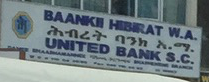
Above the sign is in Oromifa which uses the Roman script and a lot of doubling of letters eg baanke. In the middle Amharic, And below English. Addis Ababa is officially a Federal State but used to be Oromo territory so that comes first and Amharic is in smaller letters.

Certainly when I went back after the overthrow of Mengistu I experienced some trouble from this. I was living in the Wolaita area and patients coming from the Hadeyan area only 40 km down the road could frequently not be understood by the staff. The present government seems to now have a three language policy.

DCP_1734 copy
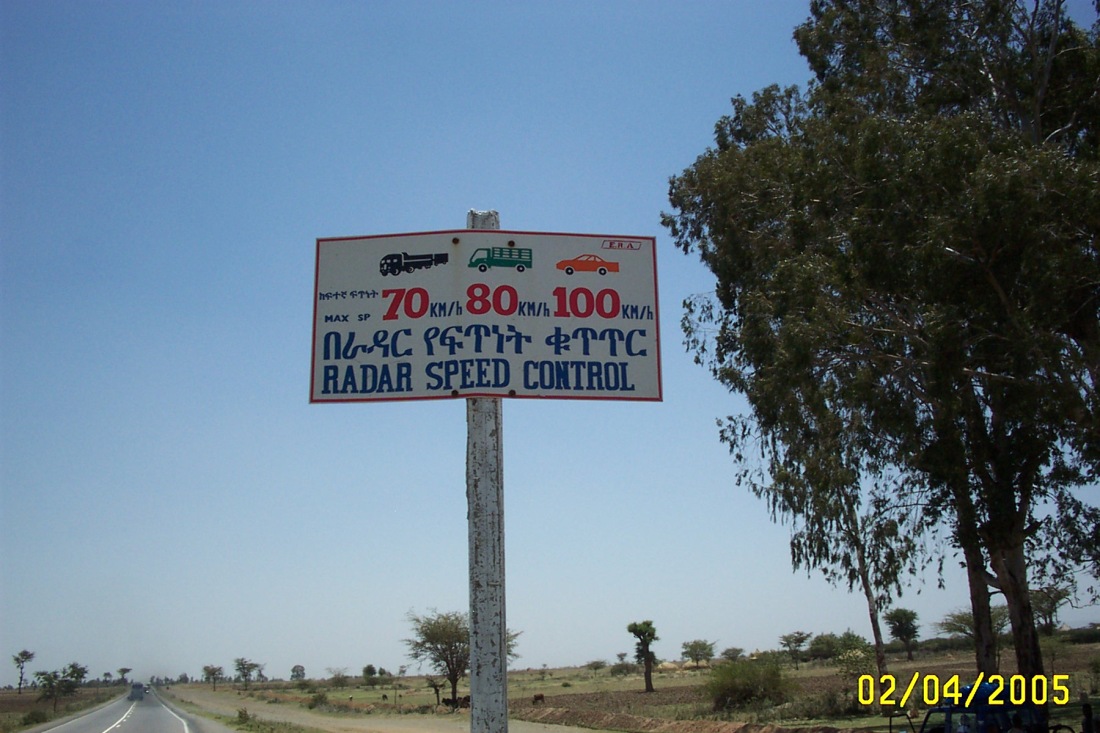
The 3 languages used here are symbols, Amharic and English. In voting, because so many are illiterate each party has a symbol to show the voters whom they should choose. I never saw a radar gun on that road!

In Amharic there are two ‘t’s – both normal for them but with very different meanings. Also with ‘k’s and ‘ch’s  differences which we describe as soft or explosive. You can get into real trouble. I was in the bank with a couple of friends and our business was drawn out. I said to my friends  ‘Chiger alle?’ thinking I was saying ‘is there a problem?’ but actually saying ‘do you have pubic hair?’ Embarrassing for them and for me, when it was explained. But their letters are written differently and so easily read but not easily heard by us, who think anything like a ‘t’ sound is in fact a ‘t’. In Amharic ‘sebake’ and ‘sebake’, depending on how you sound the ‘k’  means a ‘preacher’ or ‘a bearer of false tales’.

In English we have many letters and letter groups with same or different meaning. We spell Monday with an ‘o’ and say it with a ‘u’. We have the ‘ou’ and say it differently in the following – cough, mouse, tough, through – and pronounce it differently in each word. We have the one letter eg ‘t’ and pronounce it differently in different words. The ‘t’ in tough and the ‘t’ in take are made with the tongue in very different places. Or more significantly the ‘c’ in cat and centipede. Say them and see how your tongue is in a different position for each. We have f’s and ph’s which sound the same. In some of the languages you don’t differentiate p’s and f’s, so people, when they speak in English  go to fray or pray at church; they wear certain clothes either because it is the new fashion or new pashion, without recognising the difference. In Amharic if you know the syllabet you can read it with the correct sound even if you maybe cannot understand it!

IMG-3041
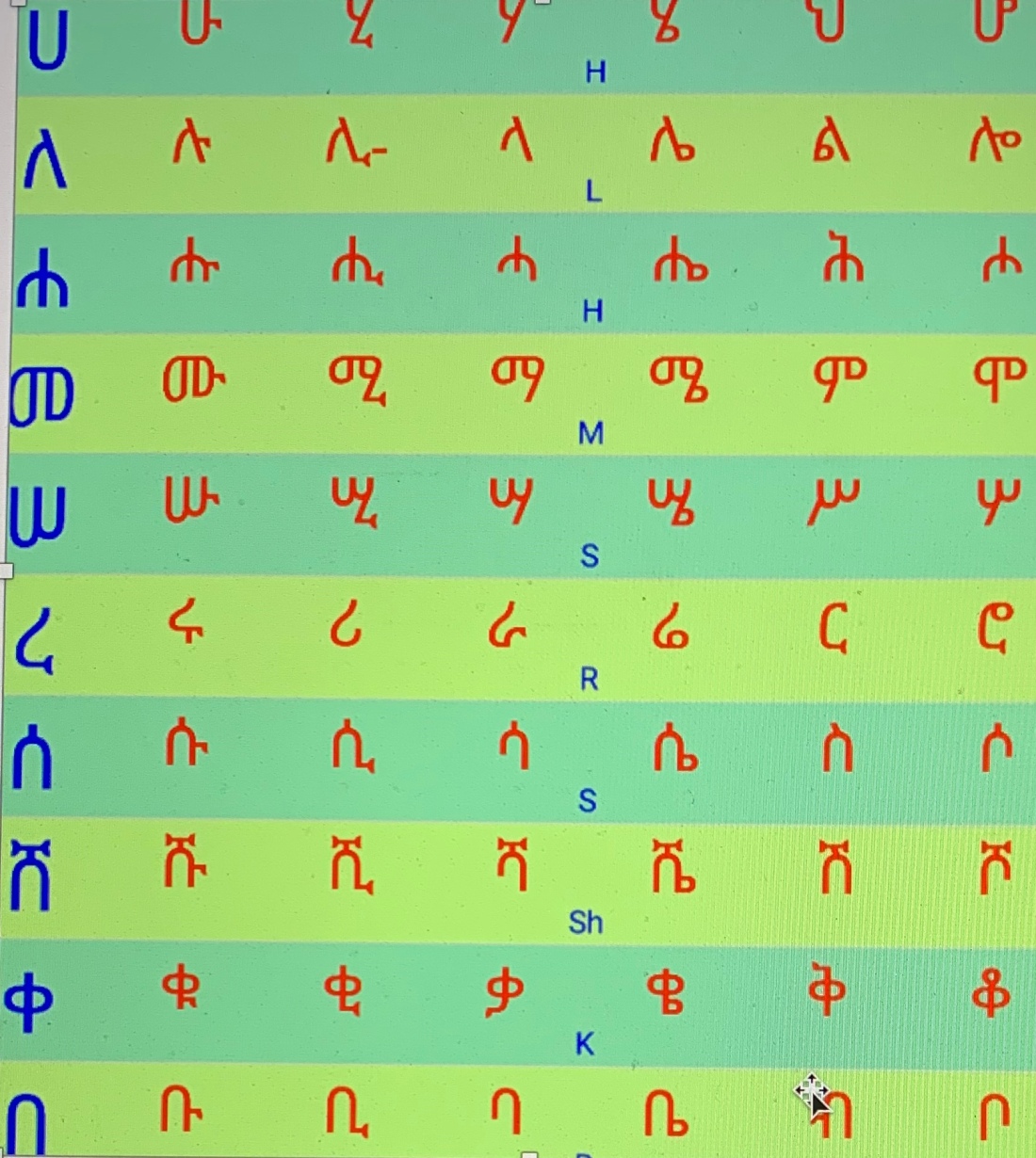
The fidel is not really an alphabet but a syllabet. The second line is basically the ‘l’ sound but the seven syllables as go across from left to right are le,lu, lee, laa, ley, li, lo. There are 238 basic syllables and another 79 special ones, punctuation marks and numbers.

I once told a patient that, as I had spent hours fixing the problems which his venereal disease had caused, ‘that if you have sex with anyone apart from my wife after this, I will kill you!’ I used the sound for my instead of the one for your. Fortunately he spoke in Oromifa and after my Amharic speaking fellow workers got up from the floor, having ceased rolling around in laughter, they translated what I had meant to say!

Learning another language is always a challenge and we all make mistakes!

Dominic Cartier

King Jafir the second.

Most people know something about Emperor Haile Selassie of Ethiopia. One of his titles was King of kings. This is no reference to the Biblical title of Jesus whom Christians call King of kings, although Haile Selassie was an Orthodox Christian. The word king is defined as a noun meaning ‘a male sovereign or monarch; a man who holds by life tenure, and usually by hereditary right, the chief authority over a country and people.’ In many countries, however, there can be multiple kings. The term here is used to define a life-time position of authority over a group of people. Thus in Haile Selassie’s time there were many who were called kings. I, for instance, in southern Ethiopia have sat at a meal between the Buna king and an American Ambassador acting as the co-translator from the Buna king’s language to Amharic and then by me from Amharic to English. The king was there all powerful over his tribe even though by that time Ethiopia was a so-called democracy.

One of the kings under Haile Selassie was King Jafir II. His father King Jafir I introduced Islam into the Oromo people in the Jimma area of Ethiopia. The story as told from the Muslim and the Christian sides varies and isn’t of relevance to this article.

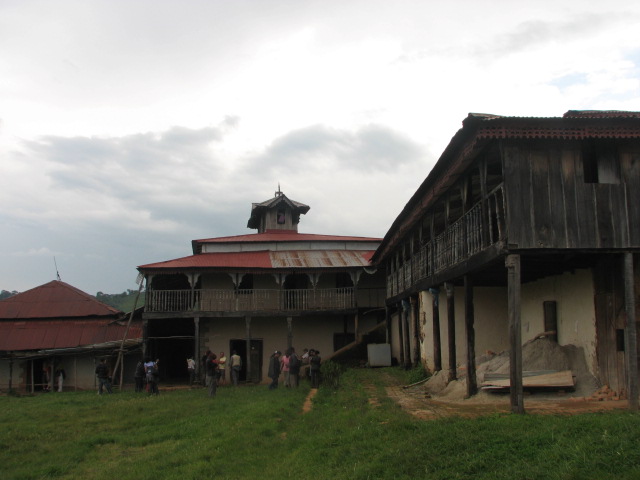
King Jafir II was born in 1861 and reigned as king 1878 to 1932. His palace although made out of mud still stands and is a major tourist site near Jimma. Unfortunately it is beginning to crumble.

Jafir photo
The king was a big man said to be over 7 feet tall.
Jafir window
The open window is suitable for the average sized person; the closed one was specially built for him to look out over his kingdom!
Jafir collage
On the left you see an Ethiopian teenager sitting on Jafir’s chair. In the centre is his super-duper king-size bed. And on the right a double minaret-ed mosque which is just outside the palace.
IMG_3078 copy
The outside of the palace. It has many rooms in part at least because he had many children. I have not been able to find a family tree for him but as a Muslim he was entitled to as many as four wives and many important people had even more.
IMG_3075 copy
Children’s rooms were upstairs and the courtyard below for their pleasure both for personal involvement (eg in swordsmanship) and for watching various contests and acts.
DSCF2056 copy
Overlooking Jimma city from the palace. Jmma is one of the larger Ethiopian cities.
DSCF2064 copy
Jafir was king of a very fertile countryside – famous as the homeland of coffee.

I enjoyed my visit there.

Dominic Cartier.