Arriving at Shashemane.

Looking East travelling from Addis to South

We travelled for the first time to Shashemane in April 1968. We had arrived in Ethiopia 16 days earlier and we were taken down the 250 Km ride by a couple of missionaries who were travelling further south to their station (another hospital 120Km on the road leading to Kenya). It was good to hear of their experiences in Ethiopia where they had been for many years. Our mission station was big and very busy. There follows an ‘Excerpt From: Barry L Hicks. “Have Scalpel – Will Travel.” Apple Books.’ 

We arrived in Shashemane at about three o’clock in the afternoon and were taken straight to the home of Dr Lindsay and Mrs. Marion McClenny, some of the loveliest people one could ever wish to meet. They were due to go on furlough in a few weeks and we just had that time to be inducted into the work. As we arrived and were introduced Lin, usually called ‘Mac’, told me that he had a patient he wanted me to see urgently – but we had time for a cup of tea first. (Tea provided by Americans! And hot tea at that.) By 3.30 we were in the hospital and we eventually got home for the evening meal at about 11.30.

In the mean time we had seen the patient he wanted me to see – a teenager with a right sided large bowel obstruction due to a huge caecal tumour – and two obstetrical emergencies both of whom needed surgical intervention; we had also seen a couple of other lesser emergencies. Mac dealt with the obstetrical cases – a high forceps and a Caesarean – and I did the right hemi- colectomy for the teenager.

I knew that I was going to have to deal with the obstetrical and gynae procedures as soon as he left and so was keen to learn all I could before he departed on furlough. The specimen of bowel removed from the girl, containing the large mass in the caecum, was sent to the only pathology laboratory available in Ethiopia at that time at the Black Lion Hospital in Addis Ababa. The report arrived exactly one year to the day after the operation. It was fortunate that the patient was not kept in the hospital until the report came back. Typical of patients in countryside Ethiopia, she never returned for any follow up anyhow, so I don’t know what happened to her in the long run.

Very early in my stay there I was asked to review the seven hundred inpatient lepers. I think that I was the first one with any specific leprosy surgical training who had ever been there and if not the first then certainly the first for a long while. In India I had learned a lot of reconstructive procedures and doing this review I had the twofold objective of finding those who could be helped by surgery and to discharge those who did not require inpatient therapy. Thinking about long term hospitalisation had changed rapidly in the few years prior to this period of time.

On the first count I found few who wanted surgery, basically because as farmers they valued strength in their hands above the restoration of the finer movements such as those used in writing – the majority couldn’t write in any case. Sadly also they were valued in their families because of the loss of sensation which allowed them to lift hot things, such as cooking pots, off the fire without pain. Many of them, although the infectious element of their disease had been cured, were left with marked deformity and shortening of their fingers.

The leprosy hospital was built largely by money given by the Leprosy Mission on land given by Princess Tenagnework. It was a 50 bed hospital with an operating suite.

Dominic Cartier


A snippet from my book…

Taken from the front veranda of our home – living in retirement!

I am, I guess, getting a bit lazy with the hot, muggy weather and the aging process. So what I am doing today, and may continue to do for a while, is posting a segment of Chapter 20 from my book ‘Have Scalpel Will Travel.

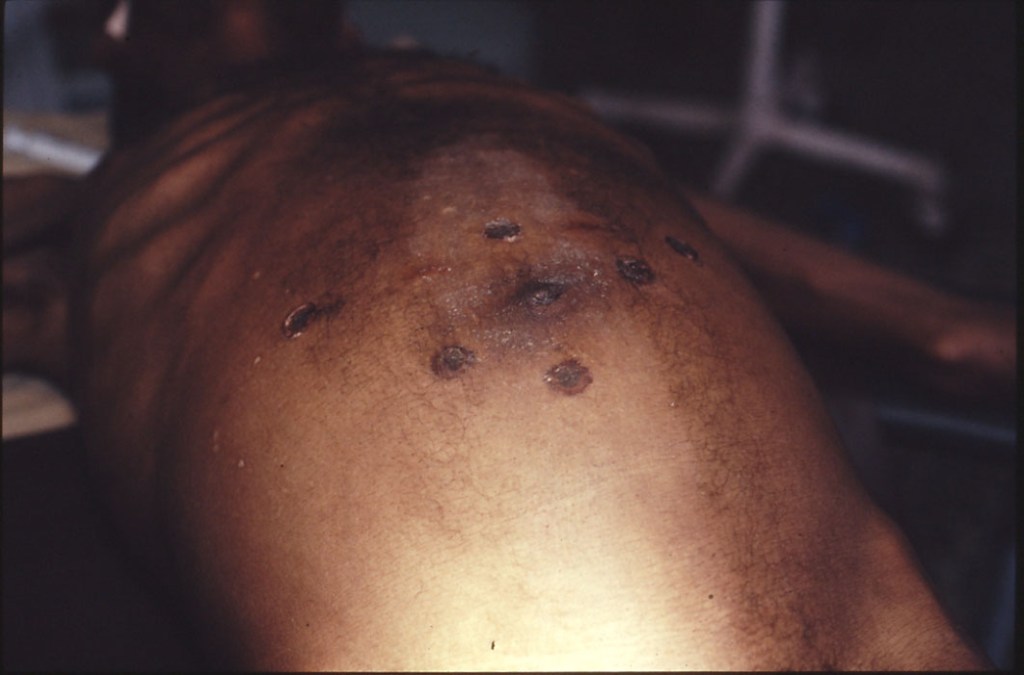
The chapter is entitled ‘A Different Culture’. I was working on a Mission Station as a Surgeon, which was a full time job. But soon I discovered that people had to be assessed and treated taking into account different things. One of these was their religion. For instance i) the dietary requirements can cause real problems treating a post operative case during Ramadan or ii) the strong religious commitment of some created unwillingness to be seen for examination particularly by a foreign infidel iii) There was a very high incidence of low large bowel obstruction due to volvulus and in treating this certain procedures, of necessity, needed the creation of a colostomy. This stopped them going into the mosque to pray. Sometimes they chose to die, although with experience we were able to reduce the incidence of needing a colostomy. This led to one of my areas of disagreement with the Surgical Department in Addis. I am delighted that my way has won the day all over Ethiopia by this time. As seen in the picture below patients, they often presented with infected burns on their abdomens – burnt to try and drive out the evil spirits causing the problem. Or often the patient had drunk the blood of an animal sacrificed to appease the spirits causing the problem. These last two situations were seen because of the animist background of the community.

My book is an ebook, presented through Smashwords. The author is Barry Hicks and you’ll have to decide if this article or the ebook is written under a pseudonym. It is easily found on internet by typing in Smashwords.com Have Scalpel Will Travel. Memoirs of an Older Surgeon. It’s cheap and I think an interesting read; you may or may not agree on that! There are no gruesome pictures, although I have many!

Continue reading “A snippet from my book…”

People make or break your day!

Often one hears of, or reads about, nasty experiences dealing with people across the counter. Well in the last two days I have twice experienced just the opposite. That is I’ve had contacts where people have made my day! I am in a run of seeing doctors and having tests which isn’t always the most pleasant of experiences and being made to feel comfortable is great.

First up I had to see a specialist whom I had known during his early post-graduate training in a department where I was a senior. I saw him late in the afternoon on the day when he had just arrived back from his Christmas break and I’m sure was exhausted and just wanted to get off duty. But for the first half an hour we talked about the past, he obviously had in some way or other followed my path when I had returned to Ethiopia. He even knew that I had had a period of teaching French! Then he dealt with me in a most kind and professional way, explained his thinking and ordered several more investigations which he wanted performed. And at the end treated me pro bono!

Then this morning I had to go to the X-ray department and sort out a tangle of appointments. At the end of of last week they had declined to carry out a CT scan because of things from my past history. They had ordered other blood tests, the results of which I was carrying with me. I also had the request for the test which they had declined to do earlier and two new requests one of which I wanted added into the previous CT request and the other which was totally different. There were obvious advantages in combining the two different CT scans.

Approaching the desk when called we (my son and I) were met by a beautiful very young looking (that’s almost everyone these days) receptionist. She expected to just open the book and give me an appointment but it wasn’t that easy. She had never, I think, been faced by an old man who knew what he wanted and would, if possible, like his own way. It was not easy for her because they had to contact someone to read the results of the previously ordered tests; she had never dealt with a patient wanting to have two requests ordered by two different doctors rolled into one; then the third test couldn’t be done in their radiology unit and the barium needed for it is difficult to find. I think because of Australia-Chinese relationship at the moment it is hard to get. Then the possible alternative to be used as a contrast in the examination had to be approved by the surgeon ordering the test, and he could not be contacted as he was operating. She sought help from a senior, another young looking very pleasant lady, and together they worked on the problem for about 45 minutes.

Through it all she was calm, professional, friendly and nice to work with. Thus I have had two very pleasant contacts in two days. Now I remain hopeful that the tests will be as comfortable and that the results are decisive and nice! I don’t know her and maybe we’ll never meet again, but she made my day! I was very happy to tell her so.

Dominic Cartier

A doctor going to the doctor.

I guess that anyone with expertise in a certain area unconsciously, or maybe consciously, wonders how they would have handled what they’re looking at or what they would have said when they are listening to a talk on a subject about which they know a fair bit. the other day, I as a lay preacher, was talking to two ministers who had been in the audience where I had just preached. One of them said that he had wondered how he would have handled the topic. And he may well have done it better but was too gracious to say so!

I was a specialist surgeon and the GP before whom I was sitting was one of my interns years ago. I wonder how he felt! When I see him, before speaking he often asks what I think, not because he’s not in charge but in deference to our past. And obviously he knows that as hard as I try not to self diagnose I have already thought about what is going on. And I know that he doesn’t want to take our conversation to all the possibilities as to what the diagnosis may be, or to where investigations and treatment may lead us. I felt sorry for him as he (we) worked on a plan as where we would go to sort things out.

I wondered what I would have said and what he was going to say, as I knew that he and I were thinking parallel thoughts. So, and I think he handled it well, he said ‘you know that is usually a significant symptom.’ Still there are exceptions!

Now to await the specialist visits and the test results!

Dominic Cartier