I have posted previously about my time working in a leprosarium. Working in a leprosarium 1968-74 And about a non leprosy medical work. The leprosarium extended – part 1 I mentioned there that was more to this other side of the non-leprosy work beyond the medical work.
The Other works for the general community consisted of the following….
A school with an enrolment of about 600 for the surrounding community. This only went to grade 8. A significant number of the pupils were mature age coming to school for the first time to learn the 3Rs. So in grade 1 you might have a six year old sitting next to a 21yo. Teachers were in such short supply that after 3 years as a student you had to become a teacher for a year, before returning to your studies. It seemed to work. One student who went to the leprosy school is now a professor of surgery!
A church with associated outreach. We were in Muslim poorly educated area. So many of our workers in all departments were people from different tribal areas and most were Christians. So the church was several hundred strong. They didn’t have hymn books but many, not being able to read, had developed their ability to memorise. So they had a wide variety of hymns of which they could sing a number of verses. I remember how if a baby would continue crying the preacher would say “haven’t you a breast, woman?”
There was a small administrative unit consisting of the station head and a secretary. They among many other things supervised an electricity generator as often the government service failed. This was a major problem if we were operating at the time the electricity went off line. Operating by torch light while you waited for the generator to be turned on was not fun! But we always kept one handy.
There were mission and government reports to be written, wages to be paid, equipment, medicines etc to be ordered (much of it from overseas, and months in advance). I’m glad someone else had to do it! Continue reading “The extended work – part 2”→
I have previously posted about my time working in a leprosarium. Working in a leprosarium 1968-74 I mentioned there the other side of the work carried out on the same station. As leprosy only rarely has acute problems I spent most of my time in the non-leprosy part of the program. I only regularly spent 2 half days/week with the leprosy program, besides seeing the occasional emergency in the leprosy department.
Other work for the general community – this post will only discuss the second non- leprosy medical work. There were several other aspects for another day!
There was an (officially) 30 bed hospital with an added 12 bed TB ward and an attached outpatient clinic.
It was the only hospital covering a large area and several million people. Through the country there were scattered clinics run by dressers (they were not to nurse standard but with some training, and had permission to prescribe a few simple medications) and a few mission clinics but the nearest hospital south was about 80 km away; north 200 km; west 150 km; east several hundred km, and this in a heavily populated, very fertile, part of Ethiopia. We were at the cross roads which led in all 4 directions. At that time cars were few and far between and public transport was limited. As loaded trucks often carried many people on top of their loads we often had mass emergencies if there were major accidents. And there often were!
It really wasn’t beds for just 30 patients. We used to put smaller children one at the head and one at the foot of the bed. In times of great overload we used to sometimes put patients on mattresses under or between the beds. There were verandas on the east and west sides of the main building and we would spread mattresses on them. Sometimes in the rainy season there would be a rush to change the ‘veranda’ patients to the other side away from the rain slanting in from one direction or the other. Most people chose to go to the clinics or to natural healers before a percentage came to us. We could never have survived if all those who should have, had come!
This general hospital had a small ‘operating room’ which was mainly used for obstetrical deliveries which needed forceps deliveries. More major cases, obstetric or other general cases, were taken to the OR in the leprosy hospital. We had few normal deliveries apart from the wealthier women from the nearby moderately large town. For a normal delivery they were charged about ten times as much as a poor person with a complicated pregnancy – something about robbing Peter to pay Paul. Unless there were problems after delivery these ladies were allowed to stay about half an hour.
The room was also used to reduce simple fractures and for suturing. The leaded room with the X-Ray machine was attached to the hospital. The machine was an old WW2 field one. A local young man was trained to take the simpler X-rays. See an example of one of the chest X-rays below.
In addition to the 30 beds there was a 12 bed TB complex. TB was very common. Only the very weak or those with complications, like lung collapse or paralysis from TB of the spine, were admitted. Another national worker was trained to aspirate chests and put in chest drains.
The outpatient department was in a separate building. It included our small pathology department. We treated about 100+ cases a day. Apart from acute emergencies, who were sent directly to the emergency room in the hospital, all were seen initially by a dresser. If they couldn’t make a diagnosis, or if the patient returned with the same problem, they were referred to the nurse. If the problem still remained the nurse arranged for them to see the doctor sometime. I, or if there were 2 one of us, tried to visit outpatients just before I/we went to lunch.
Emergencies were common. I remember one day when 3 ladies with ruptured uterus came within 5 minutes of each other! As well as daytime surgeries, planned or emergency ones, many emergencies arrived out of normal hours, so we operated most nights as well on emergencies.
The 4 nurses had the following duties: One was in charge of the general hospital; one of the leprosy hospital including the OR; one in the leprosy outpatients; one in general outpatients. If we had 5, the fifth was on night duty for all the work – if there were only 4 they rotated around taking responsibility for both parts of the work at night. They were very competent and really acted as junior surgical registrars.
I have posted before about our first day in the hospital on our first spell overseas. An introduction to Life in Africa The establishment had a large complex of programs run by a Christian mission. It was on land given by the Emperor’s daughter and it’s distinctive feature was that it was to have a large leprosarium. This was in a period where the concept for many including the government was to keep people suffering from leprosy (Hansen’s disease), certainly those with the infectious variety, apart from the general populous.
The government gave a grant to the mission to help treat 700 patients residing on the land already granted to them. Nearby there was another parcel of land given for the mission to produce food to feed the leprosy patients living on the leprosarium.
The mission took this work very seriously and expanded way beyond just keeping lepers off the streets and treating them in the relatively limited ways available at that time. The work of Drs Cochrane, Brand and Fritschi, basically in India, with their teams had made much progress but treatment was not as available nor efficient as it is today. India was much more developed. I had some time in India with Drs Cochrane and Fritschi on my way to Africa.
The local tribal language was what is now called Oromepha. The greeting was ‘Nega, fiya, urga’ roughly translated ‘hello, how are you? It’s nice to smell you.’ The last bit sounds nasty. But the verb really had broader meaning, including to sense, and I think the intent was something like ‘it’s good to sense your presence’. But because of the use of rancid butter smeared on clothing to make it waterproof, added to smokey fires in houses without chimneys, there was often a fairly powerful smell. When I had been working in the operating room where, in addition to the above, we used a lot of ether for anaesthetics, I personally collected some of the odour. Many times when I got home to greet my wife, with a loving kiss, I got told ‘You stink, go and have a shower.’
Early in our stay, I remember introducing my young son to a lovely bright young man who had come to visit me. The man knew good English. The boy greeted him politely then turned to me and said ‘Dad, do all Ethiopians smell like this?’ The guy was very gracious saying something about kids being like that everywhere!.
The compound had 2 parts. That devoted to leprosy treatment and that for general service to the surrounding community. Today I’ll write about the leprosy part of the work. The general service to the community aspects were almost as extensive! Continue reading “Working in a leprosarium 1968-74”→
Solomon has been introduced previously as one of the teengers in the post A house full of teenagers. As a double orphan we decided to adopt him. Solomon is a common name there, as Menelik I, who the first king of Ethiopia’s long dynasty ending with Haile Selassie, is claimed to be the the son of the Jewish king Solomon, from an intimate moment with her, when he was visited by the Queen of Sheba.
We were planning to bring the 3 boys with us on a holiday to Australia, and that made us put his adoption plan into actIon. We needed to get a passport and a visa for him and there was no one who could legally sign for his application papers. So we made an approach to the Australian adoption agency. They denied us permission because of our age. We were older than 45. (That age has since been raised to 65.) So we went to the Ethiopian adoption agency who said that we could but it had to be by Australian rules. Which meant we couldn’t.
So I, in desperation, went to the Ethiopian Immigration Authorities and asked if they would give me special permission to sign the application paper for a passport. They said “No. Adopt him, and then you can.” I explained the above and was told to forget themofficials and to go to a down country regional court and adopt him.
We did that. We were interviewed. They asked sensible questions, and about an hour later we had adoption papers signed and in our hands. It had cost me the equivalent of about $1.50. By local custom he was my son. Although my wife had been questioned in the meeting she wasn’t mentioned on the adoption papers. He was now ours (well mine at least). If he was ever naughty I was told that your son had …. etc.
When we flew down for this adoption, we were in a small plane. It was his first flight. Looking out the window he asked what the black dots scattered around were. We told him that they were Kraals (local mud huts). He said, “they look like cow shit”. A word he must have learned from his mates at school!
If he was to come to Australia we needed a visa for him. There was no Australian Embassy in Ethiopia but there was a High Commission in Nairobi. I was to bring him to Nairobi for an assessment, a medical check etc and if all was ok to get a visa for Australia. Ethiopians don’t need a visa to get into Kenya.
Before Ethiopia would allow him to leave the country to pick it up in Kenya we had to have a letter from a lawyer verifying that he was in fact an orphan and that we had adopted him legally.
I had previously operated on the Minister of Justice, a lawyer, under local anaesthetic for a large lump on his thumb. He didn’t trust the sterility of the government facilities. I hadn’t charged him. He was prepared to sign such a letter for me but had never written one like that before. If I wrote it he would sign and stamp it. So I did that and took the draft to his office for translation into Amharic, signing and stamping.
I had a call telling me that I could pick it up, but it would cost me US$100. In the 90’s that was a fair bit of money. At any rate my/his letter worked.
In Nairobi he passed his medical and we had an interview with a very nice lady. She was thorough. Eventually she said to me “are you telling me that he is 16?” I replied “No, I’m saying that I want him to be 16.” If over 16 he wouldn’t have been given a visa. She told me that she assessed him as older than that, and that if I had answered “yes” she would have made him have X-rays to accurately age him. (He already had wisdom teeth), but as I had been honest she would give us a visa.
Australia still doesn’t accept him as our son. He was allowed in, because there was then (now removed) a condition of entry if a child had been living with you for more than 4 years that he could get an australian visa. Solomon met that condition.
We all came for a holiday but soon after returning to Ethiopia I was expelled from the country and we returned with just him to live. Several years after he arrived in Australia he applied for citizenship and it was granted. Whilst not academic he has a strong work ethic. He is an Australian citizen. He and his wife both work in an aged care facility.
On first arriving in Sydney he was walking down the street with one of our sons. He saw an elderly lady walking a chihuahua and audibly exclaimed “Do they have pet rats in Australia?” Eventually our son by birth calmed the lady down by explaining that this was almost Solomon’s first day in Australia and they had no such dogs over there. I think she had planned to hit him over the head with her umbrella. Pet owners can be like that!
A sixth child legitimately ours. We found another later!
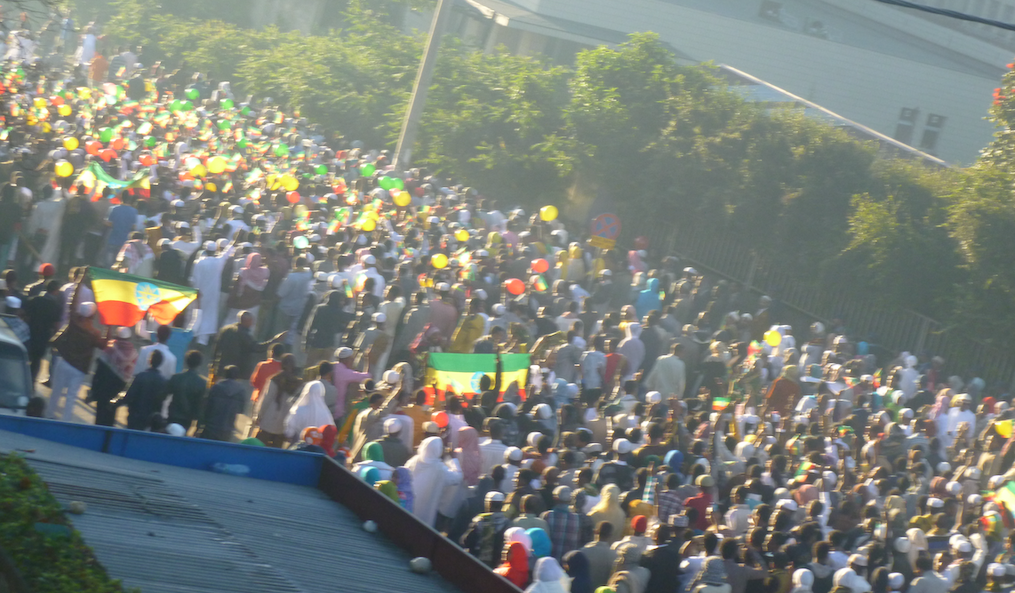
a quiet protest in the capital. The procession was about a kilometre long.
In 1968, when we first went to Ethiopia, we had a lady W/ro (weysero – mrs) Balynish. She was separated from her husband and had four children – 2 girls and 2 boys. We didn’t see much of the girls but the boys were often at our place playing with our boys. Tadessa the younger of the two was almost always at our place. He was confident, cheeky and lovely. He and our oldest son used to ride around on our two horses as bosom pals. We kept in loose contact with him until sadly he died recently. We helped send one of his sons to University. We were friends.
A couple of memorable moments.
Ethiopian food is more spicy than most of ours. I guess maybe this is not so true now as many other nations (eg Indian) foods have become part of Western food. This particular day Tadee (as we called him) was carrying on about how there were no very spicy spices in our ‘ferengie’ foods. “Are you sure about that,” I asked him. “Certain” he replied. So I went to the pantry and gave him half a teaspoon of Tabasco sauce. With great superiority he opened his mouth wide, confidently swallowed all of it; dropped the spoon and ran outside screaming for water. Lesson learned.
He was attending a nearby small church school where they had full day lessons. One Wednesday he came to our place, at lunch time, and was talking to his mother in the kitchen. We could overhear the conversation. He was boasting about how he had bested his teacher that morning. Apparently he had obtained 1 out of 20 for a maths test. The teacher at the end of the lesson asked the students to call out their marks to have them recorded. When asked to give his mark, he replied 11. 1/20 sticks in a teachers mind, so he was called out the front for lying. In spite of knowing that the punishment was a caning, he confidently went to the front and told the teacher that the teacher couldn’t cane him, because his name was Tadessa Cartier! He got away with it.
Calling him into where we were eating he, smiling broadly, verified the story. “What do you think I would do to your very good friend, my son, if he lied like that?” I asked. As the sentence came out his smile quickly disappeared. “You’d give him a hiding?”. “Yes I would. Are you sure your name is ‘Cartier’?”. He clung to our really very tenuous relationship. So I told him that I would give him a hiding but at school in front of his class, as if I gave it in our home no one else would learn a lesson.
After lunch we went to school together. The teacher said the facts were true. So I took off my belt and applied 3 good whacks to the seat of learning. He fled screaming and neither his mother nor we saw him for 3 days. I went off to review the hundred leprosy patients we had on the compound with severe foot ulcers, as I did every Wednesday afternoon. He came back without grudges and carried on as if he was Tadessa Cartier.
I loved that kid and still love the memory of him.


 Heated Stew