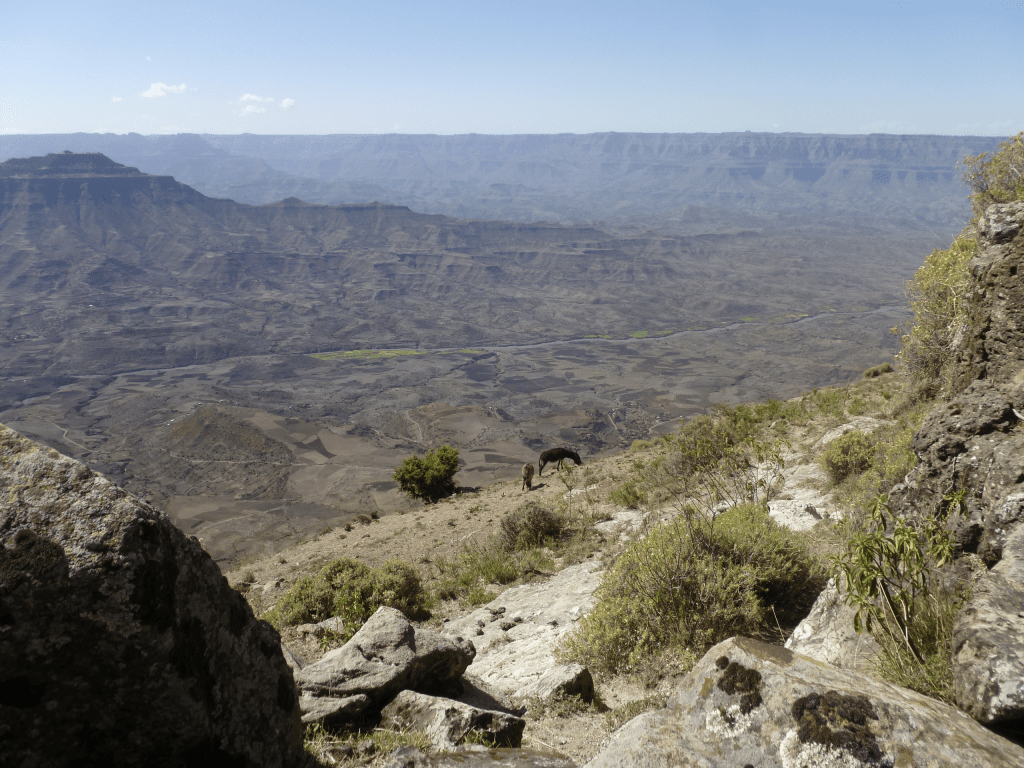
Haile Selassie – a slide discovered.

I’ve mentioned Emperor Haile Selassie in previous posts. I’ve met him, liked him and thought that he did a lot to help his country advance. He created an elected government with partial power. I think basically as an advisory body; he gave up a palace to open the country’s first University; he was very cooperative with foreigners in the country, who were there to help with education and health etc.

He was put under house arrest when the Derg arrested him and took over power. A bit later he had prostatic surgery and was doing well. He was seen on the day before his death by the Professor of Medicine (who had looked after me when I had heart problems) and was declared fit and progressing well. The next day the Professor was ordered to sign a death certificate. I presume he requested a post-mortem, because of his good health the day before, which was denied, and within a couple of days the Professor was dead, and nobody knew where the Royal remains were.

Years later, after the Derg was overthrown, the truth came out. He had been suffocated with a pillow and buried five metres under Mengistu HaileMariam’s desk. Mengistu was the Derg leader. His remains were dug up and buried with much pomp and ceremony in the church where his Majesty had regularly worshipped.

I could say a lot more very interesting stuff about him but I came across a slide in my present cataloging mania. The background to it is interesting, or at least it is to me.

The emperor, in his care for the very poor, had a hospital (Kidus Paulos, St Paul’s) built for the free treatment of the very poor. In the the foyer there was a beautiful mural painted in his honour. With his overthrow his followers felt that the Derg would certainly destroy the mural. So they rapidly but carefully had a false wall built to cover it. The wall wasn’t discovered by the Derg.

After the overthrow of the Derg, when I returned to Ethiopia, I was appointed to Kidus Paulos and was there when the false wall was pulled down. Hence the picture below.
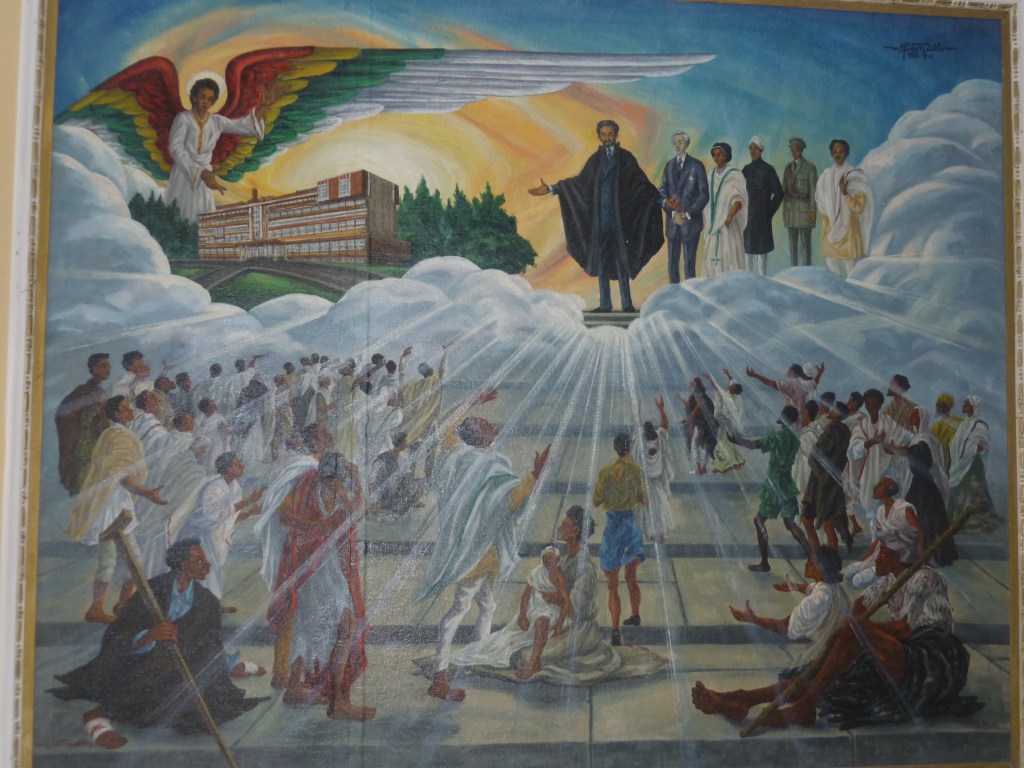
There are some very interesting things about the mural.

  • He was a short man but he is the tallest in the picture. There is a foreigner in the line up of dignitaries and the medical advisor to his government was a Scandinavian.
  • The hospital building looked just like it is painted in the mural.
  • The angel has its wings painted in the Ethiopian flag colours, but interesting in that the order is reversed. Usually the green is on top. In times of war they are reversed so that red is on the top.
  • It was the sunrise of a new era of caring for the poor and the crowd is obviously ecstatic.

Dominic Cartier
Who deserves or wants praise.

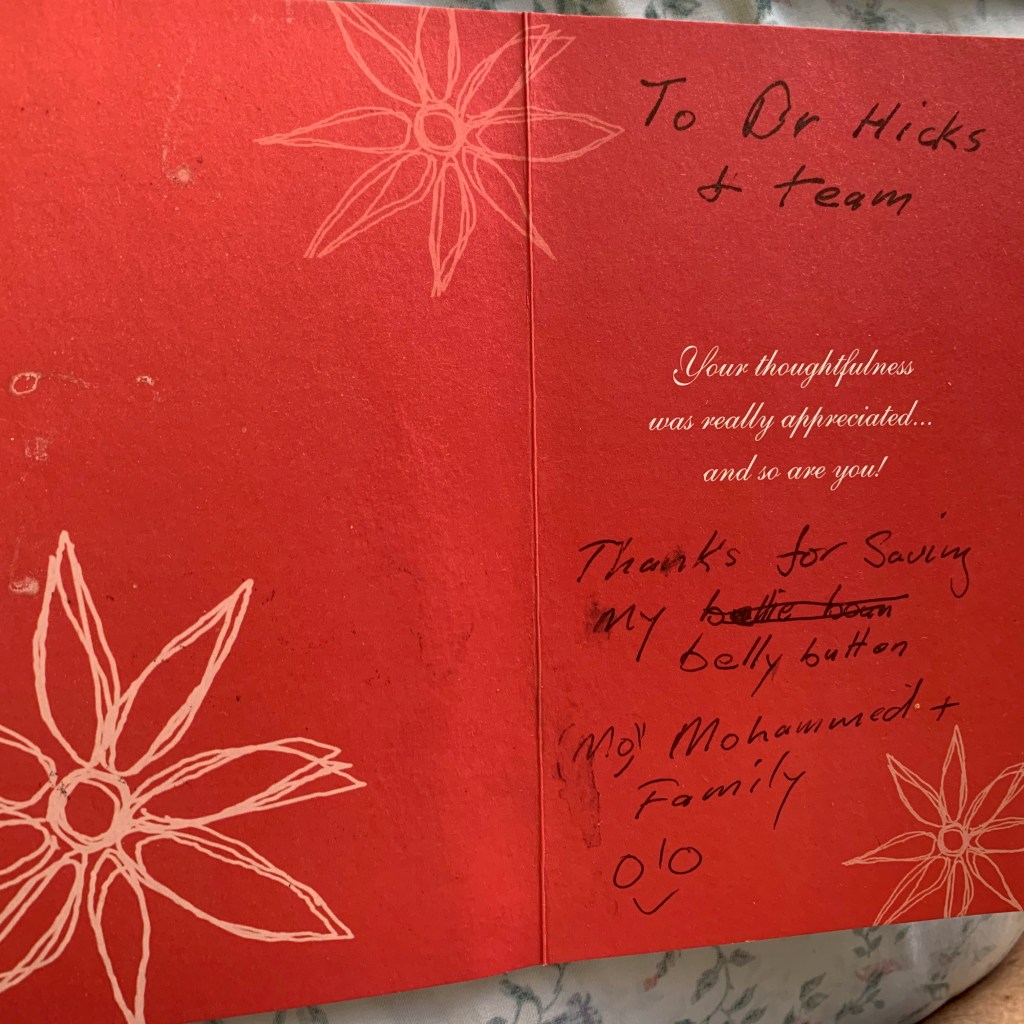
Getting old, if nothing else gives you time to think. Someone very generously nominated me for an Australian medal, and justifiable or not, it was granted to me. Twice I’ve been nominated as Australian of the Year, but I didn’t by a million miles deserve it and didn’t get it. Perhaps what I cherish most is a simple piece of paper which my medical students gave me when I was retiring.

So what am I really writing about?

We had the chance to listen in on zoom to a funeral this week. The funeral of an old lady who died at 96 in an old folks home, well cared for but at the end separated from her family because of the Covid precautions, except for daily visits by her husband. She did not get the disease. She had written a book about her experiences, which I had enjoyed, but the funeral service was a great reminder. Her husband outshone her in the eyes of the world in which they lived, or so it seemed to me. But as I listened to the service, heard the eulogies and then watched the slide show, I couldn’t help thinking that she deserved an AM much more than I do. As a child she only had an education up to grade three, but then as a young adult went on to become a triple certificated nurse. Became a nurse in the back blocks of Ethiopia, raised a family of four and still managed to achieve what I mention below. There are now tens of thousands of women emancipated and brought into real liberated life, in the Omo Valley region of Southern Ethiopia because of her work amongst women in the churches which were founded through the work of her husband and others. You could almost envisage a halo hovering above her coffin. She was a great lady.

Or I remember bringing a young down-country teenager who had never played a musical instrument, nor ever even seen a piano, into a room where a lady was playing beautifully. He listened in amazement, and when she left he went and sat down at the piano and played with the notes. Minutes later he was playing the tunes of the local songs he knew from his countryside background. Amazing – to me, who occasionally while singing accidently hits the correct note! What talent. I remember a visiting doctor friend saying that he wondered how many young geniuses were lying with bare bottoms up to the sun just watching a few animals.

Or now we have a young man (at least 25 years younger than me) living with us so that my wife and I can remain living on our little farm. He’s very naughty because he does lots of things that he doesn’t have the pieces of paper which the government want tending to confuse them for ability. He fences, builds roads, adds a patio, builds a small kitchen and replaces cracked walls inserting windows to bring light into a darkened area, puts in electrical points, answers all my questions that I need answered to keep my computer working, and many other things. But no one employs him because all of his Tertiary degrees (4) are seen as impractical. They are linguistic and theological and not seen as practical. His wife left him, so some denominations have taken away his licence to preach; others are so liberal that he cannot sign their bases of belief.

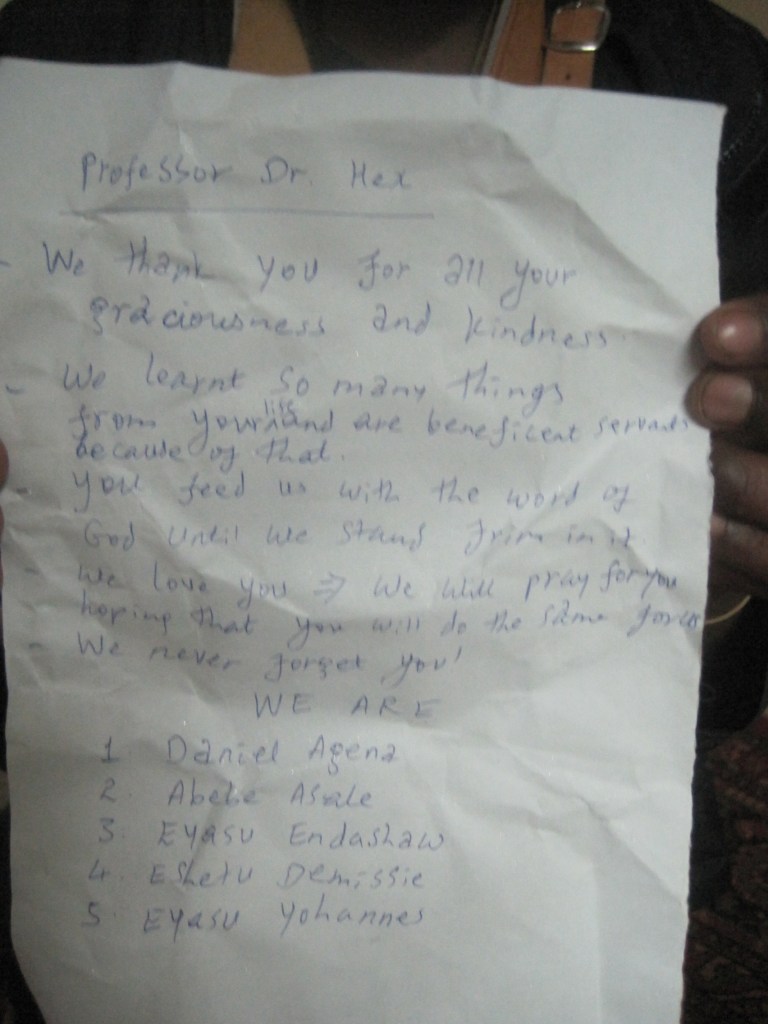
Among my slide sorting I have come across two pieces of paper which give me more joy than the several accolades which I have been given. I share them with you.

The undersigned were all final year medical students, who asked me in addition to teaching them medicine to give them some Bible teaching. You may be able to understand why sometimes I found their English a bit difficult.

They are more important than this…

There were a number of expatriates, mainly from India and the Philippines, but I was the only white person in the department of health and there were only two of us on staff in the University. Arba Mintch University had 39,000 students in 2018. The hierarchy of the University were very gracious to me but the words of a child patient and of 5 students mean more to me. I’m not ungrateful for the several go away functions and the gold medal, but a patient’s or a pupil’s thanks is worth so much more.

Dominic Cartier

Living in Another Culture

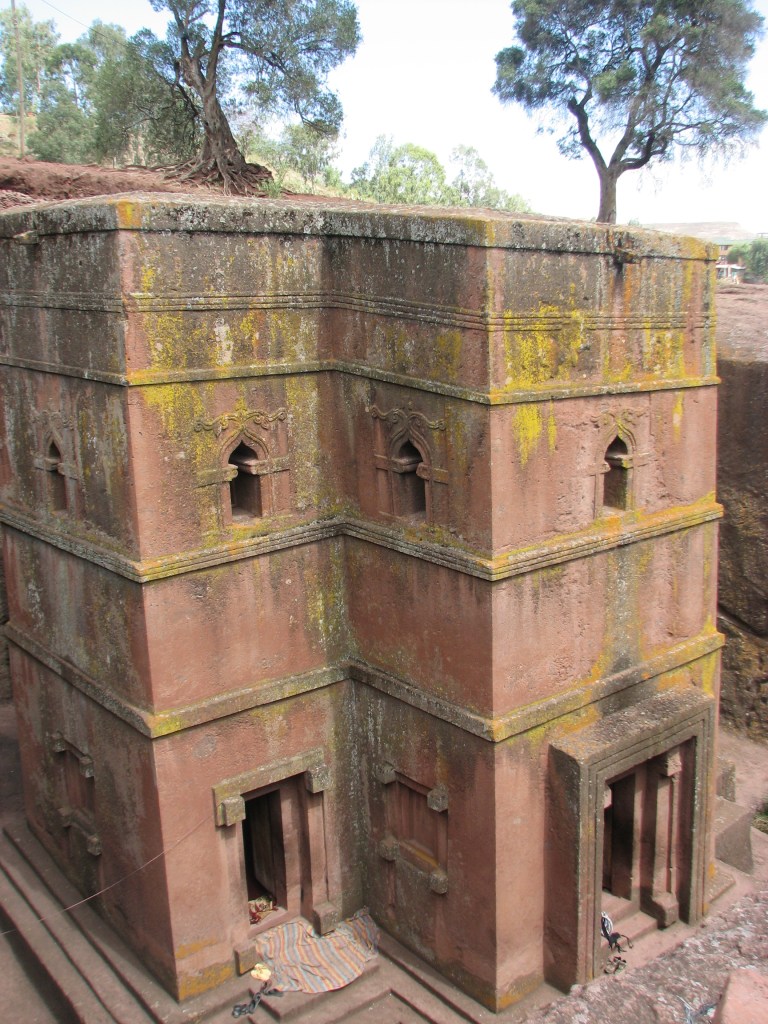
I can’t vouch for the absolute truth of all of this, but a lot of people escaped from the Crusade wars in what is the Israel area of today, via a slightly circuitous route through Ethiopia. The evidence offered to support this ‘theory’ is twofold. Firstly, St George, the patron saint of England, is held in very high esteem in the Ethiopian Orthodox Church. Interestingly he is supposed to have died eight times and risen from the dead seven times. I don’t know of any scientific proof of this. Secondly there are many Tudor roses carved into the walls of the stone churches in the north. Many of the fleeing Crusaders, it is suggested, helped out in carving out these magnificent structures.

I suspect that some of these fleeing Crusaders tried to teach the Ethiopians some basic English words and mathematical terms. But I guess they either weren’t very good teachers or time has dimmed the past scholastic abilities. They remember the word ‘chin’ but now use it for the ‘thigh’ as we call the upper part of the lower limb. They remember the word ‘feet’ but have transposed the word to the other end of the body, and use it for the face. I’m pretty sure that they taught them also the other parts of the face, they almost got ‘eye’ correct and say ‘eyne’. They all know what their mouth is for but forgot the word for nose. This is where their maths lessons came into play. (I suspect some of the English may have been cockneys) so they named the nose ‘arfincha’ because it is an ‘alf an inch’ above the mouth. Sounds reasonable, but I’m not absolutely sure of the truth of it.

I did have a man whose lover bit off a large part of his nose, I guess that is maybe why we usually make love after a meal, so that people aren’t hungry. It was a 3 stage procedure to repair his nose. I’ve put a couple of pictures below the line. I also have a picture of a lower lip bitten off by a hungry lady. But I’ll save that for another day.

Continue reading “Living in Another Culture”

I need a restful break!

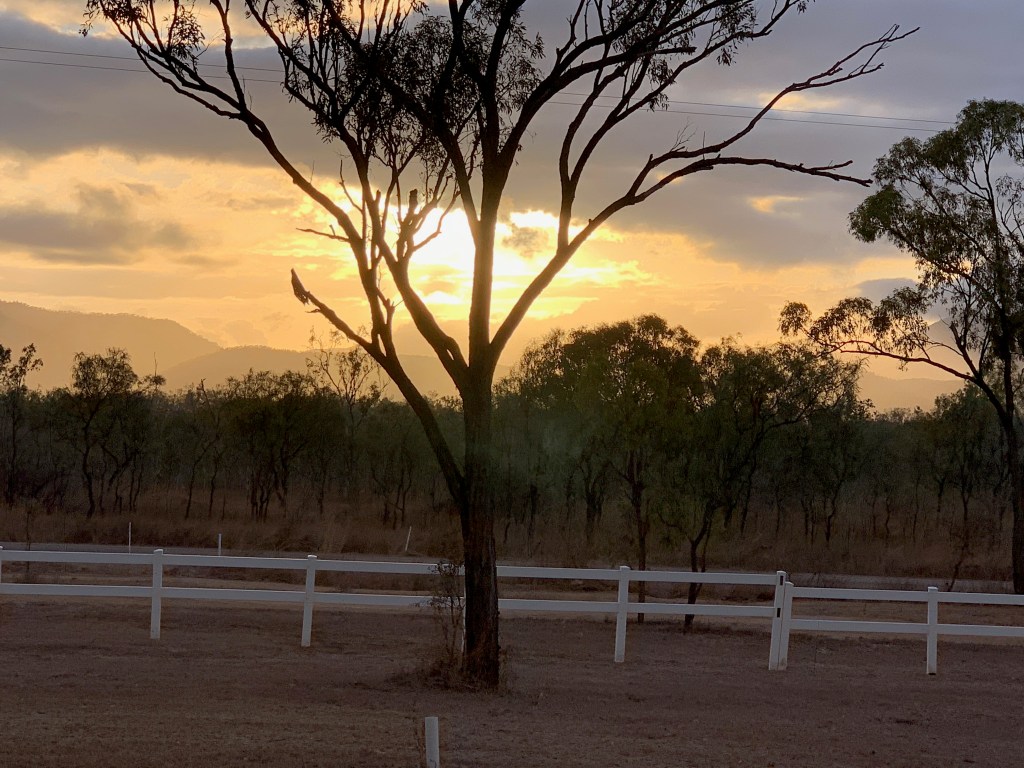
For several weeks now I have been working on thousands of slides which I’ve taken over the years and never got around to cataloging properly. I need a break, so I thought that I would show you a few sun scenes from where we live. The one which I always put at the top is from Ethiopia but the following are all from around our property where we live now in a place called Oak Valley. There is no touching up applied. Just as they were.

I could go on with more but I think that’s enough for today. I think the Creator is a Master Painter!

Dominic Cartier

How Big is Australia Really?

I’m proud to be an Australian but love the country of Ethiopia where I worked for many years. Maybe wrongly, but I have often thought that many people think of Ethiopia as a small insignificant African country. And, possibly again wrongly, I have felt that some Australian professional people have felt themselves superior to those working in these ‘backward countries’. I guess this sort of thinking sprang into my mind again when I was watching an Indian movie last night. How can India produce films as good as Hollywood? Well the one I watched last night was better (different) than many I see from the USA. Maybe because they have 1.4 billion people from whom to choose good actors? But let’s not go too far down that road.

Ethiopia is a small African country. It is about sixty percent of the size of Queensland, or about 4 times as big as Victoria. It has a population four times that of Australia. If you want to compare its history with Australia’s, it is much older. Well, if we accept ‘Lucy’ as being one of the first human being, then it is older than our Original Australian’s history, and much much older than white Australia. Their ruling dynasty which ended with the murder of Haile Selassie in 1975 dated back to the time of King Solomon in Israel. Solomon died over 3,000 years ago. Then why is it backward? I would offend Ethiopians by asking that for they are very, and in many ways justifiably, proud of their country and people. Certainly they are progressing much more rapidly than the West did!

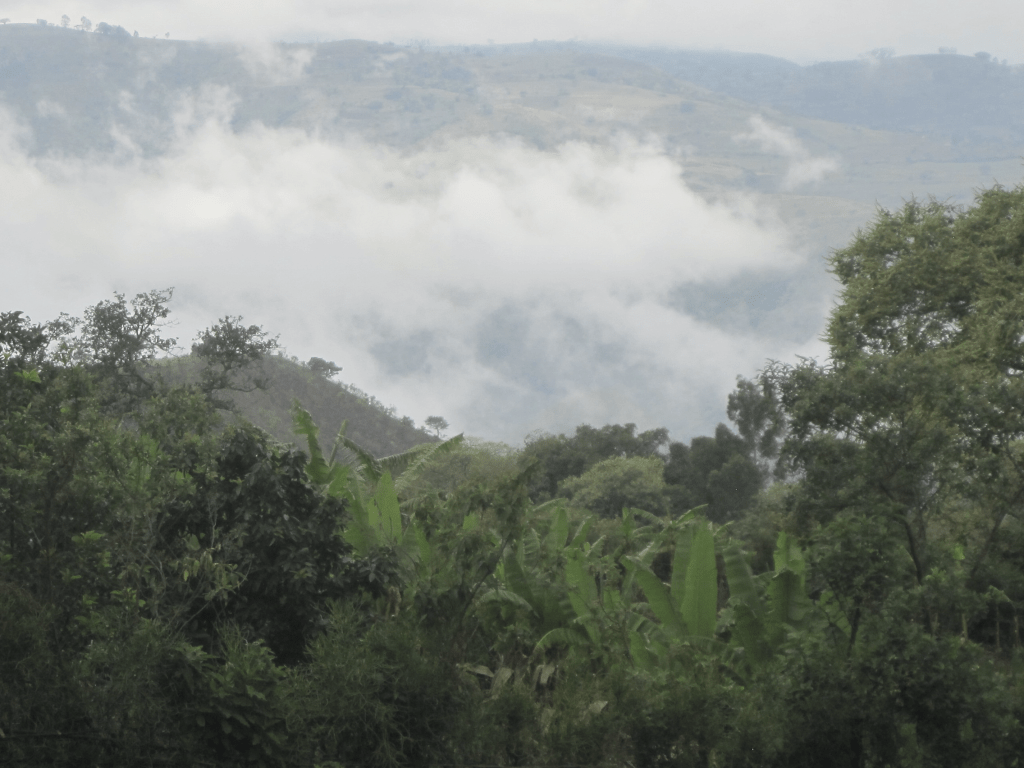
It has spectacular beauty; said to have massive gold and oil deposits; heights extend from 125 metres below sea level to 4,550 metres; there are enough rivers that all its electricity is hydro-produced.

But I really started to write about tertiary education. In 1968 when we arrived in Addis there was one University with 1,000 students. Now there are 30 Universities plus 61 other recognized private places with Higher Education standards.

According to my Mr Google – our University in North Queensland (JCU) has 17,500 students. Of the two Universities, where I mainly taught, Jimma University has 45,000, and Arba Mintch has 34,000. When we went to Ethiopia there were 300 doctors in Ethiopia and only 13 were Ethiopians. When I went to Arba Mintch in 2011 there were there 20 medical students per year, and when I left in 2016 there were 170+/year. In that same year, country wide, they graduated 3,000 young doctors. They are paid so little that many as soon as the government permits them they leave the country for richer paying fields – often to other African countries.

The last graduation I attended for doctor, architecture and Urban Planning graduates.

Maybe life was never meant to be fair, but a little more fairness would be nice.

Dominic Cartier