
One of the nastier, more difficult cases I’ve treated.
When I first went to Africa I worked in a leprosarium which served a huge area. There were up to 15 different tribal languages spoken but using one or a series of interpreters we got by. The young man with whom I frequently worked spoke 7 languages fluently. There are over 80 plus separate languages and even more dialects in the land. You wonder how often the eventual answer given was to a question different from the original! The Chinese whisper effect.
At any rate this case, a teenage boy, was brought to the hospital from a high mountainous area. No-one in the hospital knew his language and we never during his stay were able to speak a single word with him, but got to understand each other with looks and gesticulations. His need was, however, pretty obvious. He had been electrocuted and had a gangrenous right arm and right leg. In addition there was a nasty full thickness burn on his right chest and abdomen laterally and a large necrotic patch on his left calf. The accident had occurred some days earlier and he was sick, sick, sick! They had no money and in a government hospital in Africa this is not good!
 The case was even more complicated because his father (maybe during war service) had had much of the muscle and 2 nerves blown off his right arm and was not therefore able to do much for his son, whom he obviously loved dearly.
We found a generous donor for the son and we began treatment – obvious antibiotics, IV fluids and pain relief but ASAP he underwent surgery.
Initial surgery was amputation below his right knee and the amputation of his right upper limb through the shoulder and cleaning (debridement) of his other wounds. 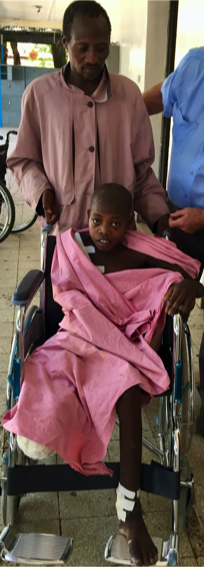 He survived this but soon developed tetanus. This is hard to treat anywhere but much more in an open ward with no intensive care specialists available – but we did. Besides the initial guillotine type amputation surgery he needed other refashioning and skin graft surgery. Early mobilisation is always attempted but how do you get one mobile if he has no armpit for a crutch and no leg on the same side? The hospital had a few wheel chairs for emergency use but none to be dedicated for a single patient. My wife and I fortunately had enough money to buy him a wheel chair which he loved. I retired when nearly 80 before the saga ended but we hadn’t solved the problem by any means. There is no social security in the country. Everything has to be paid for – so that even if it were possible to make an artificial above knee prosthesis learning to work without an arm to hold a crutch would be extremely difficult. He and his father could whizz around the cement paths of the hospital in the chair but when they went back into the mountains there would be mud and slush galore and probable no cement paths at all. I grew quickly to love both of them but I can’t even begin to imagine what life is like for them now.
Some may say that we should have let him die – but you should have seen his smile!
I guess, a medical and a moral issue. When working in India I had it said why waste money on the deformed and abort the healthy.
Dominic Cartier
 Heated Stew