Vultures and Maribou storks on the road near an abattoirs.LakeChomoLake Abiya
These two lakes are at Arba Mintch. Arba Mintch means forty springs. There were many more springs than forty. It is the only place in Ethiopia where we were prepared to drink the water straight from the tap. The two lakes are separated by a narrow strip of land and there is a creek running between the two. Yet their surfaces are about a metre and a half different. Abiya is higher than Chomo
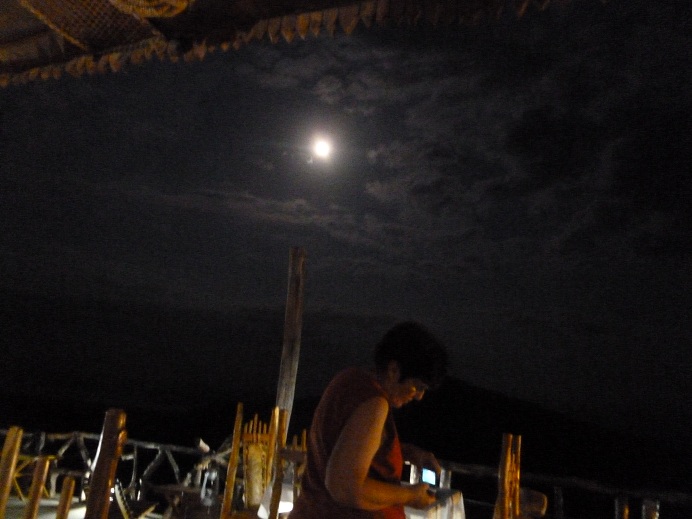
A pleasant meal, on a moonlit night looking over the lakes at Arba Mintch.
For many years the rulers of Ethiopia were from the Amhara tribe. Their religion is orthodox Christianity and they changed other tribal names of towns and areas to suit their desires, often to Biblical names. With the several changes of government over the last nearly 50 years many names have been reversed to their former names and Nazret (Nazareth) is again Adama. (The Oromos use a lot of doubling of letters to show how long a letter is to sound. They spell it Adaamaa). Is that of significance to this post? Well, yes it is. With the rise of tribalism, local people were put into positions which had previously been filled with Amharas, that is members of the then ruling tribe – not that they either were always a perfect fit for their posting. The replacements were not always well qualified. Thus the CEO of the Nazret hospital was now from the Oromo tribe. The young surgeon who wanted me to come was an Amhara. The Oromos are an Islamic tribe in the main. So when I was brought before him, the question was why he should allow this foreigner into his hospital at the request of an Amhara. There was not open hostility but below the surface suspicion.
My friend had told me that the boss had had several unsuccessful attempts to have a large umbilical hernia repaired. The hernia was visibly bulging through his shirt. So, somehow or other, it became the conversation piece. Eventually I persuaded him , if I could get a nylon mesh imported from Australia, to allow me to repair the hernia again. I promised him a 98% success rate. He agreed, and I was allowed ‘in’ to help my friend. His operation went well.
Note – in fact promising 98% sounds good but for each individual the outcome of a complication is either zero or a hundred percent. You get trouble or you don’t. He didn’t, so everything was okay for me after that. He was a happy, now cooperative, customer.
In fact it hadn’t been easy for me to make the decision to go there. Prior to meeting the CEO my wife and I had gone down, on a public holiday afternoon, to inspect what was involved. The wards were much like most Ethiopian hospitals; the surgeon was obviously trying his hardest without a lot of administrative cooperation. Not that they were against him but they had no real understanding of how to run a hospital.
But, as a surgeon, I was particularly interested in what the operating rooms were like. And seeing what we saw it was a hard choice to agree to work in them. There had been a procedure done the night before. The room had not been cleaned up; there was dirty linen on the floor and a considerable amount of blood about. A window was broken and there were flies feasting on the tasty morsels which they could smell and easily find. So in choosing to go I undertook to do and to get done quite a bit before my first operating list.
Their operating room was much worse than this!
The school at which I taught part-time Because of Bilingual Canada had a rule that the year 10 students had to have a civic experience in the community for a couple of days during the school year. That year I bought some materials, and the students with the day workers from the school all came down and the windows and screens repaired, a decent setup for pre-operation scrubs put in place, the OR complex was painted and an emu parade performed over the hospital grounds to clean up the very messy area. Thank you, school.
Adama has a population of about 500,000 and an elevation of just over 1,700 metres (nearly 6000 feet).
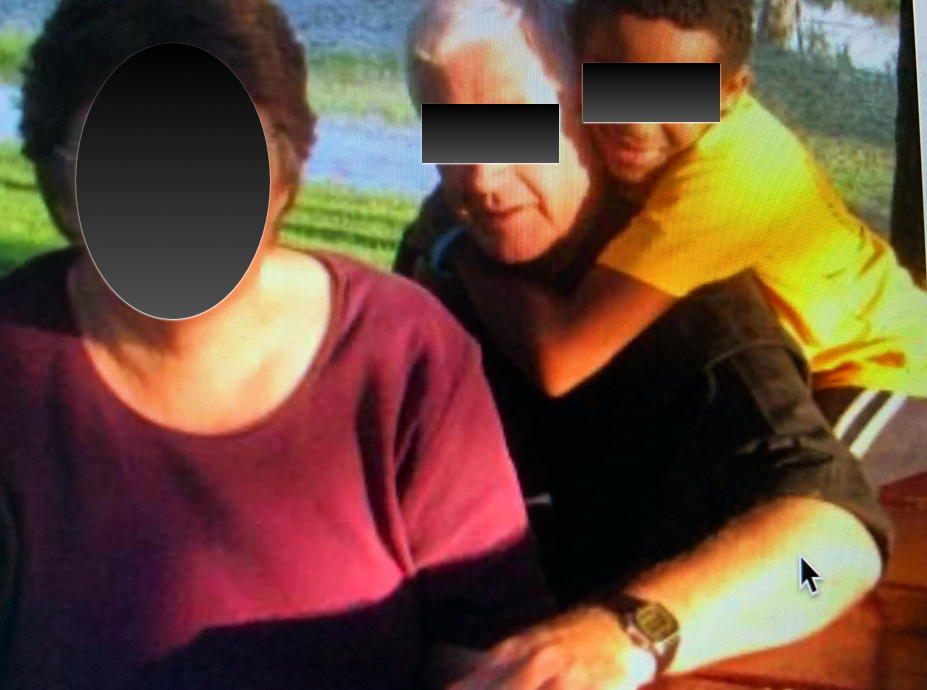
This is the story of one whom I’m sorry is not our son. The Australian government, I think for financial reasons would not countenance an adoption. They did give us a 6 months medical visa but we had to pay all expenses and he had to leave at the end of those few months.
He was run over by a train. His father was dead; his mother was cruel to him. I’ve seen the burn marks that she inflicted on his one remaining arm. He was a street kid, and I’ve no doubt a thief, a beggar and a bit of a rascal. He lived on the streets of the place I used to go to operate on Fridays. I’ve explained about Friday operating there before. I didn’t do his initial surgery but saw him on a Saturday morning round when he was just about to be discharged to be a street beggar again.
Later the young boy told me that when trying to hitch a ride to a bigger town for better pickings, his friends who were pulling him onto the train let him slip and he fell under the slowly moving train. He lost both legs and his right arm. He told me later that when taken to the hospital he still had both knees, and his thumb and two fingers on his right hand. If you have to amputate it is a good thing to remember that the longer the stump the easier to use an artificial limb. And a few fingers can be very useful!
When I saw him that day both legs were amputated very high, and his right arm was amputated just below his elbow. He was in considerable pain because in his left leg stump the bone had not been smoothed, it was not covered with muscle and the sharp spike of bone was half way through the skin.
I took him home with me that day. It was interesting because he knew no English and my Amharic isn’t perfect by a long way. I asked him three questions,
Did he wake at night with night mares? The answer was ‘no’.
Did he need to pee at night? Asked, obviously, because I’d have to carry him to the toilet. He said ‘no’, which was usually correct.
Was he worried about the future? His answer surprised me. ‘No, there’s a God in heaven, He’ll look after me.’
On the trip back it rained a bit. When it stopped other traffic splattered dirt onto the front window so that I used the windscreen wipers and sprayed, as you do, water to clean them. He asked where the water was coming from. I told him that there were two little boys under the bonnet who peed when I told them to do so. He looked at me a bit shocked so I explained the reality. But I think it helped him to know that I was a real man, like his father used to be to him. We got on famously.
I remember his first bath. He’d never seen one or been in one. He clung to me as I lowered him in, screaming at the top of his voice. Having got in, and discovering it was warm and very pleasant he didn’t want to get out. We never had that problem again.
Soon he had to go back into hospital and have the bone in his left stump sorted out; of course, not at the same hospital.
The next while was a bit mixed up; he stayed with friends while we came back to Australia for my cancer surgery; then my wife returned to Ethiopia to finish the academic year teaching her grade 4 kids. Tenesaiyeh lived with my wife while she was there. We got a medical visa for him to come to Australia for artificial limbs. I had three years of troublesome, even if not overly serious, complications after my cancer surgery. So I had plenty of time to act as his personal chauffeur and physiotherapist while he got his prostheses made and began to use them. Before I had to take him back to Ethiopia he was slowly walking up and down stairs. He scooted around on a little skate board and used to love sitting in front of the TV conducting with Andre Rieu.
It still sits under our TV set.
The local school allowed him to attend (this was new for him); he loved it and they were so good to and for him. He went around at school on his skateboard. I’m not sure how legal it was!
Australia wouldn’t let us adopt him but arrangements were made for him to be adopted into the USA. For legal reasons he had to spend time in an orphanage in Ethiopia before he could go to America. When I took him back, I spent a few days seeing him daily until I left to return home. He came to the airport with me and it took 2 people to pry him off me, for me to be able to leave. It was similar to getting him into the bath first time – except he didn’t enjoy the orphanage.
His new parents, for reasons I cannot fathom, soon found his prostheses too much problem and disposed of them. So he’s a wheelchair bound guy these days but a champion wheelchair Olympian. He’s a University student and we still correspond as ‘my American son’ and ‘my Aussie dad’. He tells me he wishes he had been allowed to stay here. So do I!
Although the hand was opening pair of hooks – he could use it well. The limbs were made to look much more normal after correct fittings were sorted out.
Tensaiyeh was not his name. It is used as a boy’s name and means ‘my resurrection’.
As older professionals, whatever that profession is, we were all young and inexperienced once. So one must not be too judgemental of others’ mistakes. I used to tell my students that we all make mistakes, but, if possible, reduce your own by learning from the mistakes of others.
I mentioned in a previous post When to leave the training nest? that, for a time, I visited and operated with/for a friend every Friday. One week I discovered that a second, just graduated surgeon had been appointed there. Neither my friend nor I knew anything about him, but as there were 2 operating rooms he suggested that we had to appoint someone upon whom the new chap should be the surgeon. Maybe one of us should have watched him, but we were in the other operating room, both involved in a complex case.
To divert – you can get hernias in many places but the commonest are in the groin or at/near the umbilicus. A rough, workable definition of a hernia is a bulge of an organ (or part thereof) through what normally contains it. Basically three words are used in describing the way you repair a hernia.
Herniotomy – the simplest of the three, where you push back the contents and just cut off the sac, which is usually a bit of peritoneum. This is the common way of repairing a child’s groin hernia.
Herniorrhaphy – where you sometimes include a herniotomy but then try to repair back to normal anatomy.
Hernioplasty – wherein you sometimes do the above but try to strengthen things by rotating something or adding some foreign material, usually some sort of plastic mesh.
We chose for him to operate on an about 8 year old boy with a common type hernia on which you did the simplest of the three repairs above, in colloquial language, it should have been a cinch. He did his operation and the boy was sent back to the ward.
On the next morning, while seeing my patients from the previous day, I came across this boy, screaming in pain and in obvious great distress. He had an exquisitely tender mass extending from his umbilicus to just above his right knee.
He was not my patient and I was not the head of surgery. So I asked my friend to contact the surgeon who had operated and ask him to see his patient. The guy didn’t answer his phone. I needed to go, so I suggested that my friend try to ring again in about an hour but that if didn’t come that my friend would have to re-operate himself – he was very capable to do that. The guy answered the next time, but refused to come; my friend operated. The top of the bladder had been cut off and left open, so the mass was all urine.
I’ve never heard on any occasion of such a thing happening. Can I forgive him? As I said at the beginning we all make mistakes. I find it very hard to understand this mistake, but certainly I don’t forgive his refusal to come when called to review his patient.
The kid recovered, but instead of a day case, his recovery took quite a while.
If you start school aged five; then spend 7 years in primary school; 5 years at high school; 6 years to get your undergraduate degree; another 6 years to get your postgrad degree – how much more training do you need before you venture overseas? The answer isn’t all that simple. Some leave for further study; some go to work in very supported environments. I knew that I was heading into a pretty primitive situation. At that time there were 42 Ethiopian doctors in the world. All had trained overseas and 28 had remained overseas. The population of the country was quoted as 30 million. Including the 14 Ethiopian doctors there were said to be 300 doctors in Ethiopia. A disproportionate number were in three big cities, Addis Ababa, Asmara and Jimma,• whereas the rural population was said to be 95% of the population. There were very few specialists. There was no training school for doctors in the country at that time.
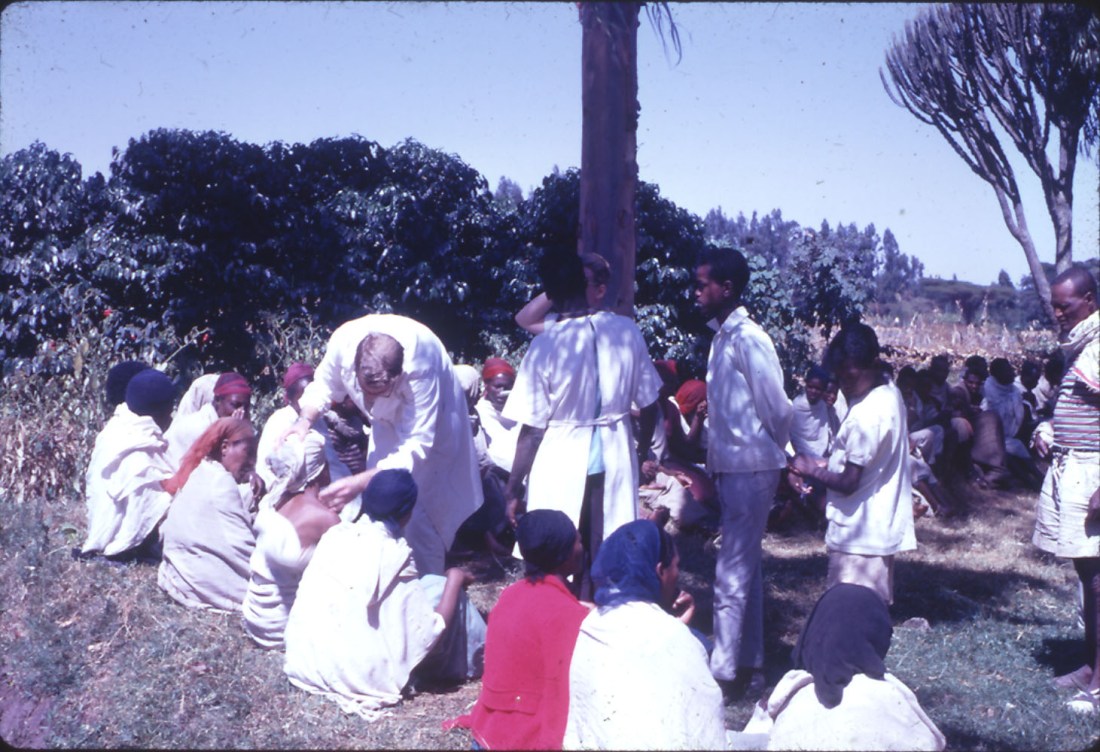
A small, but significant, percentage of the 300 doctors were missionaries. Our mission organisation alone had 5 hospitals, two with no doctor much of the time, but run by nurses; that is they were basically clinics. Between the other three hospitals we had a stable base of five doctors plus occasional very much appreciated short term help.
The medical advisor to the government of the time called the missionary doctors to a meeting. His opening statement was that he was an atheist and that when he came to Ethiopia he had no time for missions. But he had found that, thinking medically, missionaries had 10% of the work force and did 90% of the work. He then went on to discuss his plans for the future.
Returning to the thought behind the title of this post – what are the main medical needs in an underdeveloped country? So how much training should you undertake. The medical problems there are in many ways different from those in the West.
Surgical – emergencies, trauma, bowel obstructions. All those conditions we see in the West except fewer cancers. Surgery needs anaesthesia.
Medical – very little heart disease, and very little diabetes; many public health issues, many infections.
There were very few investigations possible. There weren’t referral clinics.
I don’t know that it was at that time part of my deciding to go with limited surgical experience, but, in retrospect, I’m glad that I went when I did . That is, that I didn’t stay long enough to become overly dependent on investigations. They weren’t available.
At any rate, inexperienced as I was, I went early. I did my first obstetric and gynaecology operations there. I did many other operations that I had never seen; using textbooks, reading up before and, even then, often with a book open on my old violin music stand in the operating room, with a worker turning pages as needed. Maybe I was a bit of a cowboy; maybe fool hardy; maybe too self confident. But even in retrospect I don’t think I had a choice, even if my only consolation is that I was, I hope, better than nobody. And thank God I wasn’t alone – a wife, a few nurses and some very committed national helpers. And I suspect God played a part.







 Heated Stew