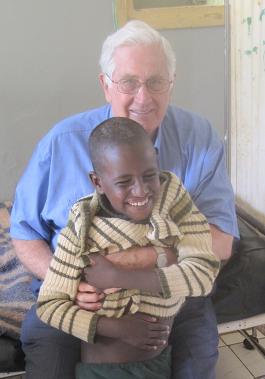
An Interesting visit to Southern Ethiopia.

One is interested in tribal customs. Some seem excellent, some queer, but these days we are discouraged from questioning things as everybody is considered to their opinions being as legitimate as anyone else’s. Unlike these days, in my time there were very few doctors to cover the increasing population and many of the doctors tended to stay in the bigger cities with more facilities and more money! The population were mainly rural.

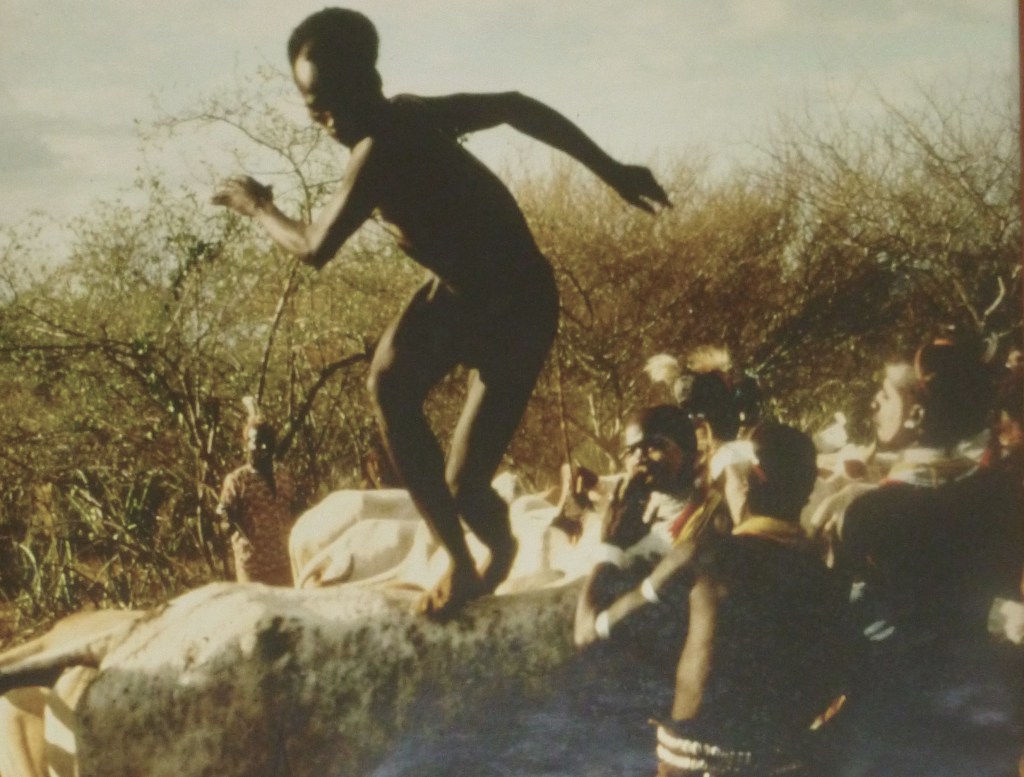
The mission with which I had a close association ran several nurse clinics which were very useful but obviously limited in their capabilities. One such clinic was near the Kenyan border where the tribe had a, to us, different custom. Before a young man was permitted to get married he had, as shown in the picture, to run back and forth, naked, over 20 cattle tied transversely. By their custom boys were not circumcised as babies (the Orthodox, Muslims and some other groups are circumcised near birth or as puberty approaches). As uncircumcised penises in adulthood, unless erect, are a bit dangly and lengthy, it was their custom to be circumcised around this time. The technique was to hold the foreskin slightly stretched out over a rock and cut it off with a swift sword swipe. Not every sword wielder was accurate with some disadvantageous results.
The tribal elders came to the lady nurse who was in charge of the clinic and asked if she could arrange for someone (eventually me) to train a young Ethiopian male dresser who worked with her to perform circumcisions. It was agreed that I would come down for a couple of days and perform 40 such procedures. Interestingly there was in the area an American Army squad vaccinating goats and their young doctor asked if he could join the process and be also taught. (The dresser was the more capable student!) Very little had been prepared and I guess it was my fault as I had expected an American nurse to realize what was necessary if I wasn’t to only use a sharpened sword! So the first evening was used making sheets to be sterilized, hunting up syringes and local anaesthetics, suture material and enough tools to do the job professionally. The next morning I met the line up, had them bathe themselves and set about with a couple of demonstrations, self performed on them, teaching them to use local anaesthetics, making sure how much you wanted to remove etc. I then guided the two trainees through the process. We did the forty finishing late in the afternoon. We stopped for a lunch of ‘Injerra b wot’. When the local anaesthetic wore off I bet there were some unhappy chappies but at least still with all the necessary bits there!

There is a very different side to that trip at that time which I might tell at some other time.

Dominic Cartier

A 5 minute experience stretched over 3 weeks!

For the sake of a brother-in-law and anyone else who doesn’t like medical pictures I promise than there are none. And neither will there be any detailed descriptions of the pathology! I have just come across a picture in association with an album of hymns to which I was listening’, and here it is.

The picture reminded me of two things. Firstly of all the anti-Trump news about his attitude to abortion. He may have been lying (an art perfected by politicians) but I heard him say (unless it was doctored by media experts) that he was against the generalization of Roe v Wade but that he felt that the people in each state should be able to vote on it. He claimed that he personally believed that there were 3 legitimate reasons for abortion – rape, incest and if the mother’s physical life was in danger. A very different view from what his opposition presents him as holding!

But what has that to do with the title of my article? Nothing! But the picture reminded me of the hundreds of cases of ruptured uteri that I have operated upon in countryside Ethiopia where in the late 1960s our small hospital was the only hospital for millions of people and we were so busy that we could not operate things like antenatal clinics – to which people wouldn’t have come because of custom, distance, lack of roads and means of travel. We served with 1-2 doctors, 5 trained nurses and a good group of Ethiopian helpers (a few of them trained elsewhere as dressers) as the only hospital area for more than a million people!

So I have seen many babies who have died before they were born. The picture above is one suggestion as to where they end up. But this is not a theological discussion.

One day, when I was the only doctor in the hospital I was faced with three ladies with ruptured uteri arriving within 5 minutes of one another. Our ‘operating suite’ had 2 operating rooms, one of them large enough to have 2 operating tables. So I had 3 tables for the 3 women. I had a nurse who was capable of watching an anaesthetic (she was v good) after I had induced the patient. We called for help from the ward and so ended up with the sickest, having been resuscitated, asleep and me operating on her. Behind a sheet for visual protection a second lady was being resuscitated as was the third lady in the smaller OR.

It was a long morning but all were eventually taken into the ward on appropriate IV, pain and antibiotic therapy. All three babies were dead (and hence the picture above). Two ladies progressed very well and were able to go home in 7-10 days. No matter what we did the third lady did not do well. She ran a high fever and using all our available antibiotics, changing to new ones as appropriate and doing an X-ray to make sure that we hadn’t accidentally left a pack or an instrument inside we eventually had to conclude that we would probably see her depart in a box.

Sadly, I believe that much of what is called ‘faith’ healing is sham. But I do believe in God and I think that He can do wonderful things. While I was operating on that same evening on which we had come to the above conclusion, the nurses and a few of the families of workers on our mission station spent the night in prayer specifically for the healing of this lady. In spite of all our failed treatment, the lady’s temperature the next day was down considerably, she felt much better and was discharged ‘well’ about 5 days later!

Dominic Cartier

Looking carefully.

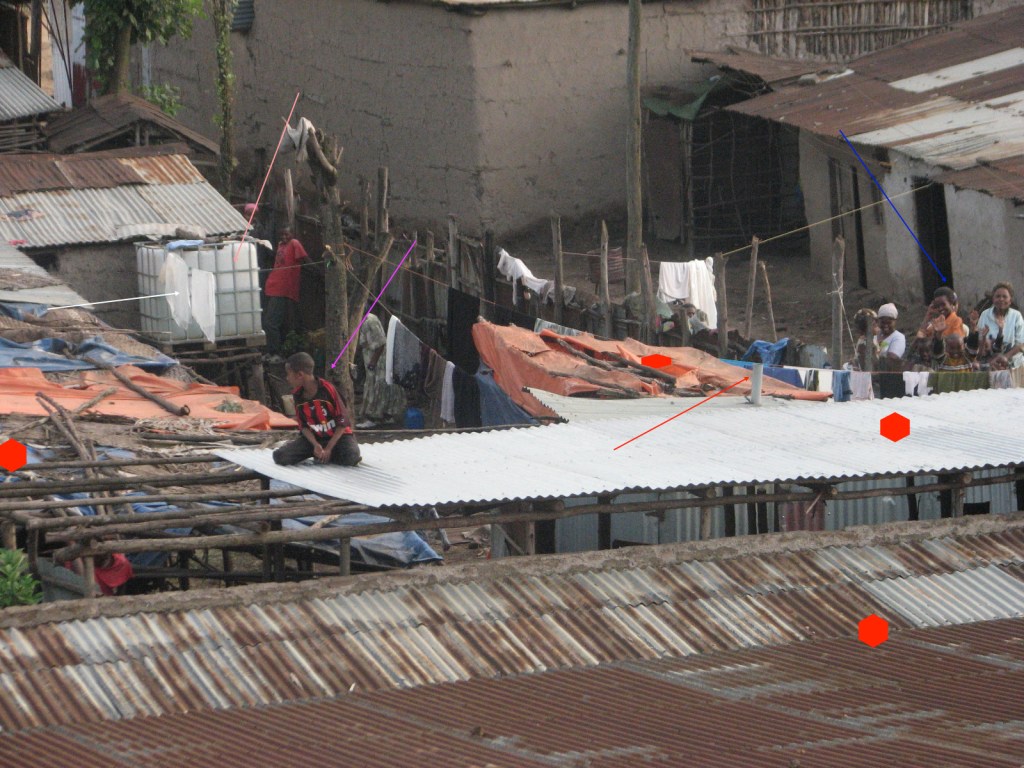
When I have not much to do, which is more often than it should be, I love looking through old photos and reliving experiences. Today’s picture could have been taken in any of the cities in which we lived in Ethiopia. I’ve tried to mark some things which reflect the economy of the land, and I comment on them. Remember that the population is still about 85% rural which tends to be poorer than the cities.

  1. You can see the tall unmarked pole, which is either a telephone (unlikely) or an electricity one. But you cannot see any connections to any of the dwellings. It is passing through to a richer area, and there are some very rich areas!
  2. The pink arrow points to a water tank. There are no gutters visible. There is a water distribution throughout the city but it is frequently not available, so when you can, you fill up a reservoir against those times.
  3. The red hexagons mark the different standards of roofing, some of which are virtually non existent. They have periods of very heavy rains.
  4. The purple arrow marks an example of child labour. Sheets of iron are being put onto the roof.He is obviously a teenager but often you see little kids carrying far too heavy loads and with great responsibility – often carrying babies on their backs or with loads of wood on their backs.
  5. The red arrow shows the outlet above the communal toilet. People often shower over the toilet or under a spray in the open. From personal experience you try to not need ‘to go’ when visiting these places!
  6. The blue arrow marks a group of ladies in community. You can see their beautiful white teeth, as grinning they look up to where I am taking a photo.
  7. The white arrow indicates their love of cleanliness in the midst of difficult circumstances.Their white clothes are sparkling!

Dominic Cartier.

Children….

I’m writing this because I read yesterday of the 150 children kidnapped from a school in Nigeria. This is one of many such attacks with about 1,000 children in all being taken since December last year. Some, a minority, have been released. That is mind-boggling and I’m surprised that that it doesn’t provoke international ire and offered help to the Nigerian Government for help. Such help may of course have been offered and rejected. Some of the pictures I have seen from before indicate that some taken were Muslims. The latest school attacked was the Bethel Baptist School.

In Australia as doctors we have to be very careful. It is difficult for medical students to get into watch a child being examined without parental or guardian permission. As a doctor I am not allowed into an operating room without special registration with each individual hospital, even with adults being operated on. This is a long way away from the old system where operating rooms had mezzanine floors built so that many students and other doctors could watch and learn.

It reminded me of a medical student from Australia visiting us in Ethiopia for an elective term, who told me that I dare not treat children with the affection that I did there, if I was in Australia.

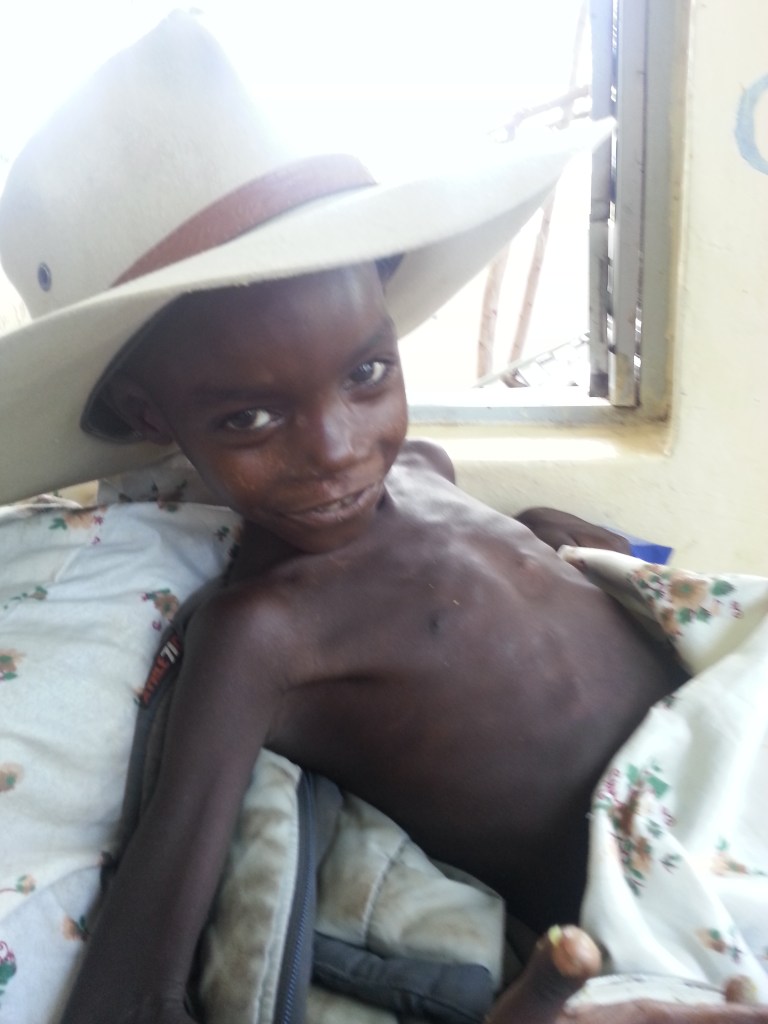
This boy had been run over by a cotton picking machine and had massive injuries from his pelvis down. It took my hat on his head to get a smile out of him. It was a weak smile but took weeks to achieve!
Months later when we got him standing with help, I got a real smile! He had about 20 operations.
Sometimes it took my glasses to get any attention

You can see that this poor kid has lost an arm. We had at least one case a week of cases like this. This occurred rarely because of an accident but ususlly because with a fracture (I guess we could call that an accident!) but that had been badly managed by a local healer who bound the limb, leg or arm so tightly that it caused gangrene.

This young guy had been kept at home until his leg dropped off. You can see how flexed his hip is. He was so weak that we had train him to stand up again, initially by holding him. We did make wooden legs initially and later there were prosthetic limbs available.

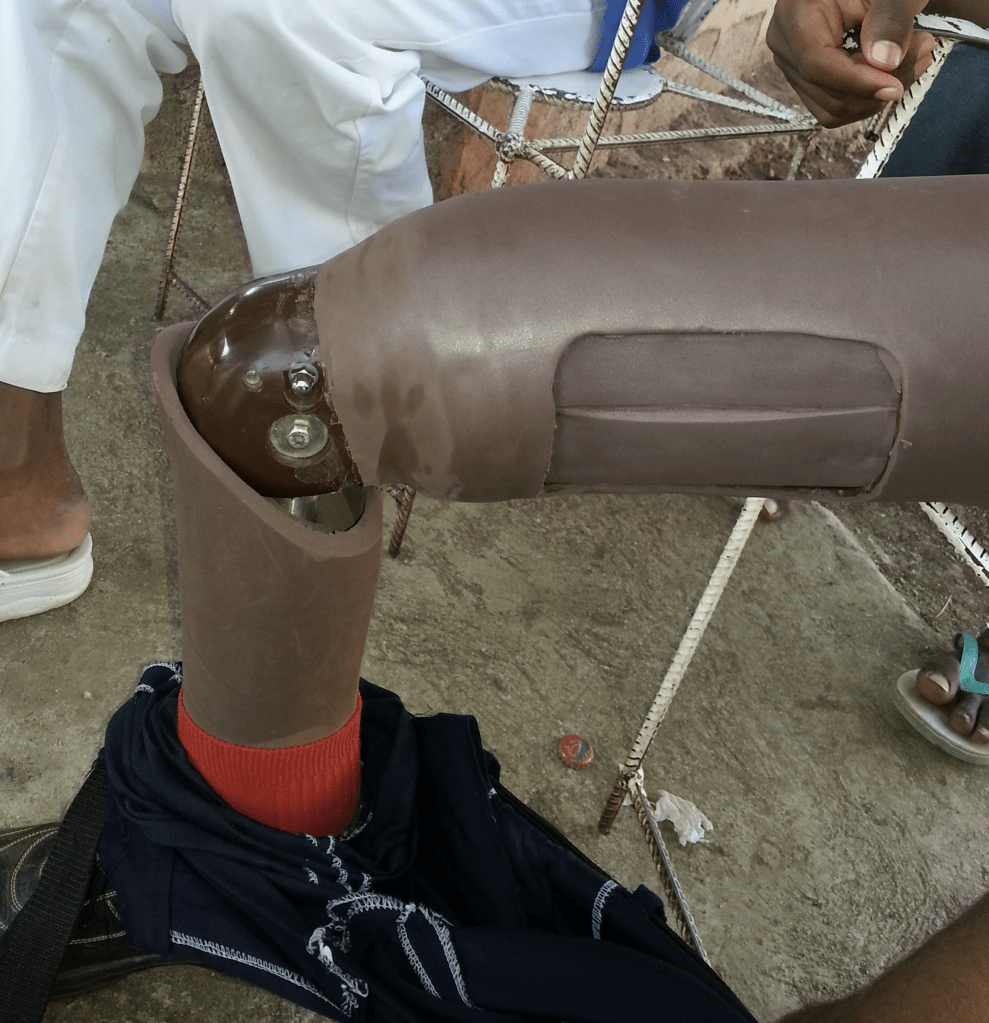
This is one such limb made in Arba Minch for a teenager who was so ill when he came in with a gangrenous leg and septic shock that even after initial resuscitation he had 2 cardiac arrests on the operating table. He did well and the last I saw him was attending school supported by an Australia who visited us and met him. There is a lot more to the story than I have told here, as you can guess!

You can see the scar on this boy’s head. He was in ICU and with a very low GCS (a count of severity of head injury) and the nursing staff wanted to put him in the ward as they were sure that he would die. I resisted and although he had a few problems (he was nearly blind), he survived and he loved me and would come running to me whenever he heard my steps. Should I have held him and tickled him? His dad was so happy that he lived!

I may show a copy of some gross pictures of suffering in my medical memoirs blog but here sufficient to say that I treated a thousand or more kids and they all needed medical, emotional and often physical loving. My heart bleeds for those taken in Nigeria and their families, but this is a worldwide problem. Let’s give all the help we can!

Dominic Cartier.

What’s in a picture? Memories

I certainly didn’t expect to see this picture when I opened my computer this afternoon. But there it was straight in front of me.

It’s not the best quality picture but it holds lots of memories.

  • Our only daughter was born when we were home on furlough in Australia but then we returned to our work in a mission hospital, where I was a surgeon. For our daughter’s sake I had better not tell which year it was, as ladies are so conscious of their ages. It was however well over 40 years ago. She is as lovely and beautiful a daughter as anyone could wish for.
  • The young man, a late teenager, was employed as a gardener but took on the role of her constant carer and companion. He loved her heaps.
  • One morning he arrived late for work and we asked if he had had his breakfast. He hadn’t, so we asked him to eat with us. We were having fried tomatoes and onions on toast. He ate it all but then said something I will never forget. ‘You foreigners don’t like all our food. Now I understand why. That was terrible.’ Innocent lovable honesty.
  • He had tuberculosis of his neck glands that responded to treatment’
  • We attended his marriage some years later. He has a lovely wife and beautiful children. Sadly one shortly after graduating from University died.
  • He’s still alive but has known tribal persecution and suffered several major health problems, but is still a man I’m delighted to call a friend.

All that flashed through my mind from just seeing a poor quality old photo. I loved the kid, loved the man and his family and still even in his relative old age think very fondly of him.

Dominic Cartier