A boy to remember/a surgeon to forget.

sunset

As older professionals, whatever that profession is, we were all young and inexperienced once. So one must not be too judgemental of others’ mistakes. I used to tell my students that we all make mistakes, but, if possible, reduce your own by learning from the mistakes of others.

I mentioned in a previous post  When to leave the training nest? that, for a time, I visited and operated with/for a friend every Friday. One week I discovered that a second, just graduated surgeon had been appointed there. Neither my friend nor I knew anything about him, but as there were 2 operating rooms he suggested that we had to appoint someone upon whom the new chap should be the surgeon. Maybe one of us should have watched him, but we were in the other operating room, both involved in a complex case.

To divert – you can get hernias in many places but the commonest are in the groin or at/near the umbilicus. A rough, workable definition of a hernia is a bulge of an organ (or part thereof) through what normally contains it. Basically three words are used in describing the way you repair a hernia.

  1. Herniotomy – the simplest of the three, where you push back the contents and just cut off the sac, which is usually a bit of peritoneum. This is the common way of repairing a child’s groin hernia.
  2. Herniorrhaphy – where you sometimes include a herniotomy but then try to repair back to normal anatomy.
  3. Hernioplasty – wherein you sometimes do the above but try to strengthen things by rotating something or adding some foreign material, usually some sort of plastic mesh.

We chose for him to operate on an about 8 year old boy with a common type hernia on which you did the simplest of the three repairs above, in colloquial language, it should have been a cinch. He did his operation and the boy was sent back to the ward.

On the next morning, while seeing my patients from the previous day, I came across this boy, screaming in pain and in obvious great distress. He had an exquisitely tender mass extending from his umbilicus to just above his right knee.

He was not my patient and I was not the head of surgery. So I asked my friend to contact the surgeon who had operated and ask him to see his patient. The guy didn’t answer his phone. I needed to go, so I suggested that my friend try to ring again in about an hour but that if didn’t come that my friend would have to re-operate himself – he was very capable to do that. The guy answered the next time, but refused to come; my friend operated. The top of the bladder had been cut off and left open, so the mass was all urine.

I’ve never heard on any occasion of such a thing happening. Can I forgive him? As I said at the beginning we all make mistakes. I find it very hard to understand this mistake, but certainly I don’t forgive his refusal to come when called to review his patient.

The kid recovered, but instead of a day case, his recovery took quite a while.

I have at least one follower who hates medical photos so BEWARE below the line. Continue reading “A boy to remember/a surgeon to forget.”

Bites 2 – continuing the list.

Monkeys – we didn’t see a lot of monkey bites. There are of course many different types of monkey. In one place where we lived there were dozens of them. We had a lot of bananas but, against what we expected, they rarely ate them. They loved our guavas. There was a large tree abutting the back of our house. They would steal as many as they thought they could hold, run along the roof ridge and, no doubt accidentally, dropped some as they ran. Those dropped would clatter down the tin roof into the gutters; which was annoying, particularly at night! They would sit on the window looking through the bars, and you wondered who was looking at whom!

monkey
Who’s watching who? -At our kitchen window.

Guereza monkeys, brilliant with their black and white colours, leaping from tree to tree were gorgeous to watch. Staying for a break at the one of the Rift Valley lakes we saw lots of those monkeys with ‘painted’ backsides. They were thieves, watching carefully and awaiting the moment, they’d jump down and steal food from your table or even your hand.

Hyenas – people think that these are only scavengers, but they are prepared to attack living animals or humans. They can cause rabies. At night time our workers would not walk alone. There were always at least 2 or preferably more of them and armed with dullahs (heavy sticks) when walking outside..

The two cases which stand out in my mind are of two boys who came in (at separate times) both having been scalped. (photos below the ‘more’ line) The bone on the top of their heads was laid bare over many sq cms. You cannot graft onto bare bone. We had to drill multiple holes through the outer table of the skull, being very careful to not go right through the inner table of bone. The tissue in the centre of the bone (the marrow or medulla) granulated out through these holes and when it had covered the bare bone totally we could skin graft it. Both boys eventually did well even if they were prematurely bald, and needed to wear protection to protect their grafted skin from trauma and the sun. Thin (split) skin grafts don’t become normal skin again.

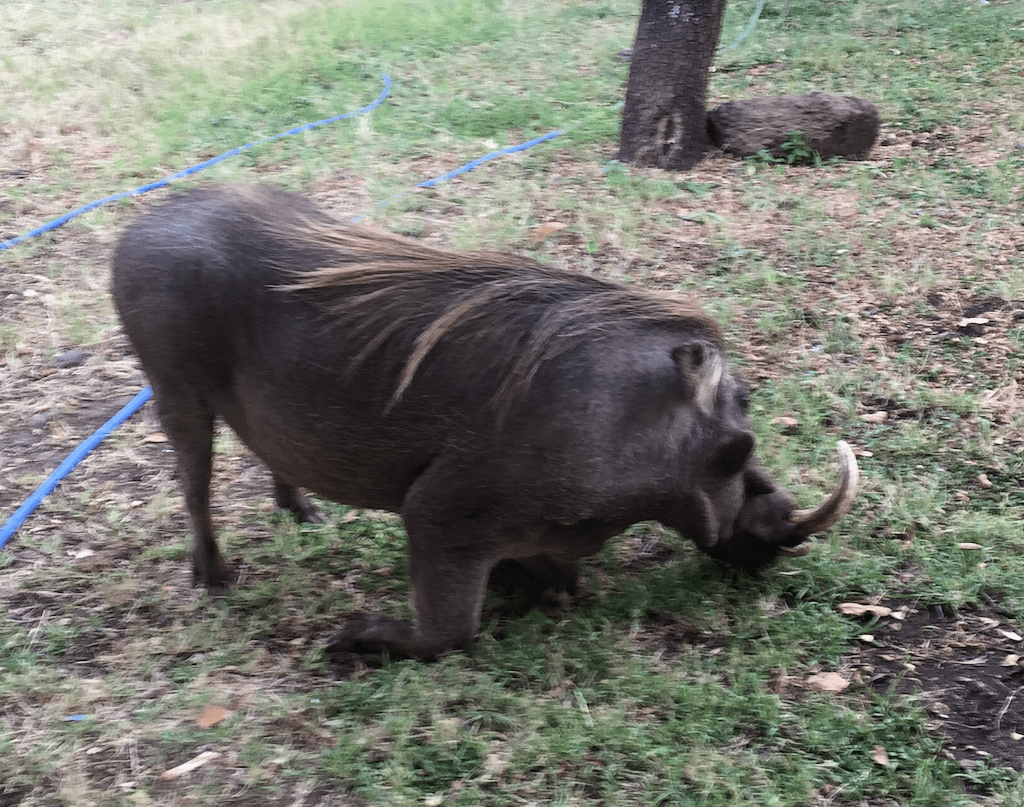
Wild boars (called kekero there). With their long tusks and bites they could tear skin and do a lot of damage. We had some that visited us daily in our garden. They learned how to turn on the tap in our back yard using their tusks – in order to get a drink. I wouldn’t have minded if they had only thought to turn them off. The locals told us when we arrived at that University that rhinoceroses came every afternoon. They got it wrong. We never saw a rhino but daily had boars visit us.

Untitled


Crocodiles  are very common in the Rift Valley lakes. Crocodile teeth tear the skin and shatter the bones. We saw a lot of their bites as the people fished from very flimsy balsa wood boats.

croc

Hippopotamuses- I clearly remember a number of hippopotamus bites, all very dramatic. The story of one boy is fascinating. The villagers were short of meat and decided a hippo would be good meat. Half the village got behind him and half on the other side; many with spears. Those at the back began to drive it forward. It began to move. The others were ready. The hippo saw them; didn’t like what he saw; began to charge at full and frightening speed. The villagers fled but this boy slipped and fell; the hippo was on him. The villagers killed the hippo and probably enjoyed the meat. The boy was brought to the hospital. He had a big gash on his chest, exposing but not breaking his ribs and a cut slicing his left buttock in two and the cut extending to the back of the knee. It was deep enough to expose the sciatic nerve, over a long segment, but did not divide the nerve.

hippos
We didn’t like getting too near hippos – they charged at you.

Another hippo bite that comes to mind is when a woman was leaning over near the edge of a lake doing her washing. A hippo came up behind her and bit her buttocks from top down laying them as if it they were an open purse. Fortunately  it was mainly skin and fat and was repaired fairly easily.

Dominic Cartier

Some hyena bite medical pictures below the line Continue reading “Bites 2 – continuing the list.”

The extended work – part 2

African sunset

I have posted previously about my time working in a leprosarium.   Working in a leprosarium 1968-74  And about a non leprosy medical work. The leprosarium extended – part 1 I mentioned there that was more to this other side of the non-leprosy work beyond the medical work.

The Other works for the general community consisted of the following….

A school with an enrolment of about 600 for the surrounding community. This only went to grade 8. A significant number of the pupils were mature age coming to school for the first time to learn the 3Rs. So in grade 1 you might have a six year old sitting next to a 21yo. Teachers were in such short supply that after 3 years as a student you had to become a teacher for a year, before returning to your studies. It seemed to work. One student who went to the leprosy school is now a professor of surgery!

A church with associated outreach. We were in Muslim poorly educated area. So many of our workers in all departments were people from different tribal areas and most were Christians. So the church was several hundred strong. They didn’t have hymn books but many, not being able to read,  had developed their ability to memorise. So they had a wide variety of hymns of which they could sing a number of verses. I remember how if a baby would continue crying the preacher would say “haven’t you a breast, woman?”

There was a small administrative unit consisting of the station head and a secretary. They among many other things supervised an electricity generator as often the government service failed. This was a major problem if we were operating at the time the electricity went off line. Operating by torch light while you waited for the generator to be turned on was not fun! But we always kept one handy.

There were mission and government reports to be written, wages to be paid, equipment, medicines etc to be ordered (much of it from overseas, and months in advance). I’m glad someone else had to do it! Continue reading “The extended work – part 2”

The leprosarium extended – part 1

African sunset

I have previously posted about my time working in a leprosarium. Working in a leprosarium 1968-74  I mentioned there the other side of the work carried out on the same station. As leprosy only rarely has acute problems I spent most of my time in the non-leprosy part of the program. I only regularly spent 2 half days/week with the leprosy program, besides seeing the occasional emergency in the leprosy department.

Other work for the general community – this post will only discuss the second non- leprosy medical work. There were several other aspects for another day!

There was an (officially) 30 bed hospital with an added 12 bed TB ward and an attached outpatient clinic.

It was the only hospital covering a large area and several million people. Through the country there were scattered clinics run by dressers (they were not to nurse standard but with some training, and had permission to prescribe a few simple medications) and a few mission clinics but the nearest hospital south was about 80 km away; north 200 km; west 150 km; east several hundred km, and this in a heavily populated, very fertile, part of Ethiopia. We were at the cross roads which led in all 4 directions. At that time cars were few and far between and public transport was limited. As loaded trucks often carried many people on top of their loads we often had mass emergencies if there were major accidents. And there often were!

It really wasn’t beds for just 30 patients. We used to put smaller children one at the head and one at the foot of the bed. In times of great overload we used to sometimes put patients on mattresses under or between the beds. There were verandas on the east and west sides of the main building and we would spread mattresses on them. Sometimes in the rainy season there would  be a rush to change the ‘veranda’ patients to the other side away from the rain slanting in from one direction or the other. Most people chose to go to the clinics or to natural healers before a percentage came to us. We could never have survived if all those who should have, had come!

This general hospital had a small ‘operating room’ which was mainly used for obstetrical deliveries which needed forceps deliveries. More major cases, obstetric or other general cases, were taken to the OR in the leprosy hospital. We had few normal deliveries apart from the wealthier women from the nearby moderately large town. For a normal delivery they were charged about ten times as much as a poor person with a complicated pregnancy – something about robbing Peter to pay Paul. Unless there were problems after delivery these ladies were allowed to stay about half an hour.

The room was also used to reduce simple fractures and for suturing. The leaded room with the X-Ray machine was attached to the hospital. The machine was an old WW2 field one. A local young man was trained to take the simpler X-rays. See an example of one of the chest X-rays below.

In addition to the 30 beds there was a 12 bed TB complex. TB was very common. Only the very weak or those with complications, like lung collapse or paralysis from TB of the spine, were admitted. Another national worker was trained to aspirate chests and put in chest drains.

The  outpatient department was in a separate building. It included our small pathology department. We treated about 100+ cases a day. Apart from acute emergencies, who were sent directly to the emergency room in the hospital, all were seen initially by a dresser. If they couldn’t make a diagnosis, or if the patient returned with the same problem, they were referred to the nurse. If the problem still remained the nurse arranged for them to see the doctor sometime. I, or if there were 2 one of us, tried to visit outpatients just before I/we went to lunch.

Emergencies were common. I remember one day when 3 ladies with ruptured uterus came within 5 minutes of each other! As well as daytime surgeries, planned or emergency ones, many emergencies arrived out of normal hours, so we operated most nights as well on emergencies.

The 4 nurses had the following duties: One was in charge of the general hospital; one of the leprosy hospital including the OR; one in the leprosy outpatients; one in general outpatients. If we had 5, the fifth was on night duty for all the work – if there were only 4 they rotated around taking responsibility for both parts of the work at night. They were very competent and really acted as junior surgical registrars.

Below the more line is a picture of a chest X-ray of a TB patient. Continue reading “The leprosarium extended – part 1”

Working in a leprosarium 1968-74

African sunset

I have posted before about our first day in the hospital on our first spell overseas. An introduction to Life in Africa The establishment had a large complex of programs run by a Christian mission. It was on land given by the Emperor’s daughter and it’s distinctive feature was that it was to have a large leprosarium. This was in a period where the concept for many including the government was to keep people suffering from leprosy (Hansen’s disease), certainly those with the infectious variety, apart from the general populous.

The government gave a grant to the mission to help treat 700 patients residing on the land already granted to them. Nearby there was another parcel of land given for the mission to produce food to feed the leprosy patients living on the leprosarium.

The mission took this work very seriously and expanded way beyond just keeping lepers off the streets and treating them in the relatively limited ways available at that time. The work of Drs Cochrane, Brand and Fritschi, basically in India, with their teams had made much progress but treatment was not as available nor efficient as it is today. India was much more developed. I had some time in India with Drs Cochrane and Fritschi on my way to Africa.

The local tribal language was what is now called Oromepha. The greeting was ‘Nega, fiya, urga’ roughly translated ‘hello, how are you? It’s nice to smell you.’ The last bit sounds nasty. But the verb really had broader meaning, including to sense, and I think the intent was something like ‘it’s good to sense your presence’. But because of the use of rancid butter smeared on clothing to make it waterproof, added to smokey fires in houses without chimneys, there was often a fairly powerful smell. When I had been working in the operating room where, in addition to the above, we used a lot of ether for anaesthetics, I personally collected some of the odour. Many times when I got home to greet my wife, with a loving kiss, I got told ‘You stink, go and have a shower.’

Early in our stay, I remember introducing my young son to a lovely bright young man who had come to visit me. The man knew good English. The boy greeted him politely then turned to me and said ‘Dad, do all Ethiopians smell like this?’ The guy was very gracious saying something about kids being like that everywhere!.

The compound had 2 parts. That devoted to leprosy treatment and that for general service to the surrounding community. Today I’ll write about the leprosy part of the work. The general service to the community aspects were almost as extensive! Continue reading “Working in a leprosarium 1968-74”