The world we live in.

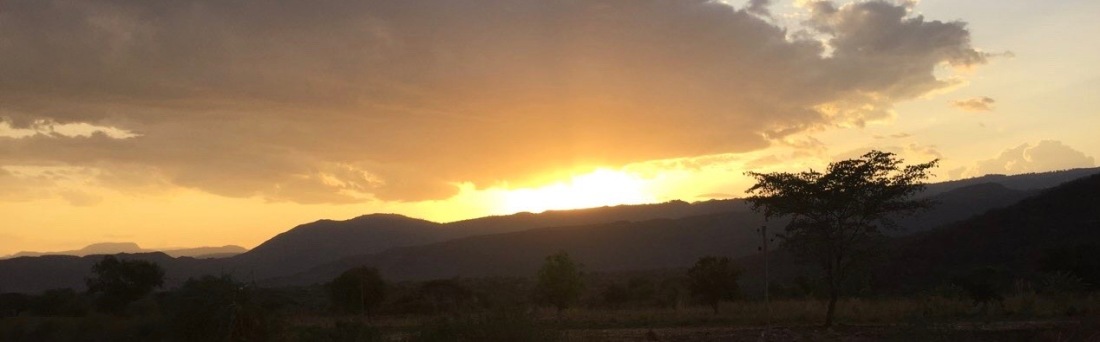
African sunset

I used to hear ‘All the world is mad but me and thee, and sometimes I have my doubts about thee.’ In the light of that consider the ‘me’ below and, if you want to, answer as the ‘thee’.

The world I live in has many levels. No doubt your life is as complex as mine, but I live –

  • inside my skin (which has different levels also!) – I’m old, unable to do what I used to do. Still mentally with it (my interpretation); a bit frustrated with the limitations of age, but fairly contented.
  • inside my family – as I’ve experienced contact with many families I think ours is pretty good; as family expands beyond a couple to children, their marriages, their children and their marriages down to great-grandchildren there is never going to be a trouble free family tree but ours is, on the whole as good as can be expected in an imperfect world. Whilst I love my kids dearly, I try to see them as of no more significance nor less significance than the smallest latest child born of any colour anywhere today. Truly they are more precious to me, and I’d gladly die for any of them, but of no more worth in the whole scheme of things.
  • inside my local community – sadly we are seeing too much unemployment, too much crime at all levels, but particularly in the youth aged group with house break-ins, and stolen vehicles high on the list. There is a feeling amongst a significant percentage of the community that offenders often get a slap on the wrist and are allowed to return to their previous activities. To quote a recent news article from the channel 9 News ‘Townsville’s growing youth crime problem has it listed as one of the worst criminal hotspots in the world, with the regional Queensland city named alongside Tijuana, Baghdad, Caracas and Tripoli’.  
  • inside my state – there is high unemployment and the rural area has been affected in a significant extent by the action against transport of live animals and the anti-mining movement. This has had a statewide effect on unemployment and financial viability. At the moment the jobless rate in the state is 6.8%. Quoting the Queensland Times – ‘Outback Queensland’ included Mt Isa, Aurukun, Cape York and Longreach and the region had an average 28.4% youth jobless rate.
  • inside my country – we have had major fires, significant floods and of course the coronavirus restrictions with major social and economic effects. There are Black Lives Matter riots, seemingly brought to the boil by the killing of a black person (with a significant criminal record) by a white policeman in the USA. It seems to have acted as the straw on the camel’s back at this moment. The bit in parenthesis is not put as an excuse for the killing but as a fact to be considered, as it would be in any accused murder situation – something about ‘innocent until proven guilty’.
  • inside the world. USA, which claims to be a democracy, ever since the last President was elected, has been the scene of politically stirred up and cause-aided disturbances to bring it to the situation where it is no longer acting as a democratic country. It is complex but it seems to me as if the entrenched rich from all political streams don’t want the changes promised by successive Presidents, (promised in my view, to get elected) but not acted upon. The present President has fulfilled their ans some of his promises, and stirred up the entrenched who never wanted the promises fulfilled, but their person to get into power. Black lives matter is absolutely true; then, if that is true, may I ask, why are the majority of black people killed in the USA killed by black people, and why the issue of roughly 50% of abortions being performed on black people (only about 15% of the population) isn’t a major issue with the cause? Is there any reason why we don’t hear of the religious and inter-tribal murders of hundreds of blacks mainly by blacks? This is happening in big numbers in West Papua and Nigeria at the moment. There are the Middle East wars and many other concerning issues to be considered in addition.
  • inside the cosmos – well I think that there are efforts being made by a number of nations, at great cost and in the name of Science, to mess this up also. There may be some advantages which come from their searching.

I’ve read that ‘3 things remain – faith, hope and love’.

I guess my faith is that God, the Creator is still in control; my hope is that at every level we’ll act with integrity and learn from our mistakes; my aim, concerning  love, is to be able to love friend and enemy and treat each person as I would seek to be treated.

Dominic Cartier
 

A personal review of things

African sunset

I write a fair bit about my time in ethiopia. Obviously one didn’t always feel on top of things. Here is a comment I have written elsewhere, when I was on sight and waiting for my wife to join me I have shown a few pictures before. A few pictures from the past.
It was, however, all both mentally and physically exhausting. There was little change or even desire to change the problem areas of the hospital. Some of the younger doctors decided not to seek my help – at least immediately. So one morning they came and informed me that the previous night, being unable to deliver a breech they had just cut off the head and left it inside – would I now please remove it. It turned out to be relatively simple but was a very gory procedure.
Then, on another occasion, two days after delivering the first of twins the duty obstetrician said that the other twin was dead and he couldn’t get it out – would I please help? I was in the middle of an operation but I asked him to bring the lady around to the holding room and I would deal with the situation as soon as I finished the present case. I must confess I didn’t even examine the lady but just put her up in stirrups and applied a suction extractor to deliver the twin – only to find that it was alive, and, in fact, the second of triplets! Both of them survived even though it was a rush to prepare and get into action with baby resuscitation equipment. I had learnt to intubate the newborn ‘flat’ babies without a laryngoscope but by putting my finger onto the top of the larynx and passing the tube along my finger into the trachea.
I have just come across a letter I wrote to my wife when I was alone at Soddo. I copy several comments here directly quoting from my letter home.
1. On the weekend I made a note in a chart that someone (a little baby) hadn’t been seen for 48 hours and was very sick and that the GP should be called.There was no record that any medicine had been given at all, he was nearly dead.This led to the accusation that I was accusing the GP of incompetence and that he would never work with me again.The other GPs all supported him saying that I should not write in the chart but send him a message through the Medical Superintendent.
2. Then on Thursday morning I arrived to find a little child grossly dehydrated and on the point of death. In spite of all I tried to do he died about an hour later. I notified the Medical Super and the Head Nurse. They chose for the case to be discussed at the next morning’s meeting. When the case was brought up next morning the situation was not discussed as the doctors said that the meeting to was to discuss out of hours admissions and this child had come in during the day.
3. I was able to intubate a woman whose operation had been cancelled while I was away because they couldn’t pass the tube. I can understand why they found it hard. She is doing well now.
4.There were a number of other very interesting and some sad cases this week. The saddest was a little baby who had his penis, scrotum and contents bitten off by a dog.
5. I’ve been able to put a few new beds in the medical ward and hope this will strengthen my relationship with the physician
There are other points made in the letter but I think that shows the tone of the working conditions.
Dominic Cartier.

A nightmare of a day!

African sunset

I am, at the strong encouragement of one of my sons, who says that there are some stories in my life worth recording, reviewing and extending a brief autobiography I wrote years ago. Going through a bit of it yesterday I came across this brief event of one day in my journey. This occured while I was briefly attached to a large teaching hospital in Addis Ababa.
I was on call one night on the eve of a large Muslim holiday. The next morning I left to go to the hospital surprised that I hadn’t had a single call over night. As usual we did a round of the whole surgical wards and early in the round I came across a poor lady lying in bed with most of her small bowel and a bit of her large bowel mixed in with a lot of dirt and gravel lying on the bed next to her. She had a large hole in her right side where all the tissues down to and including portion of the right iliac crest (part of her pelvis) had been torn off in a car accident.
Later I discovered the story. She had been hit by a car driven, by a nun, about four hundred kilometres south of Addis Ababa. The driver had taken her to the local hospital who stated, correctly, that they had no surgeon and the nearest hospital with a surgeon was one hundred and fifty kilometres up the road towards Addis. So the nun took her to that hospital, where she was told that they did have an appointed surgeon but he was away and they had no idea when he would return. They came to Addis, where the first three hospitals said that they had no empty beds. She was eventually admitted into St. Pauls – but nothing had been done for her. No IV fluids, no antibiotics, no dressings – in fact nothing at all except that she had been put in a bed.
I have learnt to be pretty patient but this stretched me to the limit. Why had nothing been done? The hospital was without water so the operating theatres were out of action and definitive treatment could not therefore be undertaken. I think it was planned to leave everything to the undertaker! So I organized for a drip and antibiotics and a clean moist dressing over the exposed entrails and planned to look into the water situation later. I had already noted a tap being used down the street by the general public.
Soon we came across another young man who had been stabbed in the back. He was as white as an Ethiopian can be. As he was of a higher social class he at least had a drip up but the blood bank was closed for the holiday. My wife had arrived in the country by this time and I arranged for her and a missionary nurse Jean Sokvitne to donate blood. With some difficulty we were able to collect it and cross match using Eldon cards.
I organized a group of workers and I worked with them. Between us, we carried water from the afore-mentioned tap and collected maybe a hundred litres in a large container outside the operating rooms. Grudgingly the staff agreed to operate. The young man when stabbed had had his renal artery and vein divided and fortunately the knife, avoiding the duodenum, opened into the peritoneum but not causing any bowel injury. He thus had a peritoneal cavity filled with blood but uncontaminated by intestinal content. We gave him two units of foreign blood and I showed the doctors how to filter the blood from inside his abdomen through gauze and we auto-transfused the patient. He survived and did very well.
Next we worked on the lady. It was difficult but we cleaned her intestines, cleaned the edges of her wound and after returning the bowel to its proper place closed the wound with considerable difficulty. She also recovered, although much more slowly than the young man. In addition to her physical disease she had underlying mental problems which added to her initial poor management and which made things difficult during her recovery.
The day after the holiday we had, as usual on working days, a morning meeting at which all admissions over the past couple of days were discussed. I was, surprisingly to me, severely chastised. Two motions were passed:
  1. Never again would doctors be involved in carrying water to the hospital or in arranging for it to be carried as this was a government responsibility.
  2. No auto transfusion would be used unless a modern cell saver were used (of course there were none in Ethiopia!) as the country was not a ‘banana republic’.

Dominic Cartier

Winning the battle; Losing the war!

African sunset

I spoke earlier about tangles with authorities. DEALINGS WITH THE LAW My biggest tangle saw me with a renewal request for my visa denied. I was working in a government hospital after ‘peace’ had been restored after the communist take over.

For some years there had been a great shortage of equipment, drugs and materials. The country was just coming out of years of war, and this was understandable. Fortunately  I was able to keep working reasonably satisfactorily because of aid sent out from Australia. I had been working in 3 hospitals where I had a private practice, and public sessions – two were private and the other a public hospital. They very generously collected good second hand equipment, and from donations we were able to occasionally buy new but usually second hand items. We paid for it to come in ship containers. No duty was charged on its entry into Ethiopia, but then everything was a gift.

new drapes
In this photo, as an example, we had provided the following: the operating table, the portable light, the oxygen concentrator, the suction machine,the drapes and gowns,as well as the diathermy machine, the leads of which you can see covered in plastic. WE had the drapes and gowns made locally.

Suddenly, whilst a container was on the high seas, an import tax was announced amounting to some 35% of the new value of these gifted usually second hand items.

It was too late to not get it, it was already on the way.

After several days at the ‘goomrook’ (customs) I was handed a bill. To get the money I had to sell my second hand Toyota Land-cruiser. The government had paid nothing for all that we had shipped in for about four years. The bill was paid by me.

Then the fun began. The powers that were in place refused to release the container. So after three months of phone calls, pleading letters I sought an appointment with the official whom I knew had both the power to stop release or to grant permission. He wasn’t the head of health (she was a pleasant lady from a smaller tribe) but the highest in line from the ruling tribe.

After over two hours of my persisting to hear the ‘no, no, no’ which he kept uttering, and I think that he realising that there was another way to say ‘no’,  said ‘ok, I will, come back tomorrow’. If I had agreed I knew that the chance of getting another appointment was minuscule. So I indicated my thanks for the ‘yes’, but as the paperwork was in front of him I wasn’t leaving until I left with the signed form. After about another 30 minutes of discussion, he said ‘ I will, but I don’t see what you see in those people!’ Naming the tribe amongst whom I was working. I should have shut up,, I guess, but couldn’t help saying ‘when you get to know them, Sir, they’re almost human.’ I got my paper and a little later the stuff. I’m convinced that he wanted the stuff for his own area.

I had won the battle, but I lost the war. Soon I had to seek a renewal of my work permit and visa. They were denied.

Some six years later, with another person in power, I got a visa again and spent another ten years working in the country.

Dominic Cartier