Following on from yesterday’s post, here are several more Ethiopian proverbs from the list my wife laid on my desk…
A mouse that wants to die goes to sniff the cat’s nose.
When spiders’ webs unite they can tie up a lion.
A house can’t be built for a rainy season that is past.
The person who grew up without correction shall find his mouth slipping instead of his foot.
No explanation comes with them but I think the meanings are pretty universally understood. I just imagined, after maybe a family evening dinner or sitting around a BBQ on the weekend, putting them up for a family discussion. Sadly our kids are all grown up and flown the coop, but with them as late pre-teens or teenagers I think we could have had some interesting discussions.
My wife is a hoarder. This doesn’t help when you live in a smallish house and are trying to downsize, but today she lay several old papers in front of me. One of them was a list of Ethiopian proverbs. I’ve a bit of interest in proverbs at the moment as in another blog I’m writing daily posts alternating roughly weekly between the book of Proverbs and the book of Luke from the Bible. It is under another name and the title of the blog is ‘As i read it! – Plainly understanding the Bible’. You can just use the following link – http://as-i-read-it.com
‘After the hyena has gone, the dog barks’. The interpretation of a proverb is meant to be pretty clear but leaves a little room for different opinions. Here I think it means that you are gutless if you stay silent when danger is near. What do you think?
Not sure about this!
‘Don’t catch a leopard by the tail, but if you do – don’t let go.‘ as concerned with leopards this is good advice. It is isn’t going to be easy for a leopard to get at you if you hanging on to its tail for grim life. Better not to have touched it at all. And I translate it to mean in life that you’re not advised to challenge a problem issue until you are prepared to chase it to the end. And it may be a very uncomfortable time. Avoid it – unless you are are sure that you want to challenge this person or issue. Again I ask, what do you think?
‘One who plants grapes by the roadside and one who marries a pretty wife share the same problem!’ Grapes are tasty but planted by the roadside are going to be tempting to every passer-by. You’re going to place you wife in the eyes of the public and her looks make her as tasty as grapes. I don’t think that the advice is to marry ‘ugly’, but to earn her faithfulness.
The other day, I think on Facebook, I saw a carton in which a child was being pushed along the street in his pram and an old man was walking in the other direction pushing his wheeled walker. And it is true that people drop off the edge and others join the race.
We have seen the cycle this week. A 100 year old lady, a close friend for many years died. I believe in heaven/hell and Jesus and I must confess I’m not weeping. For several years she hasn’t recognized anyone, not even her family and been a grumpy old thing. That was so unlike her and at her funeral we’re going to forget the last couple of years and celebrate the vibrant, loving lady who when we transferred several thousand kilometers to this area over forty years ago, was like a grandmother to our kids and a wise backup to us. I was overseas when my dad died and unable to attend his funeral, but I recall, although sad as we were to lose her, my mum’s funeral was a celebration of life lived so lovingly. So I can’t be too sad over this lady’s passing but am so thankful for the last something like 45 years that we have had the blessing of knowing her.
At 80+ I’m glad that we don’t have a new born child in our house to see the other side of the circle. But we have a great-granddaughter who will be 2 in a few days and this week we celebrate birthdays for four grandchildren, a son and a daughter in law. January seems to be the month to join the ‘cycle’ in our family!
But yesterday we did have a birth on our farm. Yesterday morning we had twelve sheep; yesterday afternoon we had thirteen! Not the same as a human addition, but we’re very happy about it. When I looked at the small flock this morning I was suspicious that there will soon be a few more playmates frolicking about the paddock. And we don’t get up at night on a feeding roster!
Dorper sheep are scruffy looking, but it had just been born and the picture was taken from a fair way away. They shed their wool and don’t get shorn.
I guess that anyone with expertise in a certain area unconsciously, or maybe consciously, wonders how they would have handled what they’re looking at or what they would have said when they are listening to a talk on a subject about which they know a fair bit. the other day, I as a lay preacher, was talking to two ministers who had been in the audience where I had just preached. One of them said that he had wondered how he would have handled the topic. And he may well have done it better but was too gracious to say so!
I was a specialist surgeon and the GP before whom I was sitting was one of my interns years ago. I wonder how he felt! When I see him, before speaking he often asks what I think, not because he’s not in charge but in deference to our past. And obviously he knows that as hard as I try not to self diagnose I have already thought about what is going on. And I know that he doesn’t want to take our conversation to all the possibilities as to what the diagnosis may be, or to where investigations and treatment may lead us. I felt sorry for him as he (we) worked on a plan as where we would go to sort things out.
I wondered what I would have said and what he was going to say, as I knew that he and I were thinking parallel thoughts. So, and I think he handled it well, he said ‘you know that is usually a significant symptom.’ Still there are exceptions!
Now to await the specialist visits and the test results!
I have been told that there is a tribe in South America which has 40 words to differentiate shades of what we might, in a single word, describe simply as ‘green’. And in a country without sign posts they use these shade words to direct people on forest paths. For example travel on the path for …. (distance) until you see a tree of …. (shade of green) then turn left. in about …. (distance) you will see a bush of …. (shade of green) there turn right. etc – you get the idea. No doubt this has worked well for centuries and still does, but what a mess a traveller would be in if someone purposefully substituted the word for a different shade of green.
I wonder how many shades of green are in this area of Ethiopian countryside?
I looked up ‘shades of green’ on google search and the list is long and interesting. Usually just saying green is enough but sometimes we need to be more specific. And this applies to many other words. And we can get into or cause trouble by unintentionally or intentionally using a shade of meaning which the speaker or author didn’t intend. There are about a million words in the English language but I am told that the average word usage of the common person is only in the thousands – 10 to 20,000. I looked up the word ‘guilty’ in google search. This is part of what I read…
culpable of or responsible for a specified wrongdoing.”he was found guilty of manslaughter” Similar: culpable, to blame, blameworthy, blameable, at fault, in the wrong, responsible, answerable, accountable, liable, censurable, reproachable, condemnable, reprehensible, erring, errant, delinquent, offendings, felonious, iniquitous, criminal, convicted, peccant
Opposite:innocent.
justly chargeable with a particular fault or error.”she was guilty of a serious error of judgement”
conscious of, affected by, or revealing a feeling of guilt.”he felt guilty about the way he had treated her “Similar: ashamed, guilt-ridden, conscience-stricken, remorseful, sorry, regretful, contrite, repentant, penitent, rueful, abashed, shamefaced, sheepish, hangdog, mortified, discomfited, distressed, uncomfortable, in sackcloth and ashes, compunctious. Opposite:unrepentant
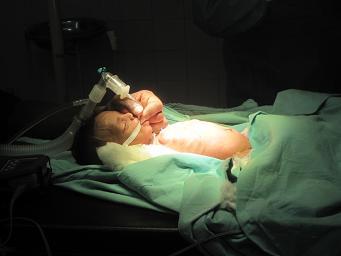
Let us say that the little baby pictured above died. That is not true, he did very well after his emergency surgery. He recovered quickly and was sent home well, but with a lot of growing up to do. But picture this scenario: –
He came in with an obstructed gut. He was operated upon and the condition corrected. On being woken up from his anaesthetic he vomited, inhaled his vomitus, but after that treated well according to the book but over the next 24 hours dies. A distraught parent accuses me of killing the baby and says that they hope I feel well and truly ‘guilty’. Should I feel guilty? I had made the correct diagnosis and done the right operation. My name was still on the end of the bed as the responsible surgeon. I had seen him and ordered several things post operatively. I was not the anaesthetist. Measures should have been taken by the anaesthetist to reduce the risk of him vomiting to a minimum, which he did not take. But I was by then in a side room writing up the case record. The mistake having been made I raced back into the operating room and did all I could to correct the situation.
But that accusation is that I have killed him and should feel guilty. I don’t think that it is fair to say that I have killed him, even if in a court the lawyers would have tried hard to push that all the responsibility of the anaesthetist fell back on me as the team leader so….? Now coming to the guilty word I have to confess that maybe I should feel guilty. I’ve seen that anaesthetist make similar mistakes before and because it was after midnight and I was tired I chose to do what was legal but maybe not wise i.e. do the rest of my legal paperwork and hopefully get home to bed. I had previously spent time on several occasions explaining the right way and watched him through several operations. I had since then stayed in the room on several occasions making sure that he did the waking up procedure correctly. But he was still relatively inexperienced. Because of the hour should we have waited until the morning, accepting that he may have died overnight and would certainly have been medically worse by the next day. If everyone had rested he might have lived and grown up to be a healthy man.
Would that label me guilty? I understand why the parents did, and I have to struggle hard to say that I bear no guilt. But I reject that I should feel guilty of murdering him or even of having done the wrong thing. Surely there must be a synonym in there for my feelings at this moment. Blameable? – but surely it is not my responsibility to do someone else’s work correctly. Ashamed? – because in the world there is such inequity between what we have in my home country cf my adopted land. Remorseful? – that I didn’t stay in the operating room until the child was wide awake. But then I knew that the post-op care workers often slept on their duty time – so should I have watched him overnight? Am I to bear the whole weight of the medical inadequacies on my shoulders.
Often when I use a word I have to depend on my reader/hearer to discern the context into which I am using it. It is not easy for the user or the recipient of a word to be sure of the correct meaning and I guess we have to settle for being honest, generous and understanding in our assessments.








 Heated Stew